

|
What this covers
|
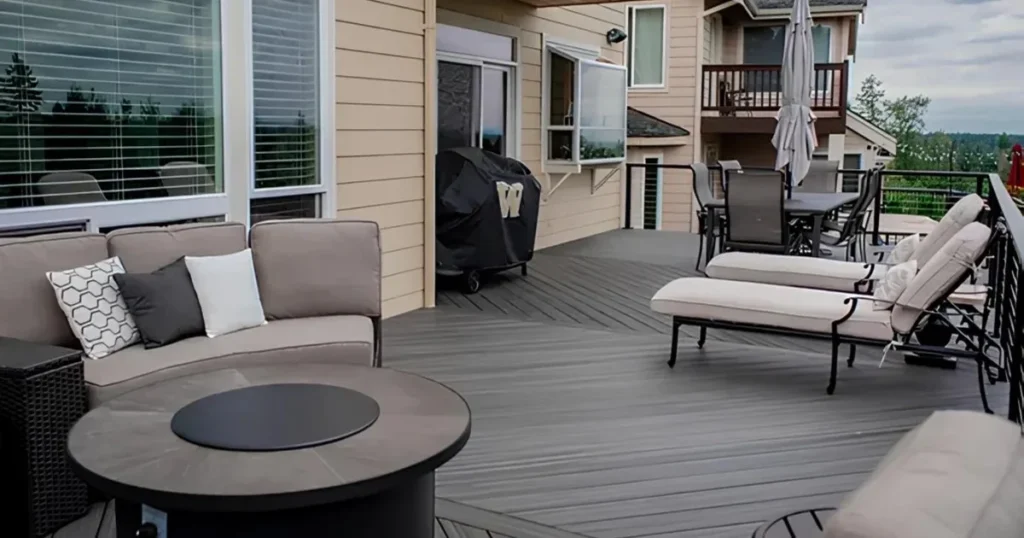
Ask three contractors for a composite deck quote and you can get three different products. One prices boards with wood fiber in them. One prices boards with no wood at all. One prices a sheet membrane that gets rolled over plywood and is not a board in any sense. All three will use the word composite somewhere in the conversation.
That is not dishonesty. The word drifted. It started as a description of one material and turned into a catch-all for anything that is not a plank of cedar. The problem is that the four things hiding inside it behave differently, cost differently, and need different framing underneath. Comparing quotes without knowing which one you are looking at is how people end up surprised.
Here is what actually separates them.
The Word Composite Covers Four Different Products
Strip the marketing away and there are four surfaces in common residential use.
Uncapped composite mixes wood flour with recycled plastic and extrudes it into a board. The wood is there for stiffness and for the look. It is also exposed at the surface.
Capped composite is the same core with a hard polymer shell bonded around it. The shell is the product. Everything good said about modern composite is really said about the cap.
PVC drops the wood entirely. The board is plastic through and through, usually with a cap as well.
Vinyl membrane is not a board. It is a sheet welded at the seams and laid over a solid plywood substrate, the way a flat roof is built. People call it vinyl deck covering, and in wet regions it is often the reason a deck is watertight enough to use the space below it.
Those are four different purchases. The first three are boards with gaps between them. The fourth is a waterproof surface with no gaps at all.
Uncapped Composite and Why It Got a Reputation
Early composite decking was uncapped, and it is the reason a certain generation of homeowners will tell you composite stains.
They are not wrong about what they saw. With wood fiber sitting at the surface, the board takes on grease, tannin from leaves, and in a damp climate a film of surface algae. It does not rot the way a plank does, but it discolors, and once it does the color is in the material rather than on it.
Uncapped boards still sell, because they are the cheapest way to say composite. If a quote is meaningfully below every other composite quote, this is usually why.
What a Cap Actually Does
The cap is a thin polymer layer bonded around the core during extrusion. It is not a coating and it is not applied afterward, which is why it does not peel the way a finish does.
What it changes:
- Spills sit on the surface instead of soaking into exposed fiber
- Color is held in the cap, so fading is slower and more even
- Surface algae has far less to grip in a damp climate
- Manufacturers extend stain and fade coverage, because now there is something to warrant
Caps come in three-sided and four-sided versions. Three-sided leaves the underside bare, which is cheaper and usually invisible. It matters if the deck sits low to wet ground, where the underside stays damp and the exposed face is the one you never inspect.
PVC Leaves the Wood Out Entirely
A PVC board has no wood fiber to stain, swell or feed anything biological. It is lighter than composite, which people notice on install day, and it stays cooler in direct sun than a dark composite board of the same color.
The trade is cost and feel. PVC generally prices above capped composite, and some people find it sounds and feels more like plastic underfoot. Whether that matters is a preference, not a defect.
|
Surface |
Wood content |
Stain resistance |
Gaps between boards |
Usable space below |
|
Uncapped composite |
Yes, exposed |
Low |
Yes |
No |
|
Capped composite |
Yes, sealed |
High |
Yes |
No |
|
PVC |
None |
High |
Yes |
No |
|
Vinyl membrane |
None |
High |
None, sealed sheet |
Yes |
Vinyl Membrane Is a Roof, Not a Deck Surface
This is the one that gets miscategorized most, and it is the one people in wet regions are often actually searching for.
A membrane deck is built like a low-slope roof. Plywood goes down over the framing, the sheet is laid and heat-welded at the seams, and the whole surface drains to an edge. There are no gaps, so nothing falls through and nothing gets underneath.
That single difference is the point. With a board deck, water goes straight between the boards onto whatever is below. With a membrane, the deck becomes a lid. A second-story deck stops raining on the patio under it, and the space below turns into storage or covered seating.
It is a different scope of work. The framing has to be sloped for drainage, the substrate has to be solid, and the seams are the whole job. Done badly it leaks, and it leaks into the structure rather than onto the ground. Done properly it is the only one of the four that makes the square footage underneath useful.
The Frame Underneath Changes With the Choice
This is where quotes quietly diverge, because the surface dictates the structure.
Composite and PVC boards flex more than solid lumber across an unsupported span. Most manufacturers specify joists at 16 inches on center for boards run perpendicular, and tighten that to 12 inches when boards run at an angle, because a diagonal board crosses a longer distance between supports.
|
If the surface is |
The frame usually needs |
|
Composite or PVC, perpendicular boards |
Joists at 16 in. on center |
|
Composite or PVC, diagonal pattern |
Joists at 12 in. on center |
|
Vinyl membrane |
Solid plywood substrate, sloped to drain |
A frame built for wood at 24 inches on center will not take composite without adding joists. If a quote covers new boards on an existing frame and never mentions spacing, that is worth a direct question. The boards are not the expensive part of getting this wrong.
Boards also grow and shrink along their length as temperature changes, which is why installers leave a specified gap at butt joints and at anything fixed, like a post or a wall. Hidden fasteners clip into a groove in the board edge, giving a clean surface with no visible screws while still allowing that movement. Face screwing a composite board tight, the way you might with cedar, fights the material.
What Each One Costs
Published installed prices vary widely by region and by grade, so these are ranges rather than numbers.
|
Surface |
Typical installed cost per sq ft |
Ongoing upkeep |
|
Pressure treated wood |
About $15 to $25 |
Clean and reseal every 1 to 3 years |
|
Composite or PVC |
About $30 to $60 |
Wash once or twice a year |
|
Vinyl membrane |
Quoted per project, closer to roofing work |
Wash, inspect seams |
The upfront gap is real and it is the number most people decide on. The gap that gets ignored is upkeep. A professional stain and seal on a mid-size deck runs a few hundred dollars each time it is done, and it is due every one to three years for as long as you own the deck. Published comparisons commonly put the break-even somewhere around year twelve, which is roughly half the service life the boards are warranted for.
That is the honest version of the argument. Composite is not cheaper. It is more expensive for a decade and then it stops costing anything.
Wet Climates Change the Weighting
Kent sits in the Puget Sound lowlands and takes on the order of 40 inches of precipitation in an average year, spread across a long damp season rather than dumped in summer storms. That does two things to this decision.
First, it makes the reseal cycle on wood harder to keep up with, because the window when a deck is dry enough to coat is narrower than the window when it needs coating.
Second, it puts surface algae ahead of sun fade as the thing that makes a deck look tired. Green film in shaded corners is a damp-climate problem, and it is exactly what a capped surface is good at resisting. A soft brush and soapy water handles it. Pressure washing at close range does not, because it can drive water into the board and, on some products, void the warranty outright.
Anyone comparing composite decking options around Kent is really weighing how many wet seasons they want to spend maintaining a surface, and that is a different question from which board looks best in a showroom. SmartDecks is one regional firm that publishes what each surface needs underneath it rather than only what it looks like, which is the part worth reading before the quotes arrive.
What Warranties Do Not Cover
Long warranties are the headline on every composite product, and they are genuinely long. They also carry conditions that decide whether you ever collect.
- Installation to specification. Wrong joist spacing, wrong gapping or the wrong fasteners can void coverage before the deck is finished.
- The structure is separate. A board warranty covers boards. The joists, ledger, posts and flashing holding them up are not included, and those are what usually fail first in a wet climate.
- Coverage is often prorated. The value declines over the term, so year twenty is not year one.
- Labor is frequently excluded. Replacement boards arrive free. Someone still has to pull the old ones out.
None of that makes the warranty worthless. It makes the installer’s competence part of the product you are buying.
The Question That Sorts the Quotes
If you only ask one thing, ask this: which of the four surfaces is this quote for, and what joist spacing does it assume?
The answer separates a capped composite deck from an uncapped one, separates a board deck from a membrane, and reveals whether the existing frame is being reused as is. Three quotes that looked like they were for the same job usually stop looking similar the moment that question is answered.
Everything else, the color, the grain pattern, the brand, is a preference. What the surface is made of and what is holding it up is the actual purchase.



More Stories
Choosing the Right Carpet for Each Room in Your Home
Home Addition Construction Roanoke VA: Planning the Right Project
Phasing and Dust Control in an Occupied Home Renovation