

Most homeowners think about rain in inches. The yard experiences it in gallons. A roof collects every drop that falls on it and delivers it to a handful of downspouts, and in Frederick County a single heavy day of rain can turn a modest house into a source of several thousand gallons of water aimed at a few square feet of lawn.
The figures are not guesswork. Two federal data sources, one on rainfall and one on water volume, make it possible to put a number on what a typical storm does to a typical property.
How much rain falls in a Frederick County storm
The National Weather Service publishes rainfall frequency estimates for every point in the country through NOAA’s Precipitation Frequency Data Server, based on the NOAA Atlas 14 study. The estimates are widely used in engineering design for culverts and storm drains. They are just as useful for thinking about a backyard.
For Frederick, the estimates show that a storm expected about once a year on average drops 2.55 inches of rain in 24 hours. A 2-year storm brings 3.07 inches. A 10-year storm brings 4.63 inches, and a 100-year storm brings 7.85 inches. The term “100-year storm” is often misread; it describes a level of rainfall expected, on average, about once a century at a given spot, not one that happens only once every hundred years on a schedule.
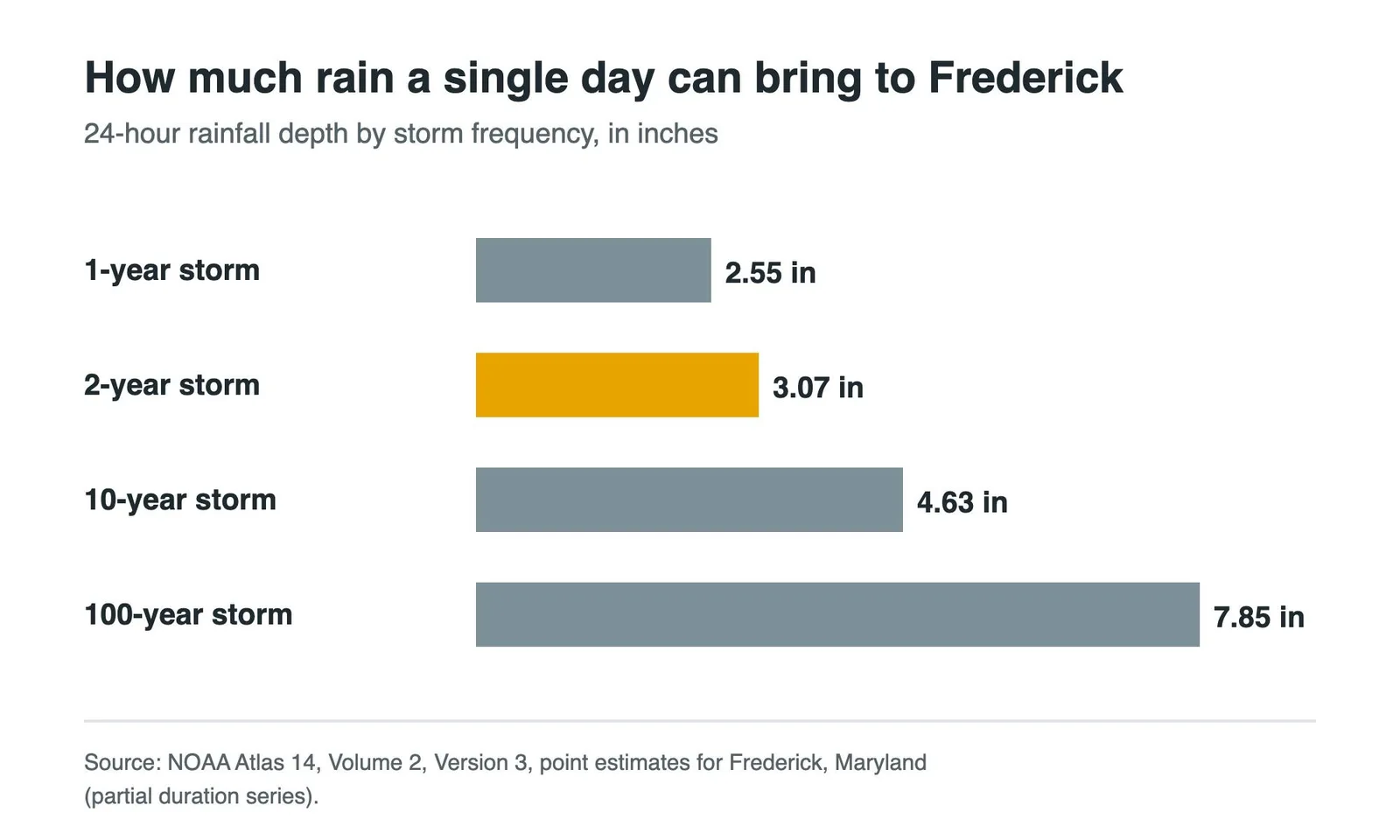
24-hour rainfall depth by storm frequency for Frederick, Maryland. Data: NOAA Atlas 14, Volume 2.
Short bursts matter too. The same estimates put a 2-year, one-hour rainfall in Frederick at 1.37 inches. That is the kind of afternoon thunderstorm that arrives fast, overwhelms gutters, and leaves water pooling against a foundation before anyone has a chance to look outside.
Turning inches into gallons
The U.S. Geological Survey’s Water Science School explains the conversion. According to USGS figures on rain and precipitation, one inch of rain falling on one acre of ground equals about 27,154 gallons. The agency’s own example is a 40 by 70 foot roof, which sheds about 1,743 gallons for every inch of rain.
Applying that roof to Frederick’s rainfall estimates produces numbers that surprise most homeowners. A storm expected about once a year sends roughly 4,440 gallons off that roof in a day. A 2-year storm sends about 5,350 gallons. A 10-year storm sends about 8,070 gallons, and a 100-year storm sends nearly 13,700. Even the one-hour 2-year storm works out to about 2,390 gallons in sixty minutes.
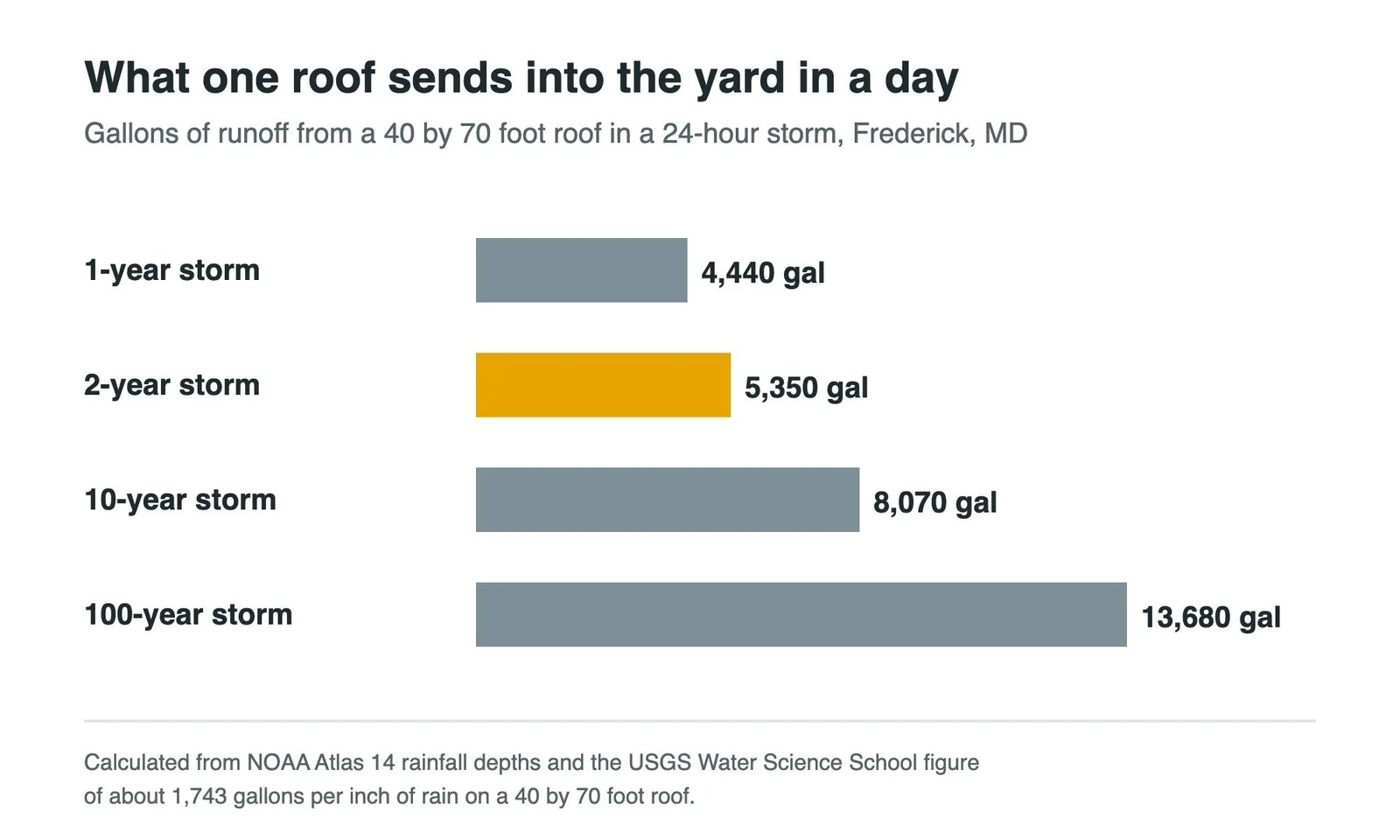
Estimated runoff from a 40 by 70 foot roof in 24-hour Frederick storms. Calculated from NOAA Atlas 14 and USGS figures.
These are rough figures. Real roofs differ in size and shape, some water evaporates or splashes, and a house with four downspouts spreads its load differently from one with two. The order of magnitude is the point: a few thousand gallons in a day is ordinary, and all of it has to go somewhere.
Where the water usually goes wrong
Most residential drainage problems start at the end of a downspout. If the outlet empties beside the foundation, onto a patio, or into a low spot in the lawn, the yard is being asked to absorb in a few hours what the roof collected over its whole surface. Soil that is already saturated, compacted by construction, or heavy with clay cannot keep up, and the water finds the lowest point it can reach, which is often a basement wall, a walkway, or a neighbor’s property line.
Contractors who do drainage work describe the symptoms in consistent terms. All American Lawn & Landscape, a veteran-owned company based in Walkersville, lists them on its drainage page: “Signs include standing water after rain, soggy lawn areas that stay wet, erosion in beds and water moving toward your home or hardscapes.” The fixes it describes range from French drains and regrading to buried downspout lines, dry wells, catch basins, channel drains and dry creek beds, matched to where the water is actually coming from.
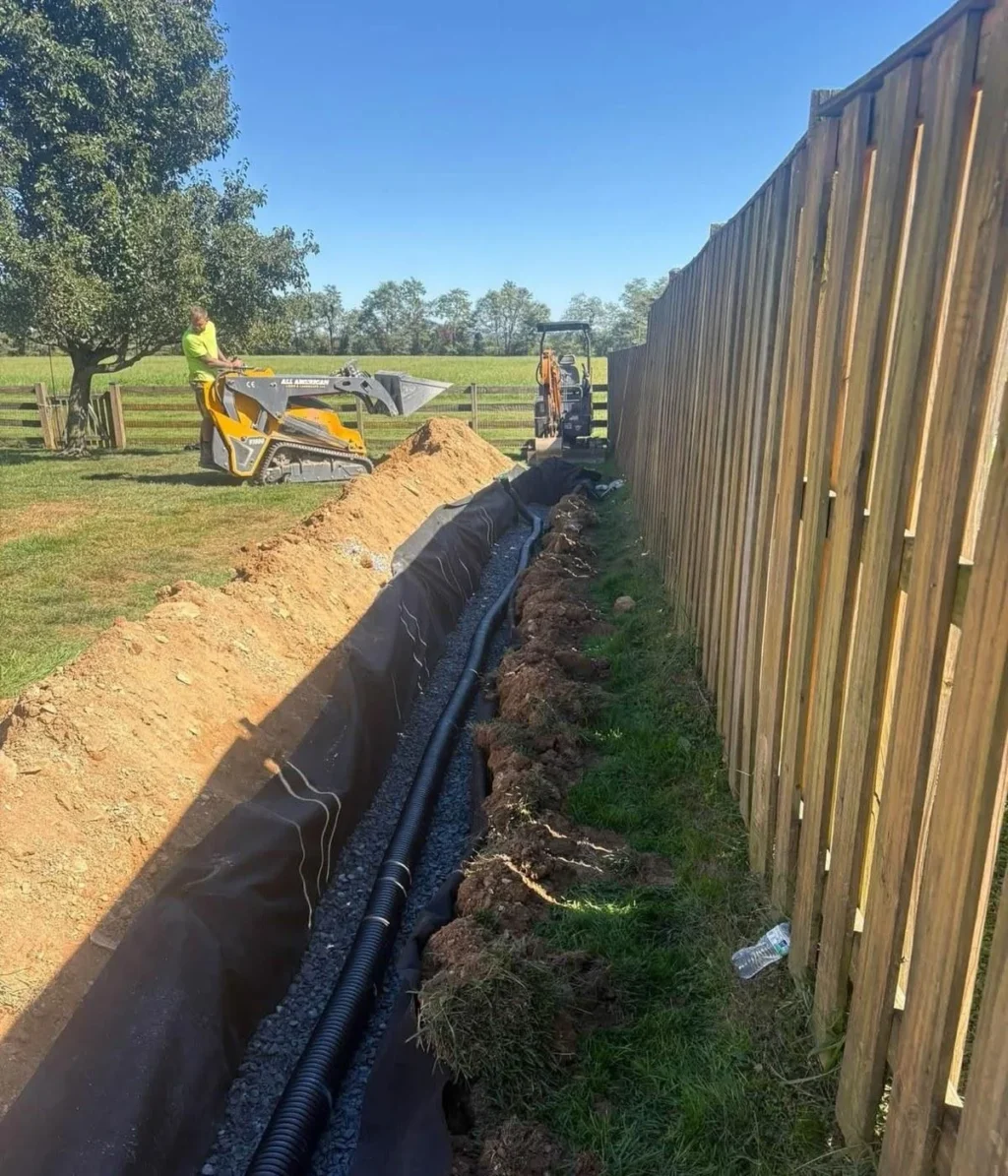
Its project records show one of those fixes: a French drain trench along a privacy fence in Thurmont, lined with filter fabric and gravel around perforated pipe. A system like that gives water a dedicated underground route instead of letting it spread across the surface.
Why timing matters for other yard projects
Drainage also interacts with everything else built in a yard. A new patio, walkway or retaining wall changes how water moves across a property, and a hard surface sheds almost everything that lands on it. All American Lawn & Landscape makes the point directly on its drainage page: “Drainage is often best addressed before or alongside a new patio, retaining wall or landscape installation.”
That sequencing is more practical than it sounds. Once a patio is down, rerouting a buried downspout line beneath it means pulling up finished work. Planning the water path first, while the ground is open, can save that rework.
Questions worth asking before a storm, not after
A homeowner does not need to calculate gallons to use these numbers. A few observations during the next heavy rain will tell most of the story:
- Where does each downspout empty, and how far from the foundation does that water travel?
- Which parts of the lawn are still wet a day or two after rain?
- Does water run toward the house, a patio, or a neighboring property?
- Are mulch beds or slopes showing erosion channels?
- Is a new patio, wall or planting bed planned that will change how water moves?
Maryland requires most home improvement contractors to hold a license from the Maryland Home Improvement Commission, and the commission provides a public license search.
A small calculation with a large footprint
Frederick averages more than 43 inches of precipitation a year under NOAA’s 1991-2020 climate normals, and its storms are well documented. What tends to be missing is the translation from a forecast into a volume of water on a specific property. Once that translation is made, a 3-inch storm stops sounding routine: it is more than 5,000 gallons from a single roof, arriving in one day.
Wherever ground is covered by rooftops, driveways and patios, more of that water moves across the surface instead of soaking in where it falls. For individual homeowners, the most reliable defense is still the simplest one: knowing where the water goes before the next storm decides for them.



More Stories
Move-Out Furniture and the Apartment Dumpster: Bulky Waste in Baton Rouge
Louisiana’s Capital Region Has Two Listed C&D Landfills, State Records Show
Choosing the Right Carpet for Each Room in Your Home