

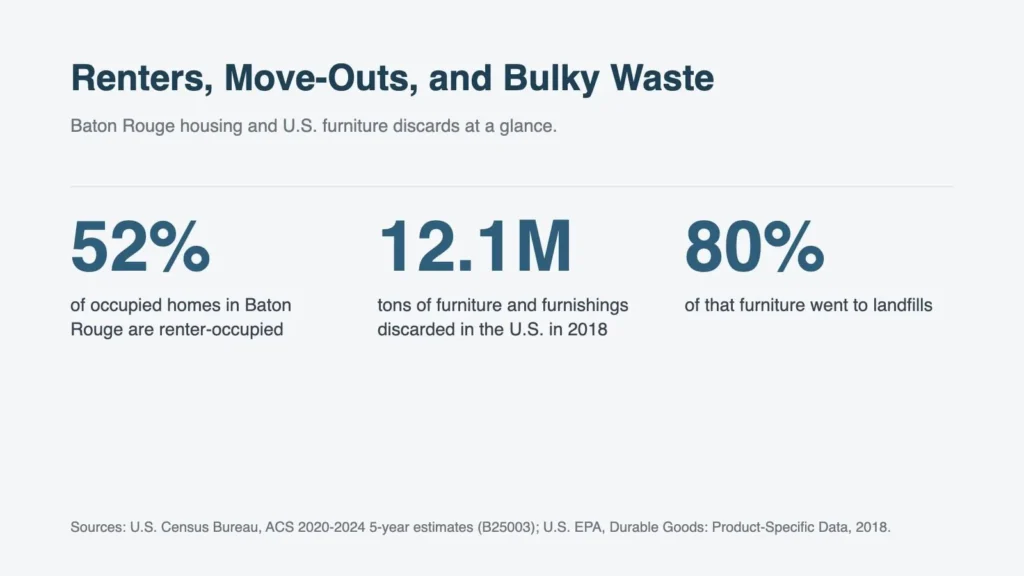
Baton Rouge is a renters’ city, and furniture is one of the heaviest things renters leave behind.
Anyone who manages an apartment community knows the scene. A lease ends, a moving truck pulls away, and a couch, a box spring, and a broken dresser appear beside the dumpster enclosure overnight.
It is easy to treat that pile as a one-off problem. The numbers suggest it is a structural one, especially in a city where most households rent.
Baton Rouge Is a Renters’ City
The latest Census figures for the city of Baton Rouge show 46,054 renter-occupied homes out of 88,205 occupied homes. That is about 52 percent, so renters outnumber owners in the city.
Many of those renters live in apartment buildings. Census estimates from the 2020 to 2024 American Community Survey put about 23,400 renter households in buildings with five or more units, roughly half of all renters in the city.
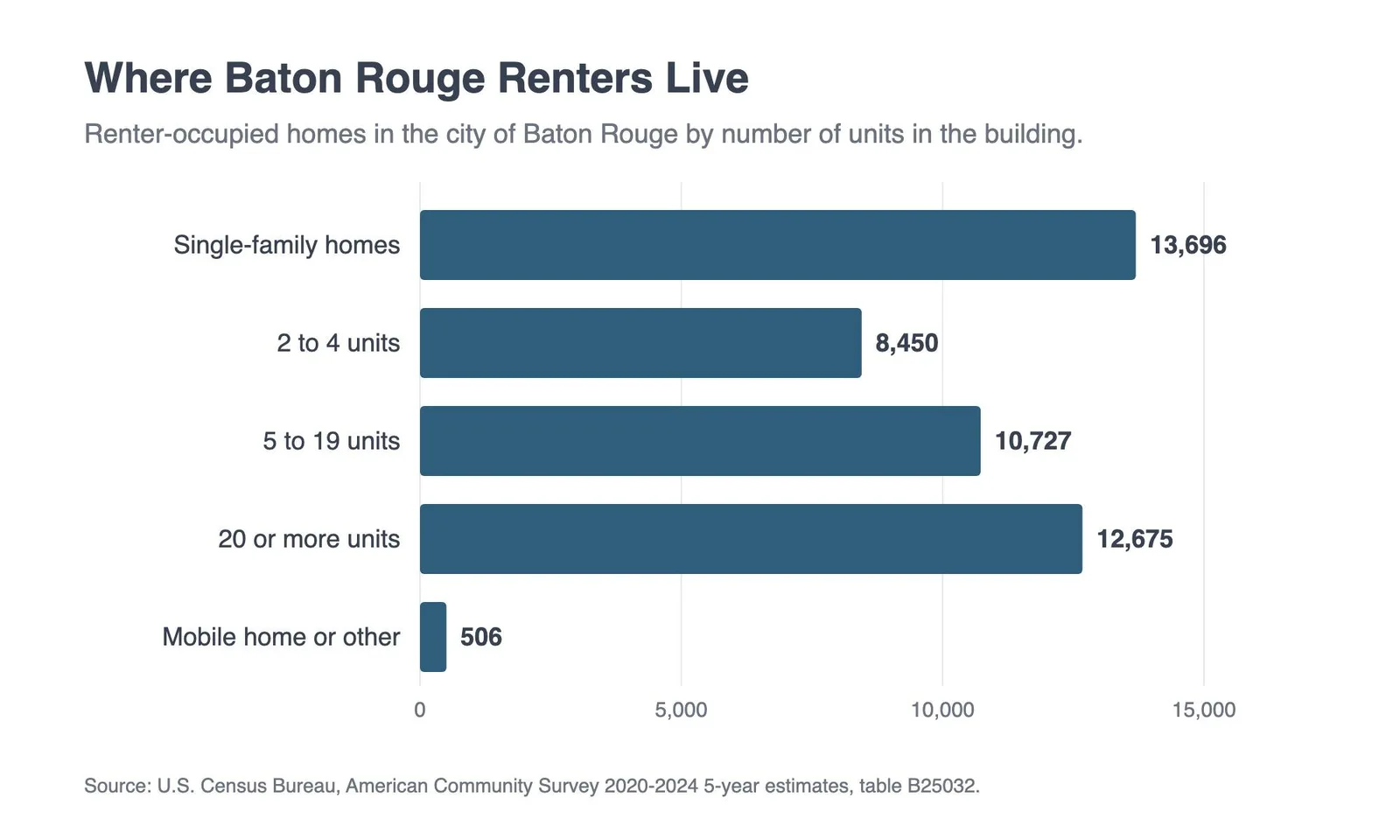
About half of Baton Rouge renters live in buildings with five or more units.
Another 12,675 renter households live in buildings with 20 or more units. In those communities, a single shared enclosure can serve dozens of households, and every move-out runs through it.
Furniture Is a Large and Growing Waste Stream
Furniture does not leave the waste system quietly. EPA’s data on durable goods puts discarded furniture and furnishings, a category that includes sofas, tables, chairs, and mattresses, at 12.1 million tons in 2018.
That is about 4.1 percent of all municipal waste, and it has grown steadily for decades. In 1960, the figure was about 2.2 million tons.
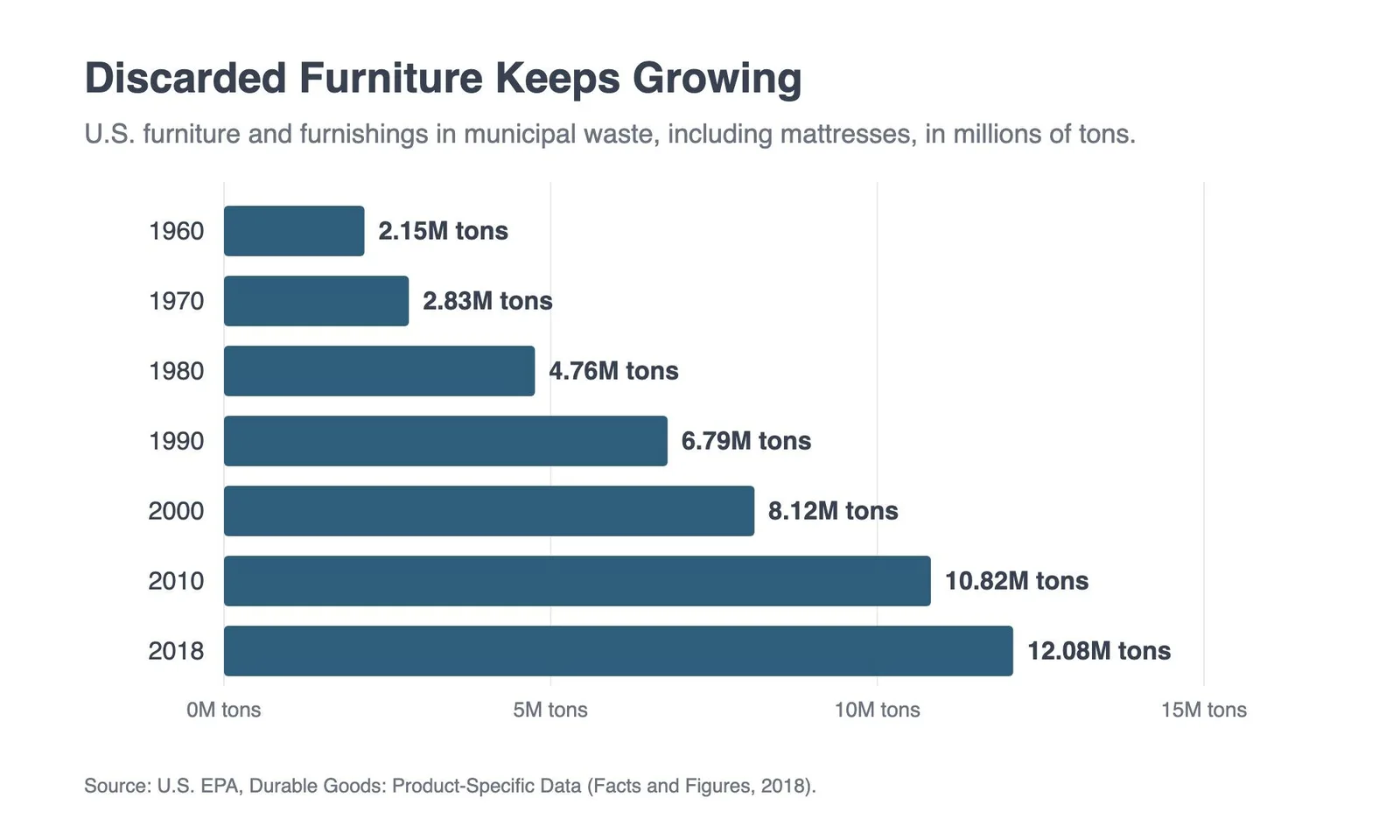
Discarded furniture in U.S. municipal waste grew more than fivefold between 1960 and 2018.
Very little of it gets a second life. EPA estimates about 80 percent of discarded furniture and furnishings went to landfills in 2018, and about 19.5 percent was burned for energy recovery. Measured recycling was close to zero, and EPA had recovery data only for mattresses in this category.
Furniture is not the only bulky item that leaves during a unit turn. Worn carpet often comes out between residents, and EPA puts carpets and rugs at 3.4 million tons of municipal waste in 2018. About 73 percent of that went to landfills, and about 9.2 percent was recycled.
Smaller Buildings Feel It Too
Large complexes are not the only properties dealing with move-out waste. The same Census estimates count 8,450 renter households in buildings with two to four units and another 10,727 in buildings with five to 19 units.
Those properties often have less room to work with. A duplex or fourplex may share a few carts or a small container, so one abandoned mattress can fill the space meant for several households. For owners of smaller rental buildings, a plan for bulky items matters just as much as it does for a 200-unit community.
Why Bulky Items Do Not Fit the Everyday System
The shared dumpster at an apartment community is built for bagged household trash. Furniture is a different kind of waste, and the EPA says as much: managers of waste facilities often call durable goods “oversized and bulky,” and these goods are often picked up separately rather than mixed with regular trash.
That gap shows up at the enclosure. A sofa or mattress is awkward to load through the lid of a front-load container, and it uses space meant for bagged trash. When it does not go in, it ends up on the ground beside the box, and a pickup that empties the container usually leaves it there.
The result is familiar. Residents see a full enclosure, add their bags to the pile, and the area starts to look neglected long before the next scheduled pickup.
A Plan for Turnover Instead of a Reaction
Because leases end on a schedule, turnover waste can be planned. A few practices help property managers stay ahead of it:
- Schedule bulky pickups or a temporary roll-off around the dates when several leases end at once.
- Give departing residents clear written instructions on what to do with furniture and mattresses before move-out day.
- Keep the shared enclosure for bagged household trash, and set a separate spot or service for bulky items.
- Walk the enclosure the morning after a move-out and deal with anything left beside it right away.
Sizing matters too. A community should be sized for its busiest week, not its average one. When an enclosure fills early during turnover, adding a pickup day can be more practical than a larger container, especially at older properties where the enclosure walls were built for a smaller box.
Who Pays for the Couch?
The last question causes the most friction: who covers the cost when bulky items are left behind?
The cleanest answer is a written one. Leases and move-out checklists that spell out how furniture and mattresses must be handled, and what happens if they are abandoned, give managers something to point to. Without that, the charge usually lands on the property. Dated photos of the enclosure taken before and after move-out day also give the manager and the departing resident a shared record to work from.
Service agreements matter as well. Ask the hauler how bulky items left beside a container are handled, how quickly they can be picked up, and how the charge is documented. Companies that provide apartment dumpster service in Baton Rouge can usually set a pickup schedule and a plan for move-out bulk at the same time, which keeps the two from colliding.
The Takeaway for Property Managers
In a city where most households rent, move-out furniture is a predictable part of property management, not an accident. National data shows that furniture is a large, growing, and mostly landfilled waste stream, and that it is handled separately from everyday trash for good reason.
Planning for it with scheduled bulky pickups, clear resident instructions, and a written policy on abandoned items keeps the shared enclosure working for the residents who use it every day.




More Stories
Louisiana’s Capital Region Has Two Listed C&D Landfills, State Records Show
Choosing the Right Carpet for Each Room in Your Home
Home Addition Construction Roanoke VA: Planning the Right Project