

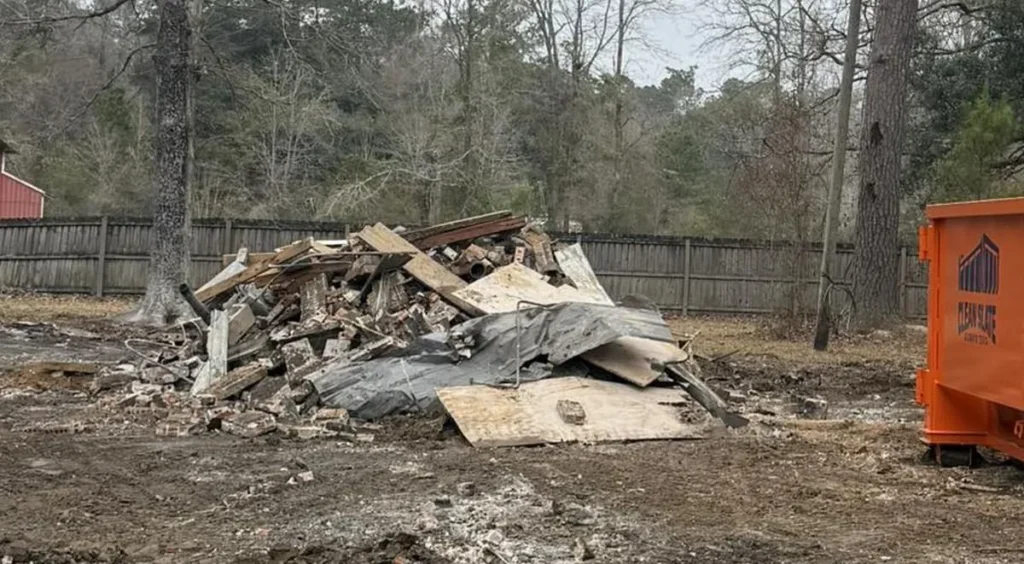
State capacity records show why the debris stream out of a parish like Tangipahoa is priced by where it can legally go, not by how long a container sits.
The Louisiana Department of Environmental Quality must evaluate the volume and types of solid waste managed in the state every two years, along with the permitted capacity available to handle it. The most recent report, covering fiscal years 2022 and 2023 and dated December 2024, reaches a reassuring conclusion: Louisiana currently has sufficient capacity to manage the solid waste it generates.
That conclusion is useful at the state level. It helps less for anyone trying to understand what a debris haul costs in a specific parish. Statewide sufficiency says nothing about where a particular type of waste is permitted to go, and in Louisiana the answer changes sharply by waste classification.
Two categories, two very different maps
Louisiana permits landfills by type. Type I and Type II facilities handle industrial and municipal waste respectively. Type III facilities handle construction and demolition debris, along with certain other wastes.
For a household or contractor in Tangipahoa Parish, that distinction shapes the haul.
The Tangipahoa Parish Regional Solid Waste Facility, identified in state records as AI 43470 and operating in Independence under permit P-0217R2, is a Type II facility. LDEQ’s tables list it among landfills accepting municipal solid waste. It received 158,098 in-state wet tons in fiscal 2023 against a permitted capacity of 8,940,000 wet tons. Its remaining capacity fell from 3,581,063 wet tons in 2021 to 3,217,243 in 2023, leaving 232 months of projected life, or a little over 19 years.
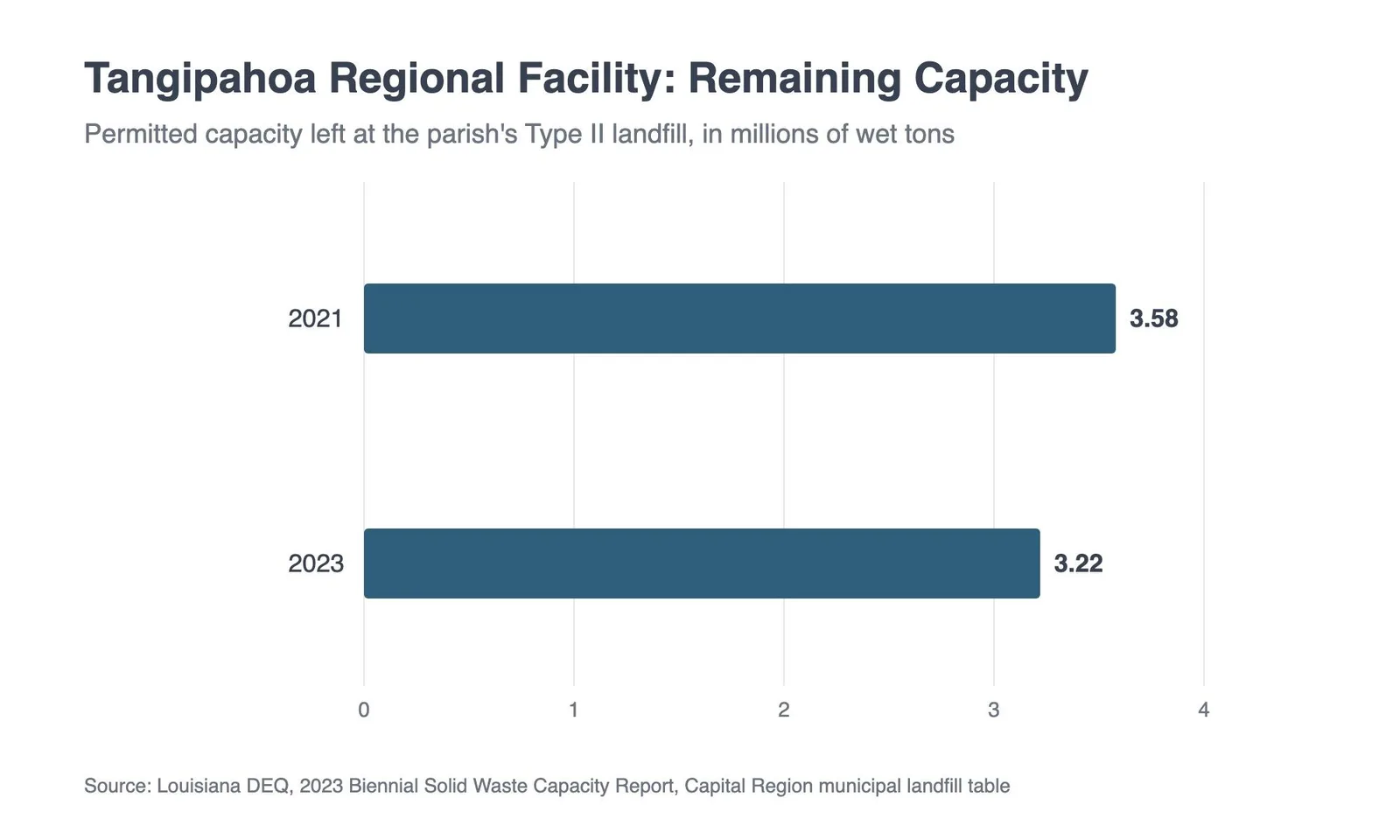
Source: Louisiana Department of Environmental Quality, 2023 Biennial Solid Waste Capacity Report.
It does not appear in the department’s table of Capital Region landfills that accept construction and demolition debris.
That table is much shorter. LDEQ places Tangipahoa Parish within its Capital Region, and the 2023 report lists two Type III facilities across that region that accept C&D debris: Ronaldson Field Landfill and Gator C&D Landfill. Together they took 207,083 in-state wet tons in fiscal 2023 and hold a combined 10,241,302 wet tons of remaining capacity. Local reporting places Ronaldson Field in East Baton Rouge Parish, and an LDEQ enforcement listing places Gator in Ascension Parish.
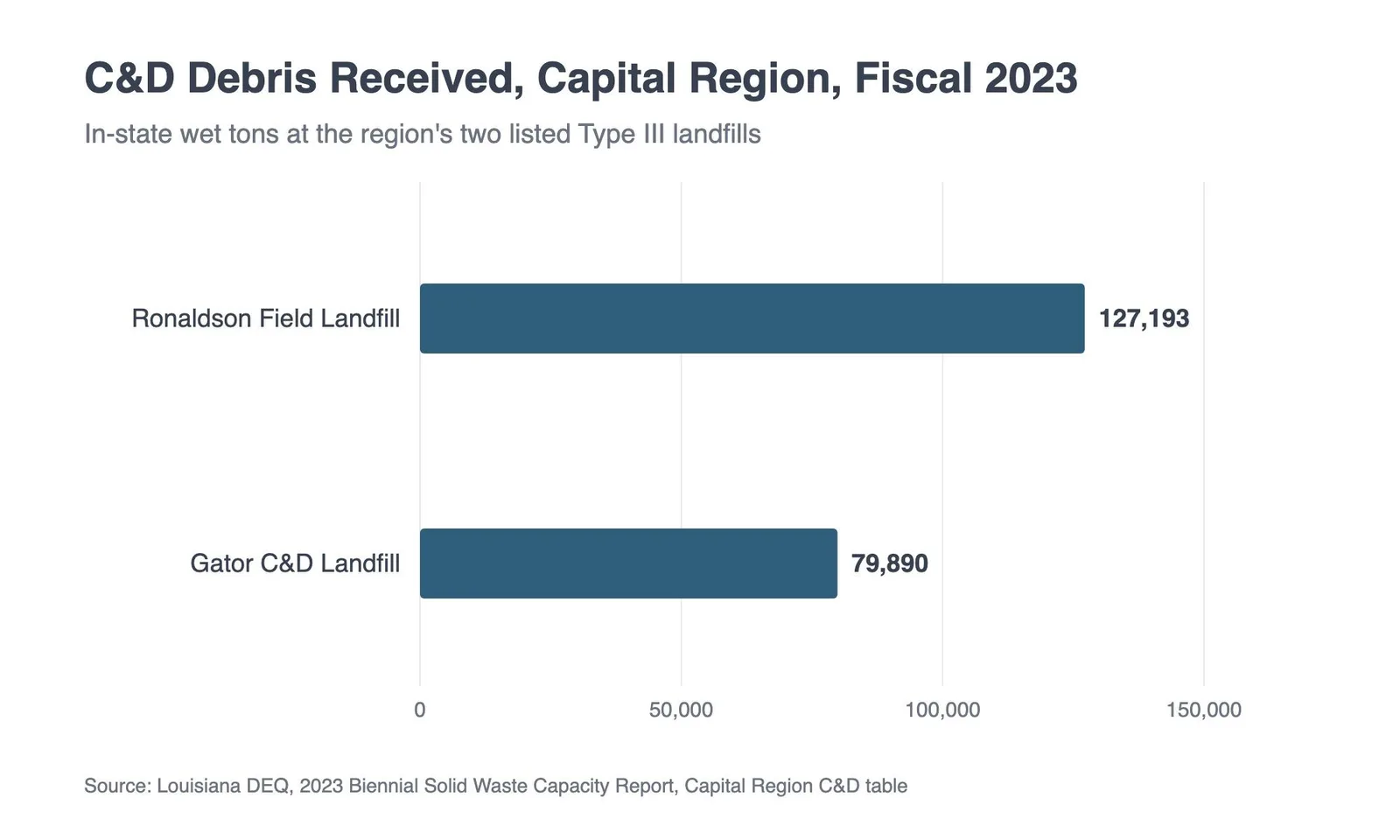
Source: Louisiana Department of Environmental Quality, 2023 Biennial Solid Waste Capacity Report.
The neighboring Southeast Region, anchored on greater New Orleans, lists four: Gentilly Landfill, Riverside Recycling and Disposal, KV Landfill, and Hwy 90 C&D Landfill. Together, they received 526,323 in-state wet tons, with Hwy 90 alone accounting for 284,172.
Why this shows up on an invoice
A roll-off container is a transport product. Customers pay for a truck moving an asset to a permitted receiving facility, a scale ticket, and a truck moving it back.
Recent analysis of roll-off pricing structure in the waste trade decomposed the flat rate into four drivers: the delivery leg, the retrieval leg, disposal billed by weight, and the amortized capital cost of the container. Three of those four are driven by events and not by time, which helps explain why extension fees tend to be small relative to base rates.
Apply that breakdown to a specific geography and the regional variable becomes clear. Both truck legs depend on distance. Disposal cost depends on the tipping fee at the permitted facility that will legally accept the material. When the nearest facility permitted for a given waste type sits outside the parish, both variables move at once, and neither relates to how many days the container spent in a driveway.
This is also why sorting can matter more in some parishes than others. A load of cleanly separated construction and demolition debris can go to a Type III facility, which LDEQ notes is less costly to build and operate than a Type I or Type II landfill. A load that mixes household goods into that debris may be reclassified, changing both the eligible destination and the rate. The right answer depends on the tipping schedules and haul distances a given operator faces, not on a general rule.
What operators do with the constraint
Regional haulers focus on the variables they control: route density and retrieval scheduling, not tipping fees or permit classifications.
Clean Slate Dumpsters, a roll-off company based in Hammond, is one example. It runs 15-yard, 20-yard, and 30-yard containers around Tangipahoa Parish. Its published one-day rates are $299, $399, and $499, with one, two, and four tons included respectively, plus $65 per additional ton and $15 per additional day.
The tonnage structure in a rate card like that one is the part worth reading closely, because it is where disposal geography reaches the customer. Included tonnage and per-ton overage are how a hauler passes through a tipping fee. The per-day charge is a small line next to the base rate.
For a customer comparing quotes, that points to a few plain questions. How many tons are included? What does each additional ton cost? Will mixed household items change where the load can go or what it costs? Those answers usually say more about the final bill than the number of rental days.
The measurement that is missing
LDEQ’s biennial reports are strong primary records, published on a set cycle with facility-level detail. What they cannot show is the haul.
The reports record what each permitted facility received. They do not record how far that material traveled or what it cost to move. A parish can appear well served on a capacity table while its contractors truck C&D debris across a regional boundary, and the capacity tables would not reveal it.
That gap matters for anyone reasoning about disposal cost at a local level, including parish governments weighing the case for additional permitted capacity. Sufficient statewide capacity and efficient local disposal are different questions, and these reports are designed to answer the first.



More Stories
Choosing the Right Carpet for Each Room in Your Home
Home Addition Construction Roanoke VA: Planning the Right Project
Phasing and Dust Control in an Occupied Home Renovation