


An indoor golf simulator setup, ready for play.
Plenty of company outings in South Louisiana are planned twice. There is the version on the calendar invite, and there is the backup plan someone builds the week before, when the forecast turns.
That second plan deserves more attention than it usually gets. In Baton Rouge, weather is not an edge case for an outdoor team event. It is the main thing to plan around.
Why Team Events Are Worth the Effort
The business case for getting people together is straightforward. Gallup’s latest workplace survey found that 31% of U.S. employees were engaged at work in the first half of 2026, unchanged from 2025 and down from 36% in 2020.
Relationships are part of that slide. In a January 2026 report, Gallup found that 41% of Generation Z and younger millennial employees strongly agreed in 2025 that a supervisor or someone at work cares about them as a person, down from 54% in 2020.
A single outing will not fix engagement. But it is one of the few settings where coworkers who rarely overlap spend unstructured time together, and that only works if the event actually happens.
Rain Is a Planning Fact, Not a Surprise
The local weather record supports a backup plan. According to NOAA’s 1991 to 2020 climate normals, Baton Rouge Metropolitan Airport averages about 62 inches of precipitation a year.
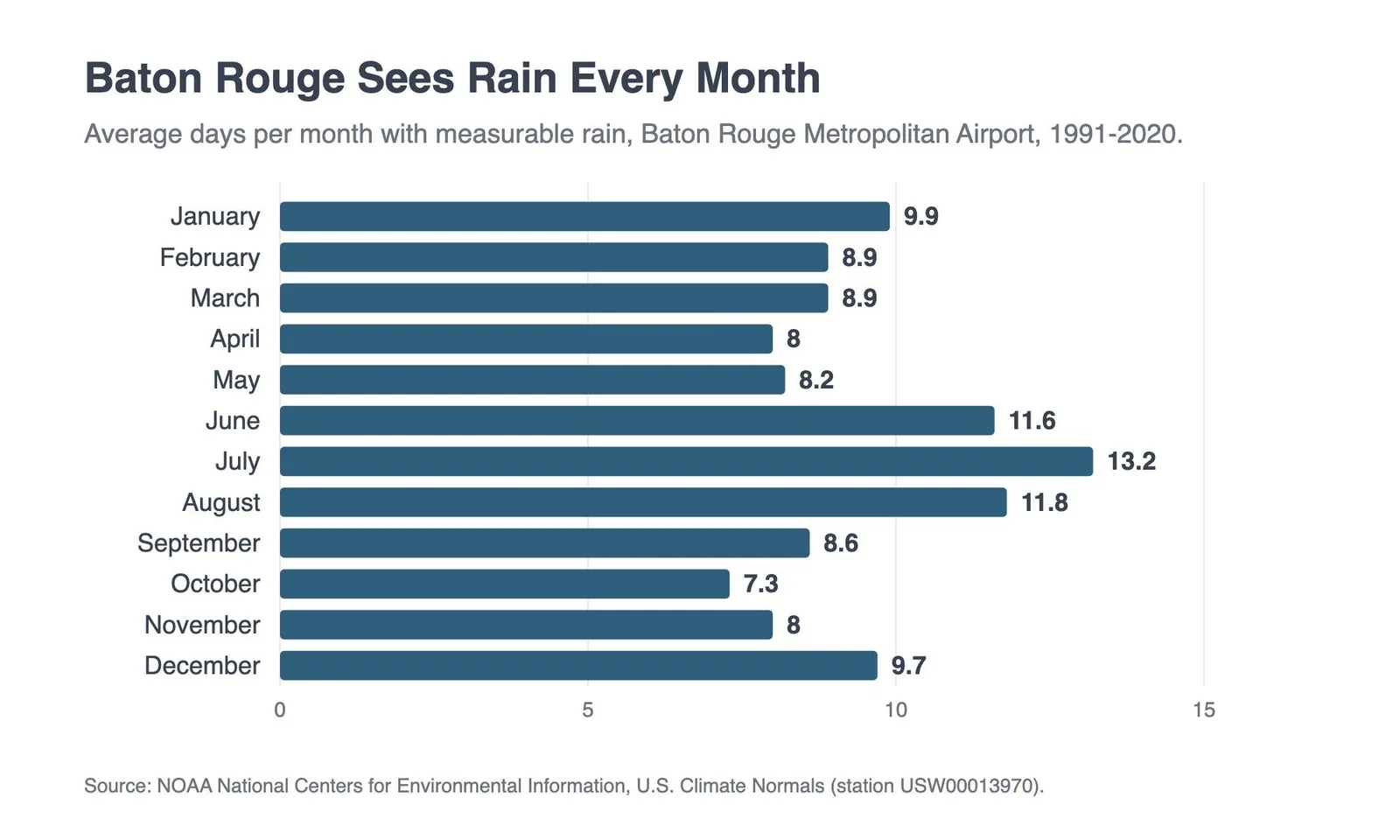
Baton Rouge averages about 114 days a year with measurable rain.
That rain is spread across the calendar. The same normals show about 114 days with measurable rain a year, and no month averages fewer than seven. July is the rainiest by that count, at 13.2 days.
October is the driest month by days with rain, at 7.3. That makes it a reasonable target for an outdoor event, though even October brings rain about one day in four.
Heat Narrows the Window Further
Rain is only half the problem. NOAA’s normals put the average daily high at Baton Rouge’s airport above 90 degrees in June, July, and August, peaking at 92.2 degrees in August.
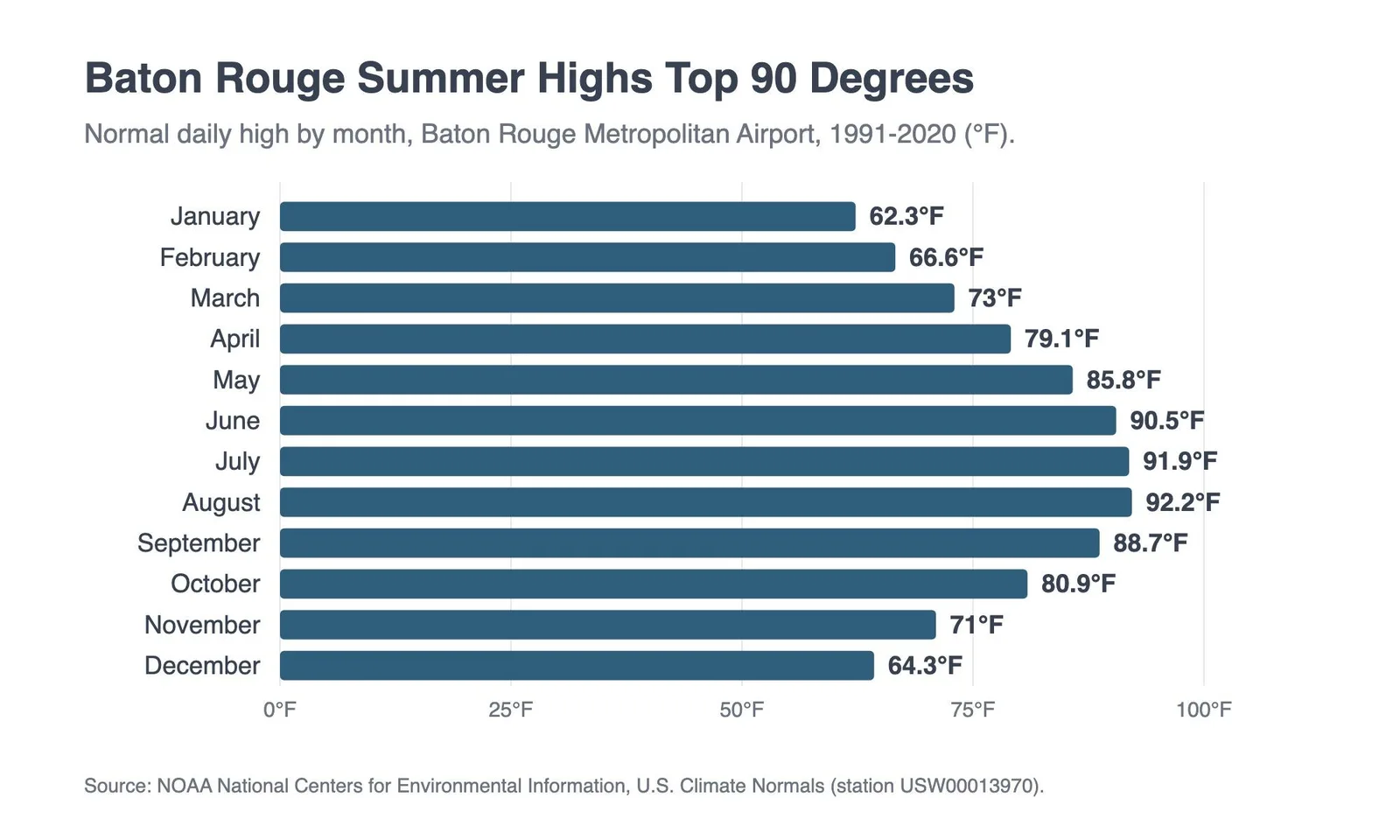
Normal daily highs top 90 degrees from June through August.
Those are averages, so plenty of summer afternoons run hotter. An outdoor activity at 2 p.m. in July asks a lot of people in work clothes, and it tends to empty early.
Put the two together, and the outdoor calendar shrinks fast. Late fall and early spring offer milder highs, but no month in Baton Rouge is reliably dry.
Plan the Indoor Version First
The practical answer is to design the event to work indoors from the start. The outdoor version becomes the upgrade on a good day, not the plan that falls apart on a bad one.
That changes a few early decisions:
- Pick an activity that fits inside the space you control, such as a warehouse bay, a large conference room, or a lobby.
- Measure the room before booking anything, including ceiling height.
- Confirm power, a level floor, and a clear path to bring equipment in.
- Ask the building about access rules, loading times, and parking for vendors.
- Keep the outdoor area as an option, with cover, rather than the default.
Room measurements matter more than they sound. Many activities that look portable need more ceiling or floor space than an office can spare.
Time It Around the Workday and the Season
The date matters as much as the venue. Some companies fold team building into a year-end or holiday gathering, and in Baton Rouge that timing has a weather upside.
NOAA’s normals put December’s average daily high at 64.3 degrees, well below the summer peak. December still averages 9.7 days with measurable rain, so the indoor plan stays in place, but a covered patio or loading dock becomes a comfortable add-on rather than a gamble.
Time of day matters too. A late-afternoon start lets people leave their desks without losing a full workday, and an event that runs into the evening avoids the hottest hours in the warmer months.
Headcount shapes everything else. A group of 20 can share one activity in rotation, while a group of 100 needs either more stations or a format where people drift in and out between food, conversation and play.
Choose Formats That Mix People
The activity itself should be easy to join. If only the confident players take part, the event reinforces the same groups that already eat lunch together.
Short, repeatable formats tend to work best. Quick turns, simple scoring, and a reason to cheer for someone else keep a group together instead of splitting it into players and spectators.
It also helps when no prior skill is required. An activity that a first-timer can try in thirty seconds lowers the bar for the people who usually hang back.
One Indoor-Ready Option
A mobile golf simulator is one example of an activity built for this kind of plan. In the Baton Rouge area, Riverside Fairways offers a mobile golf simulator for corporate events that sets up in a warehouse bay, a large conference room, a lobby, or a covered outdoor area.
The company lists what a site requires: access to electricity, 15 by 20 feet of floor space, 12 feet of ceiling clearance, a reasonably level surface, and a clear path to move equipment in. Staff set up, run the session, and pack out, with clubs for right- and left-handed players.
Its corporate sessions rotate through formats such as longest drive, closest to the pin, and a team scramble that pairs people who rarely work together. According to the company, guests do not need to have played golf before.
Where Workplace Events Are Heading
Engagement numbers have stayed flat for two years, and the weather in South Louisiana is not going to change to suit the office calendar. Both point the same way.
The events that hold up will be the ones planned for the room first and the sky second. A team outing that can move indoors without losing anything is the one that actually happens, and that is where the value is.



More Stories
Turning Ideas into Products: The Role of CAD Technology in Product Development
Home Insurance Guide: Protecting Jewellery and Valuable Possessions
From Community Service to Exequatur: The Real Path to an Honorary Consul Appointment