

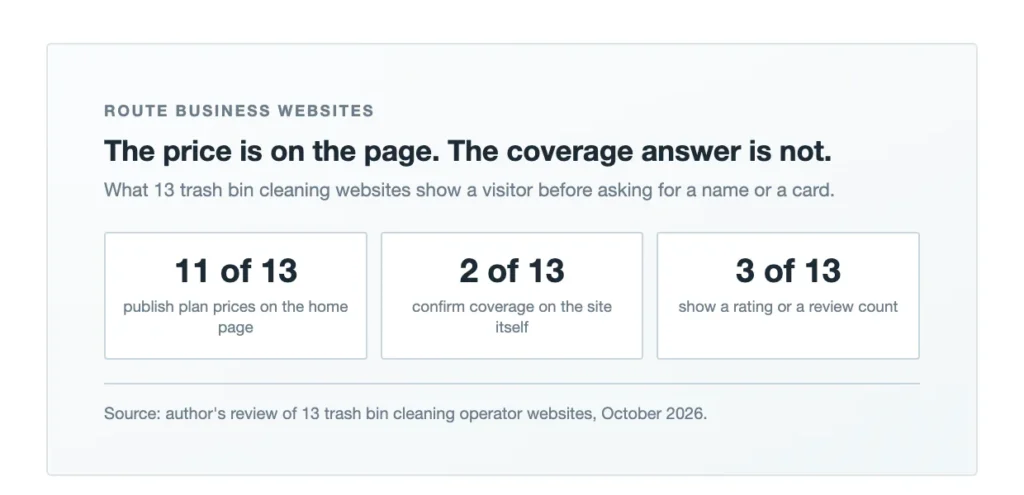
Most operators now publish their prices. Very few answer the first question a homeowner has: Does the truck come to my street?
By Clint Sanchez
Curbside trash bin cleaning is one of the simplest subscription businesses in home services. A trailer with a hot-water system follows the garbage truck, washes each can at the curb, and bills the household monthly or quarterly. The sale almost always happens by phone, on the operator’s website, with nobody from the company present.
That makes the website the entire sales process. In October 2026, I reviewed 13 operator websites in at least ten states, from Iowa and Minnesota to Texas and Florida, and recorded what each one shows a visitor before asking for a name or a card. The sites ranged from single-truck family businesses to a brand operating in six markets.
The pattern that came out is consistent enough to be useful to any business that sells a recurring service by route.
Price transparency has become the norm
Eleven of the 13 sites put plan prices on the home page. For two bins on a monthly plan, published prices ranged from about $20 to about $35.
Price transparency across the 13 sites was the review’s clearest finding. A few years ago, it was common for a local service business to hide its price behind a quote form. In this category, the operator who withholds the number is now the outlier, asking a homeowner to do more work than a competitor a few results down.
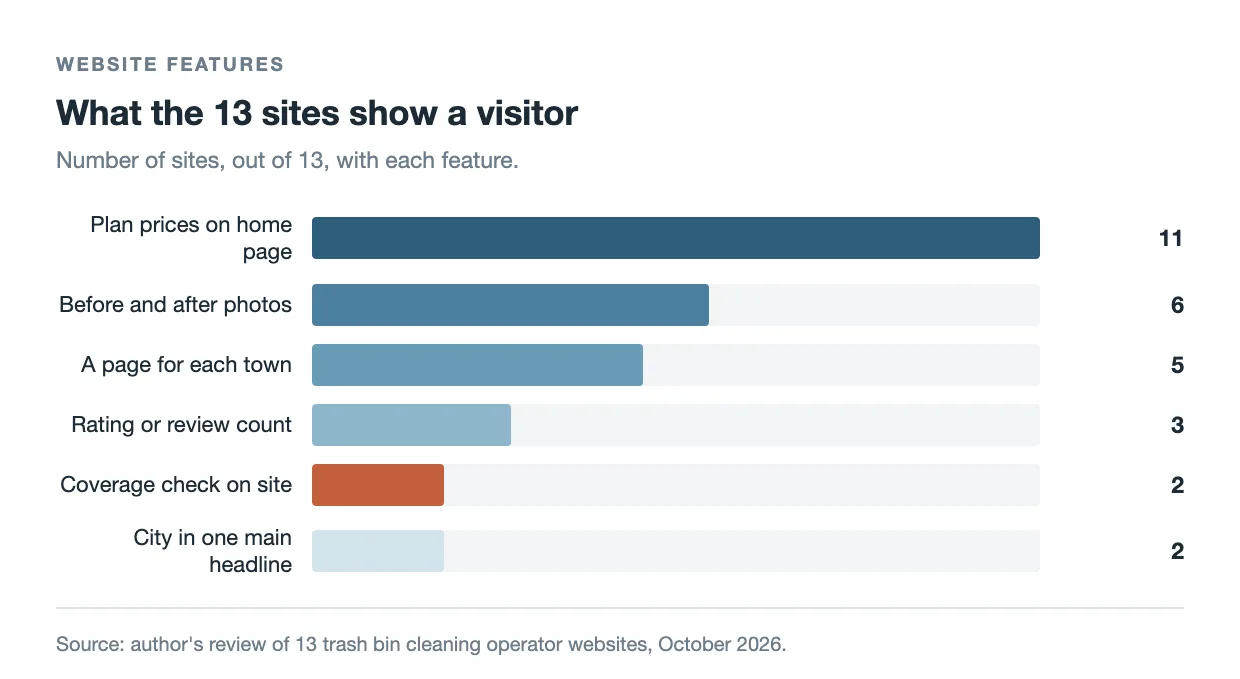
Prices are nearly universal. A coverage check is the rarest feature measured.
The reason is structural. The product is standardized, the ticket is small, and the buyer is comparing three tabs at once. A quote form adds a delay that a $30 purchase does not justify.
The question almost nobody answers
A route business has a constraint a store doesn’t. It can only serve the streets its truck already drives. The first thing a homeowner needs to know is: is my address covered?
Only two of the 13 sites answer that on the site itself, with a tool where the visitor types a ZIP code or an address and gets an answer. The other 11 leave it to a list of towns, a map image, or the signup form.
Coverage checks on the 13 sites were rarer than any other feature measured. That is striking, because coverage is the one fact that decides if every other fact on the page matters to this visitor.
Sign-up usually happens somewhere else
Eight of the 13 sites send the visitor to outside route software to sign up. The operator’s site makes the pitch, then a button opens a third-party page that collects the address, the plan, and the card.
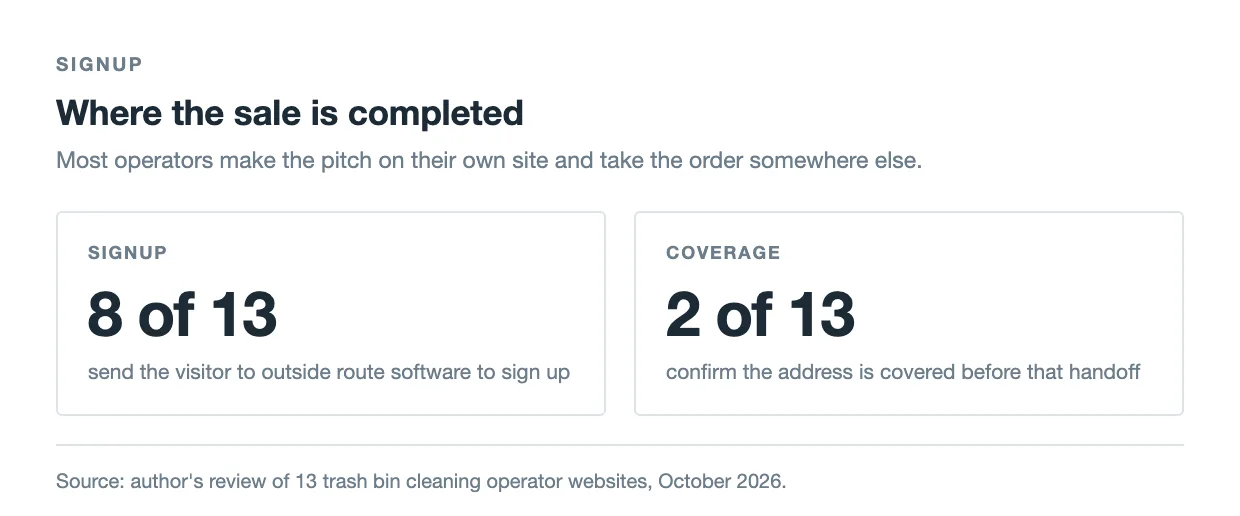
The pitch and the order usually happen on two different websites.
This is a reasonable choice for a small operator. Route software handles scheduling and billing, and building a custom signup flow is expensive. The cost is that the visitor leaves the operator’s branding, reviews, and photos at the exact moment of decision, and whatever the software asks first becomes the first impression.
It also explains the coverage gap. In most cases, the software is where coverage is finally checked, after the visitor has already been asked to start an account.
Proof is thinner than expected
Only three of the 13 sites showed a star rating or a review count. Four showed no customer quote at all. Six showed before-and-after photos, and two stated a guarantee.
For a service the customer never watches being performed, that is a thin layer of proof. It also leaves a search advantage unused. Google’s guidance on local ranking says prominence is based in part on how many reviews a business has, and that more reviews and positive ratings can help a business’s local ranking. An operator with 300 reviews who never mentions them on the site is leaving the strongest credential in a different tab.
Town pages and headlines
Five of the 13 sites had a separate page for each town served. Only two put the city in one clear main headline. Two had no main headline, five had several competing ones, and one used a phone number as the headline.
These are small technical points with a practical effect. A page per town, with details that apply only to that town, is how a route business appears when someone in that town searches. A page that could describe any town does little.
Google’s own documentation on creating helpful, people-first content asks if a page provides original information and a substantial description of the topic. A list of 20 towns in a footer does not meet that test for any of them.
What the strongest sites had in common
No single site did everything. The easiest ones to buy from shared four habits.
They published the price on the home page. They answered the coverage question before asking for contact details. They showed proof with a number, such as a rating or review count. They gave each town its own page.
None of those four things requires a large budget. They require decisions about what goes first on the page, which is the core of website design for trash can cleaning companies and any other business that sells recurring visits.
Limits of the review
Thirteen sites is a small, nonrandom sample. The sites were chosen because they were real operators with working websites that could be read in full, not because they represent the whole industry. The counts describe these 13 sites as they stood in October 2026.
The review also measured what a visitor can see, not what converts. No operator shared signup data. A site with no coverage tool may still sign up plenty of customers through door hangers and neighbors, where the website is only the payment page.
The counts show where the common gaps are, and they are not where most operators spend their effort.
What it suggests for other route businesses
Lawn care, pool service, pest control, and pet waste removal sell the same way: recurring visits, small tickets, and a service area set by drive time. The same four questions apply. What does it cost, do you come to my street, can I trust you, and how do I start?
In bin cleaning, the first question is now answered almost everywhere. The second is answered almost nowhere. As more operators enter the category and homeowners compare them side by side, sites that answer both on the first screen are likely to set expectations for the rest.


More Stories
How Rain and Heat Shape Company Events in South Louisiana
Turning Ideas into Products: The Role of CAD Technology in Product Development
Home Insurance Guide: Protecting Jewellery and Valuable Possessions