

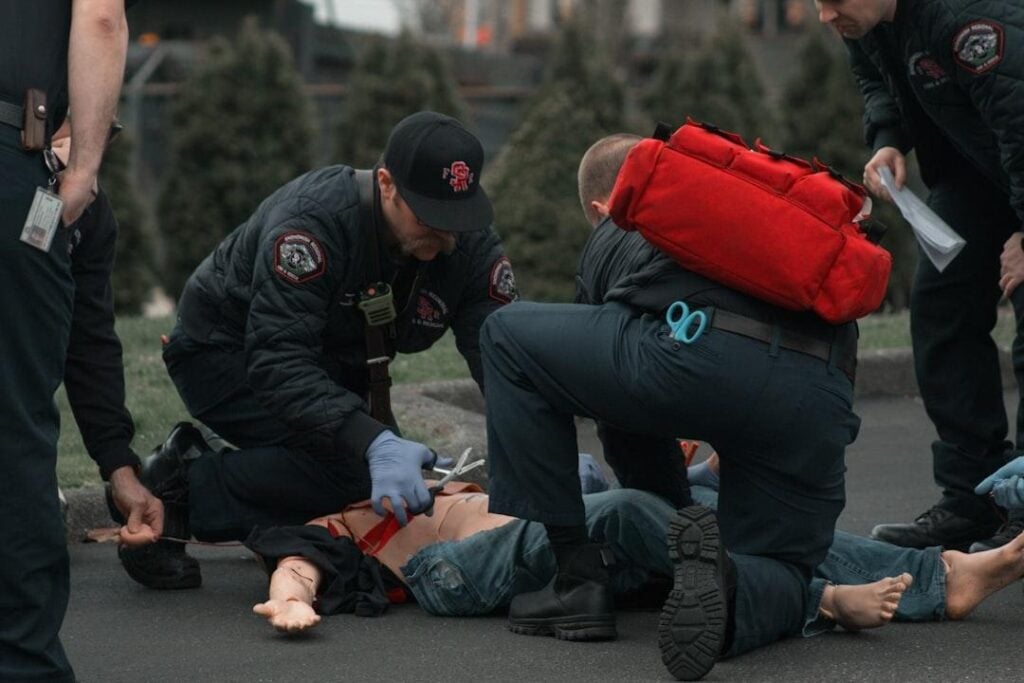
Mobile integrated health programs frequently build their field workforce from emergency medical services personnel. The logic appears straightforward, since paramedics already assess acutely ill patients outside of hospitals.
The assumption that this is a redeployment rather than a retraining is where programs most often go wrong. The two roles share skills but differ in objective.
What Is Emergency Medical Services Actually Trained For?
Emergency medical services training centers on rapid assessment, stabilization, and transport. The implicit endpoint of most protocols is delivering the patient to definitive care.
That orientation is appropriate for the mission. It also means the default resolution of uncertainty is transport.
How Does Care-in-Place Invert That Objective?
A care-in-place model asks the same clinician to determine whether a patient can safely remain home. The endpoint shifts from transport to resolution in place.
The model described in bridging the access gap for complex patients depends on field clinicians who can complete an assessment, deliver treatment, and coordinate follow-up without defaulting to transport, which is a different decision framework from emergency response. The clinical skills overlap while the objective does not.
This inversion is cognitive rather than procedural. The assessment steps are familiar, but what counts as a successful conclusion has changed.
What New Competencies Does the Role Require?
The role adds competencies that emergency response does not emphasize. Chronic disease management, medication reconciliation, and social assessment become routine rather than incidental.
Clinicians also need comfort with extended encounters. Spending 75 minutes in a home is a different activity from a rapid scene assessment.
How Does the Patient Relationship Change?
Emergency response involves brief contact with patients a clinician will likely never see again. Mobile integrated health frequently involves repeat encounters with the same patients over time.
That continuity changes how rapport is built and what history is available. It also introduces expectations that a single-encounter model does not carry.
What Does Documentation Require?
Documentation in emergency response supports handoff to a receiving facility. Documentation in a care-in-place model supports a longitudinal care team that may act on it days later.
The audience and purpose differ, which changes what detail matters. Training generally has to address this explicitly rather than assuming transfer.
Which Skills Transfer Directly?
Substantial capability does carry over, and building from an emergency medical services foundation remains sensible. The directly transferable skills include:
- Rapid clinical assessment outside a facility setting
- Comfort operating independently in unpredictable environments
- Familiarity with acute presentations across a wide range
- Established procedures for scene and personal safety
- Experience communicating with distressed patients and families
These are genuine advantages over recruiting from purely facility-based backgrounds. The retraining builds on a real foundation.
What Does the Training Actually Cover?
Programs typically train field staff in the care-in-place decision framework, chronic disease management, medication review, and use of the supervision platform. The emphasis is on what happens when transport is not the answer.
Working within real-time physician supervision is itself a learned skill. Presenting a case concisely to a remote physician differs from radioing a receiving hospital.
How Do Partnerships With EMS Agencies Work?
Many programs build capacity through partnerships with emergency medical service providers rather than employing field staff directly. The partner supplies vehicles, personnel, and geographic coverage.
The program supplies training, protocols, supervision, and technology. This division allows faster geographic expansion than building a field workforce from scratch.
What Happens When Retraining Is Skipped?
Programs that treat this as redeployment typically see elevated transport rates that persist after launch. Field clinicians resolve uncertainty the way their original training taught them to.
Disposition figures reported in the 2025 mobile integrated health results for the Massachusetts program show nearly ninety percent of encounters concluding with the patient remaining home, which is the outcome that distinguishes a retrained field workforce from a redeployed one. Transport rates are the clearest indicator of whether the retraining took hold.
High transport rates in a care-in-place program usually indicate a training gap rather than an unusually sick population. The pattern is diagnostic.
What Should Programs Plan For?
Programs should budget for structured training, supervised early practice, and ongoing case review rather than an orientation period. The behavioral shift takes longer than the knowledge transfer.
Ongoing review of transport decisions is how the shift is reinforced. Without it, clinicians revert toward their original defaults under pressure.
How Long Does the Transition Take?
Programs generally report that field clinicians need several months of supervised practice before the care-in-place decision framework becomes their default. Knowledge transfer happens quickly while behavioral change does not.
Case review during that period is what accelerates the shift. Clinicians who discuss their transport decisions with supervising physicians adjust considerably faster than those who do not.
What Does Ongoing Education Cover?
Continuing education in these programs typically addresses chronic disease management, medication interactions, and recognition of behavioral health presentations. The curriculum reflects the case mix the program actually encounters.
Programs serving populations with substantial behavioral health history generally weight that content heavily. Training aligned to the real case mix is more useful than a generic acute care curriculum.
Building a mobile integrated health workforce from emergency medical services personnel is sound, provided the retraining is treated as substantive. The skills transfer while the decision framework does not.
For programs standing up this capability, the practical implication is to budget for retraining and reinforcement rather than orientation. Transport rates will show whether that investment was made.




More Stories
Clear Aligners: A Clearer Way to Achieve a Straighter, Healthier Smile
Oren Shachar and Co-Defendant Abraham Shin Released on Bond in Medicare Case
Justin Jadali on Quantitative Microscopy in Tissue Engineering Research