

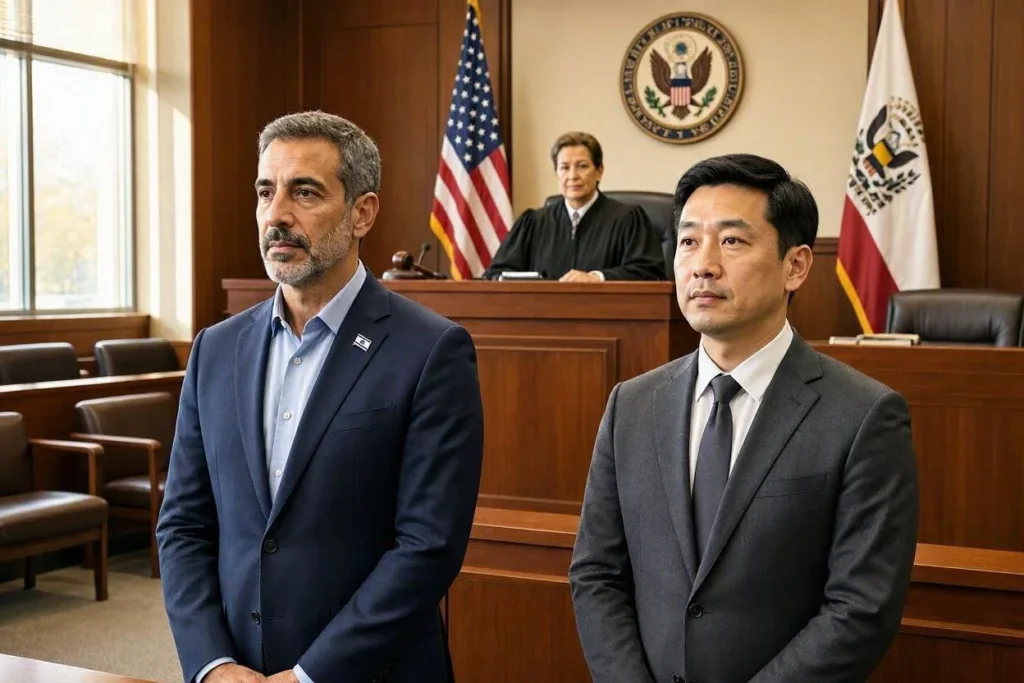
A federal magistrate judge allowed both men to remain outside custody while the Los Angeles prosecution proceeds, without deciding whether the government can prove its allegations involving hospice claims, patient information, kickbacks, and corporate funds
WASHINGTON, DC, August 26, 2026 — Oren David Shachar and co-defendant Abraham Shin were released on bond after appearing in federal court in Los Angeles, allowing both men to prepare for trial outside detention while a sprawling Medicare hospice fraud prosecution moves forward.
The release decision followed their June 18 arrests, initial appearances, and arraignments in the Central District of California, where each entered the federal judicial process under an indictment alleging fraudulent billing, identity misuse, kickbacks, and related conduct.
A federal magistrate judge ordered both defendants released, but the public Justice Department announcement does not identify their bond amounts, collateral arrangements, travel limitations, reporting requirements, passport restrictions, or any other individualized conditions imposed by the court.
That absence matters because bond is a legal status governed by a written release order, not a simple declaration of freedom, and responsible reporting should not invent restrictions merely because similar requirements often appear in unrelated federal cases.
Shachar and Shin remain presumed innocent, and their release establishes only that the court authorized pretrial liberty under enforceable conditions, not that it determined whether Medicare claims were false, identities were misused, referrals were purchased, or criminal proceeds were spent.
The bond orders followed a rapid June court sequence
The Justice Department’s official Southern California healthcare-fraud announcement states that Shachar, then identified as 59 and residing in Van Nuys, and Shin, then identified as 66 and residing in Corona, were arrested on June 18.
Both defendants made their initial appearances that day and were arraigned in United States District Court in Los Angeles, compressing arrest, notice of the indictment, entry into the case, and consideration of pretrial custody into an unusually visible procedural sequence.
The government’s announcement then reported that a federal magistrate judge ordered Shachar and Shin released on bond, while separately stating that co-defendant Jeannie Choi had been arrested several days later and would begin her own courtroom process.
Because the public summary does not reproduce the release orders, it supports the central fact of bond release but does not establish whether either man posted cash, pledged property, signed an unsecured appearance bond, obtained sureties, or accepted electronic monitoring.
Release on bond is not a ruling on innocence or guilt
Federal pretrial release addresses whether court-ordered conditions can reasonably assure a defendant’s future appearance and protect other people and the community, whereas a criminal trial determines whether prosecutors proved each charged offense beyond a reasonable doubt.
Those inquiries can consider overlapping facts yet remain legally distinct, meaning a judge may release a person facing serious allegations without rejecting the indictment, discounting the claimed financial loss, or predicting how jurors will evaluate evidence months later.
Likewise, detention would not prove criminal liability, because custody before trial responds to statutory risk findings rather than replacing testimony, authenticated records, cross-examination, expert analysis, jury instructions, deliberations, or a verdict on any charged count.
The bond ruling therefore preserves the ordinary adversarial process, leaving prosecutors responsible for proving their case while allowing defense counsel to challenge the government’s narrative without treating temporary liberty as either vindication or judicial skepticism.
Federal law favors the least restrictive workable conditions
Under the federal Bail Reform Act, a judicial officer generally considers release on personal recognizance, an unsecured appearance bond, or the least restrictive combination of conditions reasonably calculated to assure appearance and community safety before ordering detention.
The statutory analysis can examine the nature and circumstances of the alleged offenses, the weight of available evidence, a defendant’s history and characteristics, community connections, financial resources, prior conduct, and any identified danger associated with release.
Financial conditions cannot lawfully become a disguised detention mechanism merely because a defendant cannot satisfy them, although courts may impose secured arrangements when supported by the circumstances and combined with other measures addressing appearance or safety concerns.
None of those general principles reveals what the magistrate judge specifically found concerning Shachar or Shin, because the summarized public announcement reports the outcome without describing the evidence, arguments, concessions, sureties, or reasoning presented during their hearings.
Readers should consequently avoid translating the word bond into a guessed dollar figure, since federal usage can encompass multiple release structures whose financial, supervisory, and behavioral requirements differ substantially from commercial bail practices familiar through state cases.
The undisclosed conditions should remain undisclosed in coverage
Federal release orders may require regular contact with pretrial services, restrictions on travel, surrender of travel documents, residence approval, limits on contact with witnesses, prohibitions against new crimes, or financial disclosures, depending upon the individualized record.
The available public sources do not confirm that any particular condition from that illustrative list applies to Shachar or Shin, so attaching customary restrictions to either man would convert a general description of federal practice into unsupported case-specific reporting.
The same caution applies to collateral, because a bond may be secured by money or property, supported by third-party sureties, unsecured but enforceable upon nonappearance, or structured through another mechanism authorized by the judicial officer.
Accurate future updates should rely upon filed orders, hearing transcripts, or verified statements before naming financial amounts and restrictions, while noting that release terms can later be modified when circumstances, schedules, risks, or compliance information materially change.
Shachar and Shin face materially different charge totals
The indictment contains sixteen counts and names Shachar in every one, but Shin appears in seven counts comprising the alleged healthcare-fraud conspiracy, three representative healthcare-fraud executions, and three related aggravated-identity-theft allegations involving identified Medicare beneficiaries.
Shachar’s additional counts allege five earlier healthcare-fraud executions, one transaction exceeding $10,000 involving purported criminal proceeds, two substantive kickback payments, and the unauthorized sale of nine Medicare beneficiary identification numbers to an unnamed physician.
Shin is not charged in the Rolls-Royce transaction count, the two substantive payment counts, the five earlier claim executions, or the alleged $12,500 sale of beneficiary identifiers, although the broader conspiracy narrative attributes later marketing conduct to him.
That allocation remains important when discussing bond because the court evaluates each defendant individually, and one person’s ownership role, financial activity, exposure, resources, history, or alleged conduct cannot automatically determine another person’s appropriate release terms.
The indictment alleges nearly $27.7 million in disputed claims
Prosecutors allege that four hospices associated with Shachar submitted approximately $27.731 million in false claims between February 2021 and March 2026, while Medicare allegedly paid approximately $26.908 million on the challenged submissions during the alleged operation.
The four providers are Gentle Touch Hospice Care in Valley Glen, Oxford Hospice Care in Montclair, Art of Hospice in Encino, and Holly Trinity Hospice in Glendale, each carrying separate corporate, enrollment, clinical, billing, and banking records.
Those aggregate figures describe the government’s allegation rather than an adjudicated loss, a completed asset recovery, or money either defendant personally retained, because later proceedings may examine legitimate services, offsets, causation, tracing, restitution, and forfeiture.
Bond release does not authorize either man to disregard the case, but it also does not permit the public to treat the approximately $26.908 million payment figure as a verdict, sentence, restitution order, or established personal benefit.
Prosecutors describe living and deceased beneficiaries
One branch of the indictment alleges that beneficiaries who were not terminally ill were enrolled for hospice services through misleading representations, inducements, or payments, even though Medicare hospice coverage generally depends upon a qualifying terminal prognosis and informed election.
Another branch alleges that personal information belonging to deceased beneficiaries was used to create backdated medical records portraying nursing evaluations, physician certifications, elections, and hospice services as occurring while those individuals remained alive and eligible.
The government further alleges that Shachar paid marketers for referrals and provided benefits to encourage living patients to remain enrolled, while claiming that Shin and Choi supplied referrals and personally identifying information during their alleged participation in 2025.
Each allegation remains contestable through medical evidence, witness testimony, record metadata, payment context, communications, and statutory interpretation, none of which the magistrate judge resolved when addressing release after the defendants’ arrests.
Identity allegations will require evidence beyond data accuracy
The indictment alleges that genuine names, Social Security numbers, Medicare identifiers, death details, physicians’ names, relatives’ information, and identification images were transmitted through messages before disputed records and claims were created within hospice systems.
An Amicus International Consulting analysis of identity crimes built from authentic personal information explains how valid identity fields can support unauthorized activity when the person’s knowledge, consent, presence, or underlying transaction has been fabricated or misrepresented.
That broader explanation does not establish wrongdoing by Shachar or Shin, because prosecutors must connect specific defendants to knowing, unauthorized use and qualifying healthcare-fraud conduct, not merely show that accurate beneficiary information appeared in a disputed record.
Defense lawyers may examine who first obtained each identifier, who controlled the relevant devices, whether messages are complete, when records were created, what employees understood, and whether any defendant possessed the knowledge required by each statute.
Pretrial liberty can materially strengthen defense preparation
A released defendant can meet counsel more readily, review discovery over sustained periods, locate records, assist with timelines, identify witnesses, and consult experts without the scheduling constraints and communication limits that accompany detention in a custodial facility.
That practical benefit is especially significant in a document-intensive healthcare prosecution involving years of claims, four providers, clinical charts, Medicare enrollment materials, bank accounts, messaging data, corporate records, death information, and numerous potential witnesses.
Release also allows ordinary family, medical, and employment responsibilities to continue under the court’s conditions, while requiring defendants to attend hearings, protect evidence, avoid prohibited contact, and follow every instruction in their orders.
The government retains full authority to prosecute notwithstanding that practical advantage, and prosecutors can seek review or modification when legally justified without treating defense access to records and counsel as an improper obstacle to adjudication.
Digital evidence may become the case’s central timeline
Claims databases can identify provider numbers, beneficiaries, dates of service, billed amounts, reimbursements, recertifications, discharges, and death dates, while electronic medical records may reveal when disputed charts were opened, edited, copied, signed, or backdated.
Device extractions and messaging records may show when Choi or Shin allegedly transmitted personal information, when Shachar or employees received it, whether payments followed particular referrals, and how participants described the purpose of their communications.
The defense can challenge authorship, device possession, incomplete threads, ambiguous language, missing attachments, lawful retrospective documentation, and witness interpretations, particularly when multiple people accessed shared offices, provider platforms, phones, accounts, or administrative systems.
Remaining outside custody does not change evidentiary standards, because prosecutors must authenticate digital material and establish relevance while the defense may test collection methods, search authority, preservation, completeness, metadata, and expert conclusions before trial.
Financial tracing remains separate from bond security
One Shachar-only count concerns a $15,000 wire from Holly Trinity Hospice’s bank account as an alleged partial payment toward a lease-to-own Rolls-Royce Phantom arrangement, while Shin is not named in that disputed financial transaction.
The existence of a financial count does not disclose what property, if any, secured Shachar’s bond, because criminal-proceeds tracing and pretrial-release security involve different records, purposes, standards, and judicial determinations within the same prosecution.
Prosecutors may use remittance data, bank statements, wire instructions, authorized-signer records, lease documents, and corporate ledgers to argue that hospice revenue funded private spending, while the defense can dispute source, knowledge, control, ownership, and purpose.
Similarly, any asset pledged to assure appearance would not constitute an admission that the asset derived from wrongdoing, and any property sought through forfeiture would require the government to satisfy separate statutory and procedural requirements after qualifying convictions.
Compliance with every release term is essential
A defendant who follows every condition remains entitled to prepare for trial outside detention, while a material violation can prompt additional judicial scrutiny, modification, revocation, forfeiture consequences, or separate allegations depending upon the conduct and governing law.
Court appearances therefore become mandatory milestones rather than optional scheduling requests, and counsel ordinarily helps defendants understand changing dates, approved travel, document obligations, witness-contact limits, and communications with pretrial services under their actual orders.
An Amicus overview of Interpol Red Notices and extradition procedures illustrates how cross-border surrender differs from ordinary domestic pretrial release, although nothing in the reviewed public sources indicates that Shachar or Shin has fled, violated bond, or triggered any international process.
That distinction should remain explicit because explaining the consequences of hypothetical nonappearance must never become an insinuation that these released defendants intend to evade court, particularly when the verified record reports authorized liberty rather than misconduct after release.
The announced August trial date was an early scheduling marker
The Justice Department’s June 23 announcement stated that Shachar and Shin were scheduled to go to trial on August 11, placing an early target on the calendar less than two months after their arrests and arraignments.
Complex federal trial dates can shift due to later orders addressing discovery volume, expert preparation, motion practice, attorney availability, co-defendant issues, plea discussions, evidentiary hearings, continuances, or findings concerning the interests of justice in the Los Angeles court.
Accordingly, the June announcement should be described as the schedule reported at that stage, not as proof that jury selection, opening statements, or testimony necessarily began on the original date without a later verified docket update.
Bond typically continues while the case remains pending unless a judge modifies or revokes release, meaning a changed trial date would not, by itself, terminate supervision or erase the defendants’ obligations under their respective court orders.
News coverage has emphasized the unusual hospice allegations
The Times of Israel reported that Shachar and Shin pleaded not guilty in Los Angeles, while summarizing accusations involving deceased beneficiaries, referral payments, four hospice businesses, and nearly $27 million in disputed Medicare billing.
The report’s dramatic subject matter explains substantial public attention, but charge allocation requires greater precision because the document contains sixteen total counts, names Shachar in all sixteen, and names Shin in seven rather than every count.
Media shorthand can also obscure the limited meaning of bond by suggesting that release reflects leniency, wealth, innocence, or prosecutorial weakness, even though the lawful question concerns manageable appearance and safety risks under individualized conditions.
Responsible reporting should identify the source of every allegation, distinguish charged conduct from proven facts, avoid publishing unverified release restrictions, and remind readers early that an indictment remains an accusation until established through an accepted plea or verdict.
The two defendants occupy different alleged operational roles
Prosecutors portray Shachar as the owner, controller, or operator of four hospice companies whose Medicare enrollments, patient records, billing systems, bank accounts, and referral relationships allegedly formed the financial infrastructure supporting the wider scheme.
They portray Shin as a later-participating marketer who allegedly joined no later than March 2025, helped enroll ineligible living beneficiaries, and supplied personal information connected with deceased beneficiaries alongside Choi during a narrower period.
The defense may argue that marketing, introductions, document transmission, or payment receipt had lawful explanations and did not demonstrate agreement, fraudulent intent, knowledge of medical ineligibility, or unauthorized identity use beyond a reasonable doubt.
Because those disputed roles differ, evidence relevant to Shachar’s corporate control or luxury transaction may be inadmissible or limited against Shin, while conspiracy principles may generate separate arguments concerning foreseeability, common purpose, and responsibility for jointly undertaken conduct.
Hospice eligibility cannot be reduced to survival time
Medicare hospice eligibility generally turns upon a physician-supported expectation that a patient has six months or less to live if the illness follows its normal course, not an infallible prediction that death will occur within a fixed deadline.
A beneficiary’s survival beyond six months or later discharge therefore does not automatically prove fraud, although repeated unsupported certifications, concealed eligibility facts, fabricated encounters, kickback-tainted referrals, or impossible service dates may support a broader evidentiary pattern.
Defense experts can evaluate prognosis, chart support, diagnoses, functional decline, comorbidities, recertifications, face-to-face requirements, and clinician independence, while government experts may compare records against claims, communications, beneficiary testimony, and objective timelines across the contested period.
The bond hearing did not resolve those medical questions, and any release-related discussion should avoid converting a preliminary custody ruling into an endorsement of either the prosecution’s fraud theory or the defense’s anticipated clinical explanations.
Hospice companies can draw immediate compliance lessons
Legitimate providers should prohibit compensation linked to referral volume or enrollment duration, independently verify terminal eligibility, document every beneficiary election, review gifts and support items, and audit marketers whose patients generate unusual billing, discharge, or death patterns.
Corporate groups operating several providers should consolidate analytics across beneficiary identifiers, clinicians, marketers, addresses, employees, bank accounts, claim dates, record-creation times, and related-party payments, rather than reviewing each hospice as an isolated business.
Access to Social Security numbers, Medicare identifiers, death records, identification images, relatives’ information, and physician histories should be role-limited, logged, and monitored, and unapproved personal-device photography or messaging should be treated as a serious security event.
Financial controls should require independent approval and documented business purpose for owner transfers, marketer payments, unusual wires, luxury expenditures, and related-party transactions, while preserving legitimate explanations through contracts, invoices, payroll treatment, tax records, and board minutes.
Patients and families can identify unexplained activity
Medicare beneficiaries should review claim summaries, hospice elections, provider notices, and medical records for unfamiliar companies, clinicians, service dates, equipment, certifications, or restrictions affecting curative treatment connected with an underlying illness during the charged period.
Families handling a deceased relative’s affairs can preserve suspicious communications, enrollment forms, payment offers, provider names, death timelines, and claim notices, then report discrepancies through appropriate official channels without confronting possible participants or altering potential evidence.
An unfamiliar claim does not always establish fraud because delayed billing, administrative corrections, name similarities, and clerical errors occur, but impossible service dates, unknown hospice companies, forged signatures, or post-death clinical encounters deserve careful investigation.
Those safeguards support program integrity without prejudging Shachar, Shin, Choi, clinicians, employees, or marketers, because compliance review identifies risk and protects beneficiaries even when a particular allegation remains contested or ultimately fails in court.
Release preserves liberty while the evidence is tested
Shachar and Shin’s bond release allows them to await further Los Angeles proceedings outside detention, but their liberty remains governed by court orders whose precise conditions should be described only after reliable, case-specific documentation becomes publicly available.
The ruling does not dismiss any count, reduce the alleged Medicare billing, authenticate disputed messages, validate medical certifications, establish lawful referral payments, or decide whether personal information was used knowingly and without authority.
It likewise does not prove that either defendant presents no conceivable risk, because federal release asks whether identified risks can be managed through appropriate conditions rather than demanding an abstract finding that future compliance is absolutely guaranteed.
Prosecutors must transform a detailed indictment into admissible, count-specific proof, while defense lawyers may separate legitimate hospice services, medical judgment, administrative conduct, and lawful payments from the coordinated scheme the government alleges.
Until jurors return verdicts or a court accepts a voluntary guilty plea, every factual accusation remains unproven, every defendant remains presumed innocent, and bond should be understood as supervised pretrial status rather than reward, punishment, acquittal, or prediction.
The central development is therefore procedural but consequential: a magistrate judge permitted Shachar and Shin to prepare for trial in the community, preserving their liberty while leaving the government’s Medicare fraud, identity, kickback, and financial allegations fully unresolved.




More Stories
Clear Aligners: A Clearer Way to Achieve a Straighter, Healthier Smile
Justin Jadali on Quantitative Microscopy in Tissue Engineering Research
Oren Shachar Medicare Fraud Case Raises Scrutiny Over Hospice Billing in California