
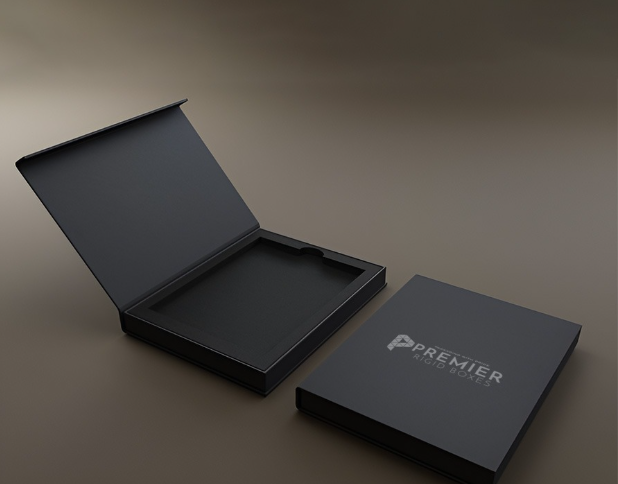
In the realm of quality packaging, a first impression is all you want. Whenever a product is shown to consumers, they make split-second decisions based on what they see, feel, and even hear. booklet rigid box is among the most advanced and efficient packaging solutions nowadays. Sometimes referred to as the “rolling Royce” of folding cartons, this style combines the structural integrity of rigid board with the functional elegance of a lid that opens like a book. The end product is a packaging experience that is not only protective but is actually theatrical to display a product like it is on a pedestal.
Booklet rigid boxes have swept through the luxury industries such as cosmetics, jewelry, electronics, spirits, and premium confectionery. The booklet design has a lid that swings fully on the side, exposing the product in one continuous motion. In contrast to traditional rigid box designs that lift straight off, or magnetic closure box designs that hinge on the back, the booklet design features a lid that swings completely on the side, exposing the product in one continuous motion. This is not a random design. It provides a natural stage on which the product is placed, level and sitting in a custom foam, fabric or plastic tray, with the inside of the lid being used as valuable real estate to brand the product, tell the story or provide more information about the product. Booklet rigid boxes have become a necessary resource to those brands that are interested in differentiating themselves in the overcrowded shelves or unboxing videos posted across social media.
Structural Advantages of the Booklet Style
A box made of thick, heavy-duty paperboard, between 1.5mm and 3mm thick, that is wrapped in decorative paper, art paper, or even silk, is referred to as a rigid box. A booklet rigid box is made out of this durable base with a hinged lid that folds out flat like a hardcover book. It is possible to have this hinge either on the long side or the short side of the box, depending on how the product should be oriented inside the box.
Durability is one of the main advantages of such a structure. Rigid boxes do not change their form during shipping, storage, and repeated in-store handling, unlike standard folding cartons which are capable of crushing or warping. In the case of retailers, it translates to fewer damaged returns and a continually high quality of presentation. To consumers, even the box itself can become a memento a reusable storage container of jewelry, watches, or other valuables long after the initial purchase.
Moreover, the booklet opening enables the display of the product better than almost any other box style. A customer can see the product as soon as he/she lifts the lid, and the product is right in front of him/her. No inner lid to be lifted, no piece of tissue paper to unfold, no awkward angle to peep inside. The whole interior is shown in one view, which is especially useful in products containing multiple parts, like a fountain pen and ink set, a watch with extra straps or a skincare routine with several bottles.
Enhancing the Unboxing Experience
The unboxing experience is now a pivotal marketing experience in the age of e-commerce and social media. Unboxing videos on TikTok, Instagram, and YouTube are watched by millions of people, and a catchy unboxing can become an organic buzz that cannot be purchased with the help of advertising. rigid boxes are designed in such a way that they maximize this moment. The feel of a lid opening with a satisfying resistance, the visual impression of a product surrounded by a custom-cut foam insert, and the tactile delight of high-quality wrapping materials are all elements contributing to a sense experience that feels luxurious and purposeful.
The interior of the lid the book cover section can also be customized by brands with printed messages, magnetic closures, or even small pockets to carry booklets, warranty cards or even thank-you notes. This makes the packaging a communication channel. A perfume line can have the scent description and story behind the perfume printed on the inside of the lid. A technical firm may have quick-start messages directly on the inside surface. A jewelry brand may also incorporate a soft layer that reflects the color of the gemstone within it. Such specifications make a plain box into a brand ambassador.
Applications Across Industries
Although the rigid boxes of booklets started their use in the high-end jewelry and watch cases, their application has increased many times. They are used by electronics brands in high-end headphones, smartwatches and phone accessories due to the rigid structure, which provides excellent protection to fragile components. They have been adapted to limited-edition whiskies and cognacs in the liquor industry, with the box serving to both display and gift the presentation. Curated palettes, gift sets, and holiday collections are packaged in Booklet boxes with mirrors or applicator slots cut into the tray.
Even the pharmaceutical and medical device industries have followed suit, using rigid booklet boxes to house high-value products such as continuous glucose monitors, insulin pens, or luxury nutraceuticals, where patient education information can be printed on the inside of the lid to be easily referred to. This flexibility is based on the capability of the box to be completely customized in size, shape, color, and internal configuration.
Sustainability and Material Choices
With consumers growing increasingly environmentally aware, packaging vendors have reacted by providing booklet rigid boxes made of materials that are responsibly sourced. FSC-certified paperboard, water-based adhesives and recyclable wrapping papers are now standard options. Other manufacturers go to the extent of providing agricultural waste fibers or recycled rigid board without affecting the strength or the appearance. Further measures by the brands to minimize environmental impact is to replace the plastic trays with a molded pulp or recycled foam substitute.
Nevertheless, one may want to mention that rigid boxes are by definition more material-intensive than average folding cartons. This is because of their weight and thickness which imply that they have a greater carbon footprint per unit. The trade-off is that the rigid booklet boxes are much more likely to be re-used and re-purposed by the consumer, and have a longer useful life, and some of that initial impact is offset. As brands that are truly in need of high-end presentation wedding rings, high-end watches, high-end electronics the booklet rigid box can still be one of the most responsible choices as it puts a higher priority on durability and reuse.
Production and Customization Opportunities
Creation of a booklet rigid box has a number of expert procedures. First, the board is rigid and die-cut and creased. It is then covered with a decorated sheet of paper of a printed or laminated sheet. The hinge is made with either paper or cloth tape and the tray is usually made separately then glued into the box. Internal fittings like foam pads covered with velvet, suede or satin are cut using CNC or laser technology to custom cut the perfect cradle of the product.
Various finishes are available in a great variety of finishes. It can be matte or gloss laminated, spot UV coated, embossed, debossed, foil stamped (gold, silver, rose gold, holographic) and soft-touch coated. The wrapping paper can be custom-printed with patterns, logos, or gradients. Even the sides of the hard board may be painted or covered so as to have a smooth appearance. It is this amount of detail that distinguishes booklet box with mass-produced packaging.
Cost and Return on investment
It is impossible to avoid it: the rigid boxes of booklets are costlier than the usual packaging. A bare rigid box could cost between 2to2to5 per unit at scale, whereas a fully customized booklet rigid box with high-grade finishes and foam padding can be in the range of 8to8to20 or more per unit. In the case of small-scale artisanal products, the value of per-unit costs might be even greater. But in the case of brands that are located in the premium or the luxury segment, such an investment can be easily justified. The fact that a product is delivered in a thin or generic box sends a message of low value, despite a product being of high quality. On the other extreme, a product packaged in beautiful booklet rigid box, can have a higher price point, lower the rate of returns and create word of mouth marketing which far overshadows the cost of the packaging.
It has been reported by many brands that, as a result of switching to booklet rigid boxes, their conversion rates on the e-commerce sites increased by 15-25% as a result. These boxes are used in retail settings to avoid damaging shelves and to save on having to constantly stock shelves.
Future of Booklet Rigid Boxes
In the future, the innovation of rigid boxes in booklets will be based on three pillars; smart packaging, modular design and sustainable materials. NFC chips or QR codes can be embedded within the lid to authenticate products or link to user manuals or to trigger an augmented reality experience. Modular designs enable the consumer to re-configure the inside tray to suit various purposes after buying. And new materials, e.g., mycelium-based rigid board or algae-derived coats of the material can be much more environmentally friendly without compromising on durability or beauty.Booklet Rigid Box are not a fad in the mind of any brand serious about product display, customer experience and shelf impact. They make packaging more a permanent aspect of the product identity, rather than merely a disposable need. That change can be the difference between success and failure in a competitive marketplace where attention spans are short and expectations are high.



More Stories
University Finance Clubs in Argentina Often Begin With a Shared MetaTrader 4 Download Session
Why Service Area Details Are So Hard to Find on Bin Cleaning Sites
How Rain and Heat Shape Company Events in South Louisiana