

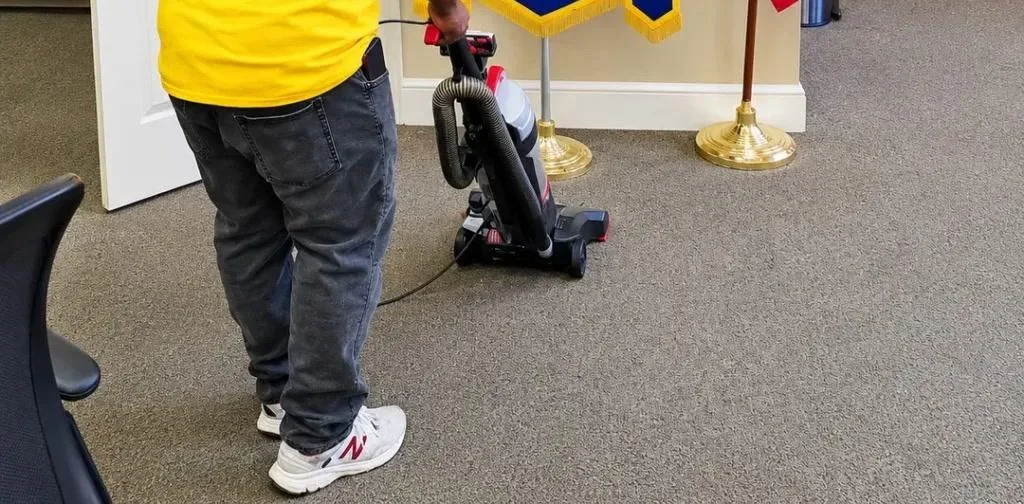
Rain in Baton Rouge is usually discussed in inches. Annual totals, storm totals, and flood stages get the headlines.
For anyone who looks after a building, a different number matters more. It is how many days a year people walk in from wet pavement, and federal climate data puts that figure well above 100.
What the Climate Normals Count
Every ten years, NOAA’s National Centers for Environmental Information publishes official climate averages for weather stations across the country. The current set, the 1991 to 2020 U.S. Climate Normals, is calculated over a uniform 30-year period and covers almost 15,000 stations.
For Baton Rouge, the reference station is at the city’s airport, listed by NOAA as Baton Rouge Ryan Airport. Its normal annual precipitation is 61.94 inches.
The normals also count days. NOAA reports the average number of days each year with at least 0.01 inch of precipitation, at least 0.10 inch, and at least 1 inch.
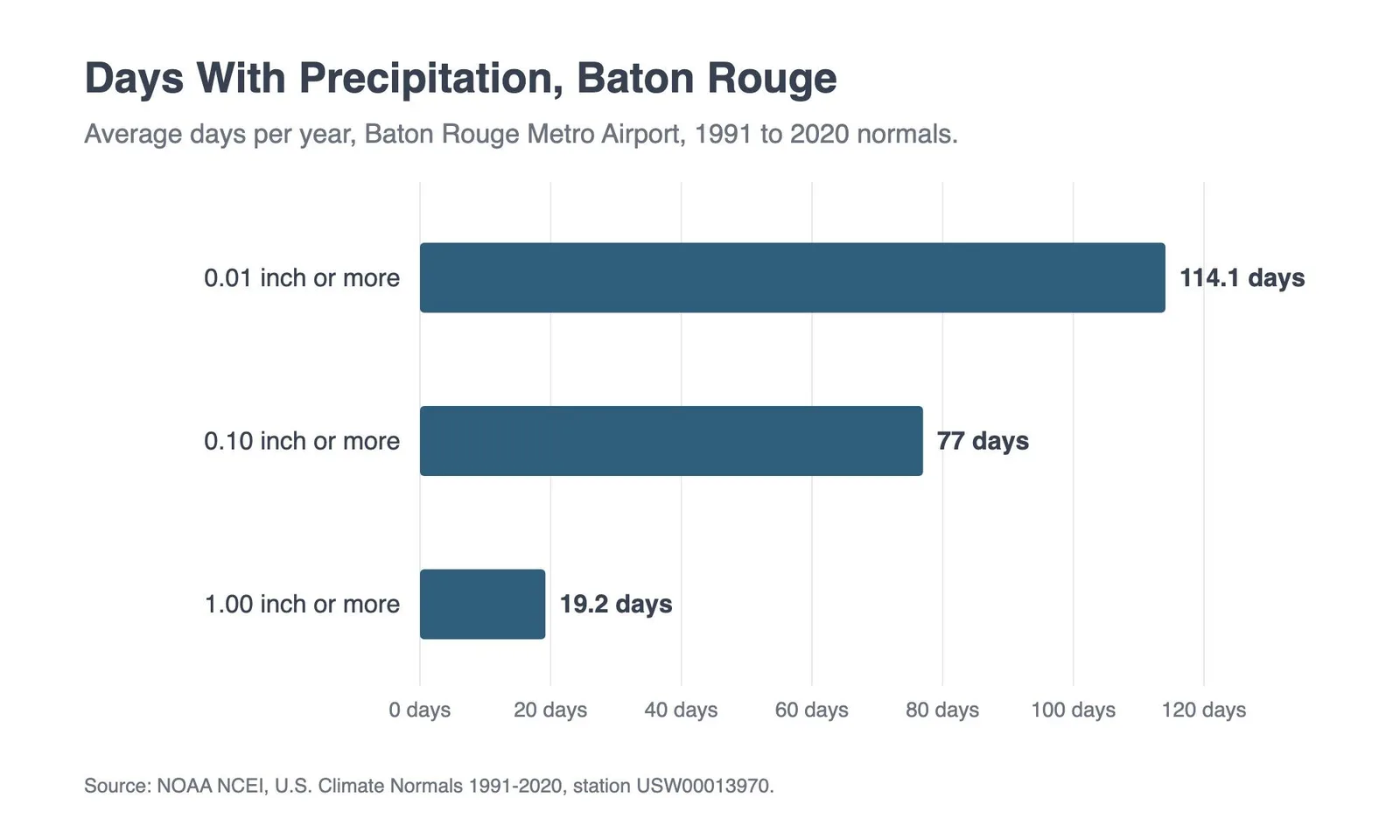
Average days with precipitation per year, Baton Rouge, 1991 to 2020 normals.
The station averages 114.1 days a year with measurable precipitation. That is about 31% of the year by our arithmetic, or roughly one day in three.
It averages 77.0 days with a tenth of an inch or more, and 19.2 days with an inch or more. Those heavier days are the ones people remember, but the lighter ones still leave sidewalks, parking lots, and shoes wet.
Summer Brings the Most Wet Days
The calendar matters too. Wet days are not spread evenly across the year in Baton Rouge.
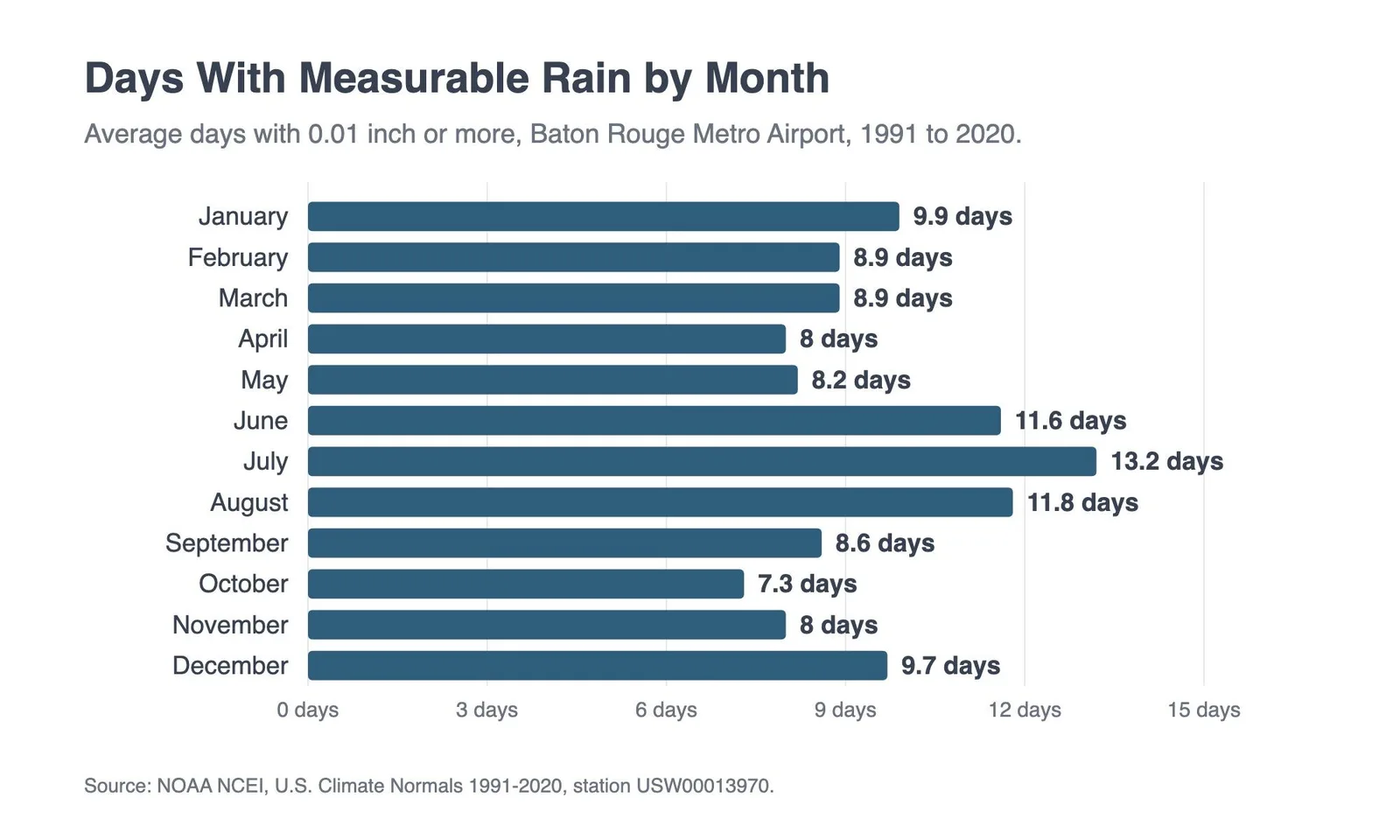
Average days with measurable rain by month, Baton Rouge, 1991 to 2020.
July leads with 13.2 days of measurable rain, about two days in five. June averages 11.6 and August 11.8, so the three summer months together average 36.6 wet days.
October is the driest month by this measure, at 7.3 days. Even so, no month in the normals drops below seven wet days.
Monthly totals tell a slightly different story. June has the highest normal rainfall at 6.45 inches, followed closely by August at 6.37 and January at 6.36. November has the lowest, at 3.90 inches.
These are long-term averages for one airport station. A given year, or a given neighborhood across the parish, can run wetter or drier. As a guide to how often a building’s doors see wet shoes, they are a reasonable stand-in.
Where Tracked-In Soil Ends Up
Federal indoor air guidance has a lot to say about what happens at the door. The EPA’s Indoor Air Quality Design Tools for Schools says entry mat systems are critical in trapping soil, pollutants, and moisture that would otherwise spread into and throughout a building.
The same page cites the International Sanitary Supply Association, which reports that most of the dirt in a building is tracked in on people’s shoes. It adds that 85% of that can be removed if entry mats are properly designed and maintained.
The EPA lists what tends to happen without an entry mat system. Entrances and lobbies can quickly become unsightly. Dirt spreads to larger areas and raises maintenance costs. Moisture tracked onto hard floors can increase the chance of injuries and can reduce the life of carpet.
The guidance is written for school design, but the mechanics are the same at an office lobby, a church foyer, or a clinic waiting room.
What the EPA Says About Rainy Climates
The EPA guidance does not treat every climate the same. It says the right mix of mats depends on climate and location, and that a rainy location may need more absorption mat.
It describes a three-part system. A scraper mat at least 6 feet long sits outside the doors. An absorption mat at least 6 feet long sits just inside. A finishing mat at least 8 feet long follows it.
Together, the EPA says the system should be at least 20 feet long and as wide as the entry doors. It also notes that daily cleaning of the mats will be required.
Few existing buildings have that much room at the door. The guidance is still useful as a reference point, because it shows how much walking it takes before shoes stop carrying soil and water inside.
Carpet Holds What Gets Past the Door
Carpet is where much of the remaining soil settles. The EPA describes carpet as a reservoir for dust, dirt, pollen, and other materials brought in from outside.
It notes that inadequate maintenance can allow large quantities of dust and debris to build up. Its recommended care is regular vacuuming plus periodic wet extraction cleaning.
In practice, that soil is not spread evenly. It concentrates along the paths people walk most, starting at the entrance and running down main hallways.
Who Handles the Deep Cleaning
Many facilities handle vacuuming with their own staff and bring in an outside company for periodic deep cleaning.
In the Baton Rouge area, Divine Cleaning and Janitorial is one company that describes commercial carpet cleaning in Baton Rouge on its website. It lists hot water extraction to remove embedded dirt and refresh high-traffic areas, with extra attention to entrances, hallways and busy walkways.
The company says it works with offices, schools, places of worship, commercial properties and other facilities throughout Baton Rouge and South Louisiana. It schedules work around a facility’s hours and offers one-time or recurring service.
A Simple Check for Facility Managers
None of this calls for a new program. It mostly means treating the entrance as the start of the carpet plan.
A few questions can help any Baton Rouge building:
- How far do people walk on matting before they reach carpet?
- Are the mats cleaned often enough to keep holding soil and water?
- Do the entrance, the main hallway, and other busy walkways get more attention than low-traffic rooms?
- Is carpet care planned around the summer months, when wet days peak?
With measurable rain on about one day in three, the front door does a lot of the work in a Baton Rouge building. The data suggests it deserves a place in the cleaning plan.



More Stories
1. How did Blaze PR get started, and what brought you into the firm?
Here are the answers to your questions. The respondent is Donny Bradley,
1. How did Blue Mint Thai get started, and what inspired the restaurant?