

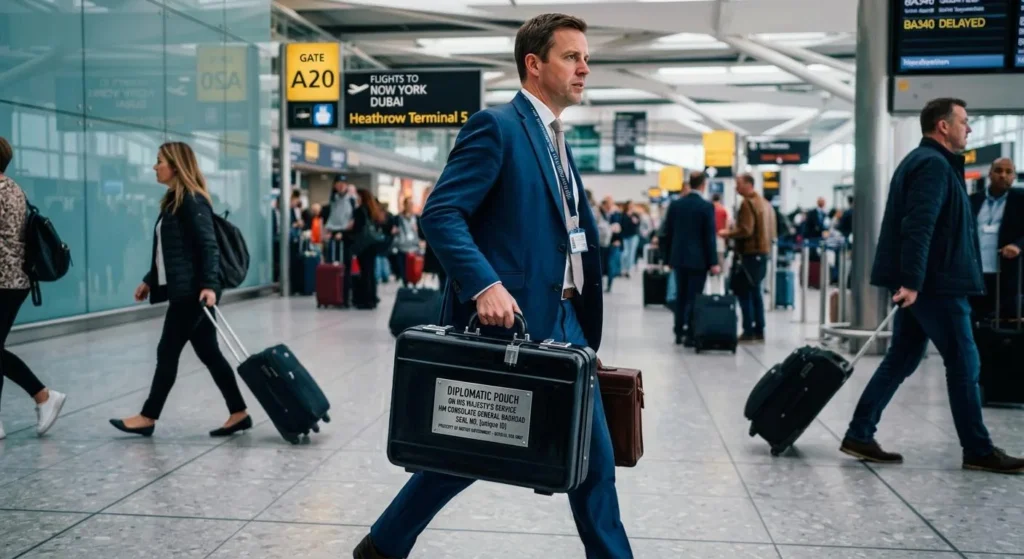
Honorary consul privileges protect legitimate government communications, but the Vienna Convention includes safeguards against misuse, while the “Shadow Diplomats” investigation exposed allegations involving contraband, misleading immunity claims and failures of oversight across the honorary consular system.
WASHINGTON, D.C., October 10, 2026. Consular bag protections can complicate border enforcement, but calling them an unrestricted smuggling loophole overlooks treaty provisions that limit permitted contents, let authorities challenge suspicious shipments, and distinguish official communications from an honorary consul’s private possessions.
The central legal distinction concerns Article 35 of the Vienna Convention on Consular Relations, which protects consular communications while expressly providing a procedure for responding when authorities have serious reason to believe a consular bag contains unauthorized material.
Article 62 addresses a separate issue, granting customs exemptions for specified supplies intended for the official use of an honorary consular post, rather than creating a general exemption for any package associated with its head.
Together, these provisions protect public functions while leaving governments with a difficult enforcement question: how to preserve confidential international communications without allowing officials or private intermediaries to misuse the credibility attached to consular office.
Article 35 Protects Communications but Includes a Safeguard
The Vienna Convention on Consular Relations establishes that official consular correspondence is inviolable and that a consular bag ordinarily must remain unopened and undeterred, protecting communications between a consular post and the government it represents.
However, Article 35 also provides that competent authorities with serious reason to suspect unauthorized contents may request that an authorized representative of the sending state open the bag in their presence, rather than treating its claimed status as conclusive.
If the sending state’s authorities refuse that request, the treaty requires the bag to be returned to its place of origin, meaning refusal does not create an entitlement to continue transporting a suspicious consignment into the receiving country.
This procedure qualifies the claim that customs officials must always allow a verified consular bag through, although it does not give border officers an unrestricted power to open protected communications whenever they choose to do so.
The provision therefore creates a controlled response to suspicion, preserving the sending state’s role in handling its communications while giving the receiving state a means to prevent a disputed shipment from completing its intended entry.
Article 62 Provides a Narrow Customs Exemption
Article 62 covers articles supplied by, or at the instance of, the sending state for the official use of a consular post headed by an honorary officer, including flags, seals, official printed material, and office equipment.
Its listed categories also include coats of arms, signboards, stamps, books, and office furniture, with the exemption aimed at equipping and operating the post rather than facilitating the honorary consul’s private trade or personal financial affairs.
The treaty excludes charges for storage, transportation and similar services from that exemption, reinforcing the distinction between relief from specified customs charges and a general right to move goods without administrative requirements or associated service costs.
A shipment’s eligibility for customs relief and its treatment as a consular bag are therefore separate legal questions, even when both arise during the same border crossing or involve materials intended for the same consular office.
Private gold holdings, commercial diamonds, or criminal proceeds do not become qualifying office supplies merely because an honorary consul owns them, accompanies them, or claims their movement reflects a broadly described relationship with a foreign government.
Article 58 Connects the Rules to Honorary Consulates
Article 58 is essential to understanding this framework because it expressly applies Article 35 to consular posts headed by honorary officers, while separately identifying the provisions governing those posts and the individuals who lead them.
That structure prevents the assumption that an honorary consul automatically receives every privilege available to a career consular officer, since the convention deliberately assigns different protections to different categories of officials and their respective consular establishments.
Article 58 also imposes a specific restriction on exchanges of consular bags between two posts headed by honorary officers in different countries, requiring consent from both receiving states before that exchange may take place.
The restriction shows that the convention does not create an unrestricted international delivery network for honorary consuls, although the practical effectiveness of its safeguards depends on governments recognizing the applicable rules and applying them consistently.
An appointment, an official consignment, and permission for a particular exchange must therefore be assessed within their own legal contexts, rather than treated as a single assumption that everything associated with a consulate enjoys identical protection.
What the “Shadow Diplomats” Investigation Established
Published in November 2022, the “Shadow Diplomats” investigation by ICIJ and ProPublica identified at least 500 current or former honorary consuls accused of wrongdoing or embroiled in controversy, including allegations, convictions, and other publicly documented disputes.
The reporting described allegations of cash and contraband concealed in consular offices or pouches, as well as cases in which officials invoked diplomatic credentials or exaggerated immunity claims to resist searches, arrests, or other forms of scrutiny.
One example concerned former honorary consul Ladislav Otakar Skakal, whom the investigation reported had been convicted in absentia in Egypt of attempting to smuggle more than 21,000 antiquities in a diplomatic container, including funerary objects.
These findings support scrutiny of consular privileges and their administration, but they do not establish that every controversial consul used a protected bag, or that all shipments described in reporting had identical legal status under the convention.
Nor does evidence of an official’s alleged misuse establish that the appointing government authorized the criminal conduct, a distinction that matters when evaluating whether an incident involved personal wrongdoing, official complicity, or failures of supervision.
A Consular Label Does Not Legalize Private Cargo
Article 35 limits consular bag contents to official correspondence, documents, and articles intended exclusively for official use, making the contents’ purpose central to the protection rather than leaving the matter entirely to the sender’s description.
The requirement for visible external markings identifies the consignment’s claimed character, but it does not convert a false description into legal authority or make prohibited private cargo an authorized part of a consular post’s work.
Calling a shipment official correspondence therefore cannot settle every question about its treatment, particularly when competent authorities have serious grounds to suspect that the contents fall outside the categories the treaty permits within a consular bag.
At the same time, authorities must address suspicion through the applicable legal process, since the possibility of misuse does not erase protections for genuine government correspondence or let authorities disregard international obligations without further analysis.
This distinction focuses on the shipment’s legal character and the conduct involved, rather than treating either an official label or a customs officer’s initial concern as sufficient to resolve the entire dispute.
Personal Baggage Remains a Separate Legal Category
An honorary consul’s personal suitcase does not receive the consular bag’s protection simply because its owner holds an appointment, and the convention’s honorary consul framework does not generally extend the career consular baggage exemption to that individual.
Career consular officers have different baggage provisions under Article 50, but those provisions allow inspection where serious grounds exist, including suspicion of prohibited articles, provided the inspection occurs in the relevant person’s presence.
Diplomatic agents fall under another treaty framework that also distinguishes official diplomatic bags from personal baggage, so broad statements that every diplomat’s belongings are completely immune from examination are legally misleading and potentially consequential for travelers.
For an honorary consul, the critical distinction is between personal possessions and legitimate official communications, and applicable agreements and recognized status require examination before anyone can accurately describe the protections available in a particular situation.
Claims that private luggage becomes untouchable through a change in description confuse the rules governing protected communications with those governing travelers, obscuring the boundaries authorities and consular officers must preserve.
A Diplomatic Passport Does Not Decide the Question
The term diplomatic passport often appears alongside discussions of honorary consul appointments, but a travel document alone does not determine whether its holder enjoys diplomatic immunity or whether a particular consignment qualifies as an official bag.
Those questions depend on recognized status, the applicable international framework, and the function being performed, making the passport’s description an inadequate substitute for examining the actual legal basis asserted for a privilege at the border.
Likewise, obtaining another nationality or making a lawful change of name does not create consular authority, because personal identity documentation and a government’s appointment of an accepted representative concern different legal relationships and different official responsibilities.
Readers reviewing Amicus International Consulting’s information about new identity services should distinguish those subjects from consular privileges, whose scope must be established through the applicable government recognition and legal framework rather than inferred from a private service description.
The same distinction matters for anyone researching a diplomatic appointment as a route to easier travel, since the relevant question is what a government has actually authorized and another government recognizes, rather than what an intermediary promises.
Honorary Consuls Can Face Criminal Proceedings
Article 63 expressly anticipates criminal proceedings against honorary consular officers and requires them to appear before competent authorities, while also requiring respect for their position and procedures that avoid unnecessarily obstructing legitimate consular functions.
The article also contemplates arrest or detention, contradicting any suggestion that honorary consul status generally bars prosecution when an individual invokes the prestige or official responsibilities associated with the appointment.
Immunity for acts performed in the exercise of consular functions remains a separate issue under the convention, but a claim that private smuggling constitutes an official function requires legal examination rather than automatic acceptance.
Protecting a particular communication also does not necessarily protect its sender from every investigation, because the legal status of a shipment, the admissibility of evidence and an individual’s responsibility for alleged conduct are distinct questions.
Accordingly, discovering suspected abuse may trigger several proceedings or diplomatic responses, depending on the evidence, the individual’s recognized status, and the laws and international obligations applicable to the countries involved.
The Enforcement Problem Extends Beyond the Bag
The treaty’s structure suggests that effective oversight must distinguish legitimate official activity from private business interests, particularly when an honorary consul continues a commercial career while also performing limited functions for a foreign government.
For policymakers, that distinction supports clearer appointment records, defined responsibilities and reliable communication between foreign ministries and enforcement agencies, so that uncertainty over an individual’s status does not become an avoidable obstacle to lawful decisions.
Oversight also requires restraint in the opposite direction, because treating every honorary consul as suspicious would undermine legitimate services and confuse documented misconduct by particular individuals with the legal role performed by the wider consular community.
The practical challenge is to identify misuse without turning protected communications into ordinary commercial cargo, while ensuring that respect for a consular office does not become an unwritten exemption from accountability.
That balance follows from the convention itself, which combines communication protections with restrictions on contents, a procedure for suspicious bags and provisions addressing criminal proceedings against honorary officers whose conduct falls outside protected official functions.
Anonymous Travel Claims Require Clear Legal Boundaries
For readers exploring Amicus International Consulting’s anonymous travel information, the consular bag debate illustrates why privacy terminology should be separated from claims of official privilege, since discretion in personal affairs does not establish a treaty exemption at an international border.
Similarly, living anonymously or changing one’s lawful identity does not authorize false customs declarations, transform private merchandise into government correspondence, or resolve criminal responsibility arising from conduct unrelated to a legitimate consular function.
For someone facing an unresolved criminal matter, an honorary appointment should not be understood as a mechanism that extinguishes the case, particularly when the convention expressly recognizes proceedings against honorary officers and limits immunity to qualifying official acts.
Governments assessing suspected bag abuse must therefore examine the applicable protection and the alleged conduct together, using the treaty’s safeguards while preserving the confidentiality necessary for legitimate consular work and the accountability required when official status is misused.



More Stories
What Happens When a Passport Application Raises Fraud Concerns?
Extreme Summer Heat Is Putting U.S. Roads, Cars and Drivers Under Greater Strain
Koby Evans Faces Charges After Indictment Alleges He Helped Funnel Patients to Leigh Tesar for Medicare Billing