

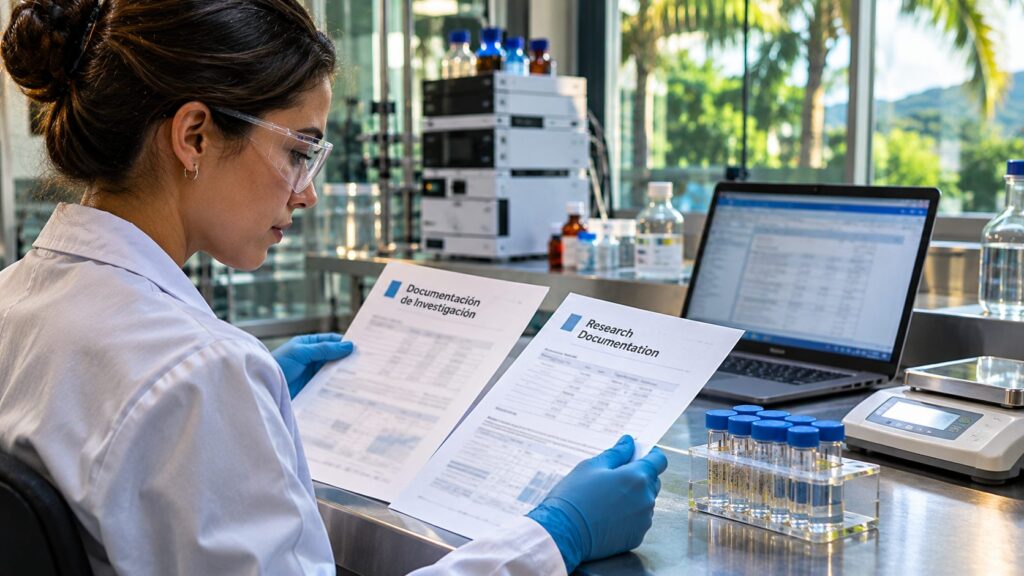
A research laboratory can receive the material it ordered and still face a serious procurement problem. The supplier’s website may list the correct compound, the invoice may show the expected quantity, and the delivery may arrive on schedule. Yet the supporting documents can tell a less consistent story. A product description appears in English, the invoice uses Spanish terminology, and the certificate supplied with the shipment contains a laboratory identifier that nobody can connect confidently to the order.
In international scientific procurement, these discrepancies are not merely translation problems. They can affect the identification of materials, the interpretation of analytical records, and the ability to reconstruct what was received. For small laboratories, research organizations, and specialized distributors, unclear documentation also consumes time that could otherwise be devoted to scientific work.
Costa Rica provides a useful setting for examining these issues because research suppliers may communicate with Spanish-speaking local customers while using technical documents prepared by laboratories, manufacturers, or distributors elsewhere. The same substance may appear under different naming conventions across catalogs, invoices, sample records, and analytical reports.
The business challenge is therefore not simply to offer information in two languages. It is to ensure that both versions refer to the same material, the same specifications, and the same evidence.
The Product Name Matched, but the Documentation Did Not
Consider a hypothetical research organization purchasing an analytical reference material from a regional supplier. Its procurement team submits an order using the English compound name. The supplier confirms the order through a Spanish-language invoice, and the material arrives with a certificate of analysis prepared by an external laboratory.
The shipment appears complete until a researcher compares the documents. The invoice contains a shortened product description, the container has a lot number absent from the purchase record, and the analytical certificate uses an internal sample code. The certificate may genuinely correspond to the shipment, but the available paperwork does not yet demonstrate that connection.
Translation alone cannot resolve the discrepancy. The problem involves the relationship between identifiers, records, and physical material.
Reliable procurement documentation should make it possible to establish what was ordered, what was delivered, which batch or lot was supplied, and what analytical information applies to that material. A laboratory should not need to guess whether two similar names identify the same chemical substance.
This is especially important for peptide research materials, where related compounds may have different sequences, modifications, counterions, or analytical characteristics. Similar names do not establish equivalence, and a generic product description cannot replace an appropriate identity record.
Why Technical Translation Requires More Than Fluent Vocabulary
A fluent translation can still be scientifically misleading. The meaning of a technical term depends on the measurement, procedure, or material it describes.
Words associated with purity, content, concentration, identity, stability, and analytical verification are particularly sensitive to context. A Spanish-language document might correctly translate the word for purity while leaving unclear how the original laboratory determined the reported percentage.
Likewise, a product page may describe a material’s stated quantity without explaining whether the figure refers to the contents of the container, the concentration in a prepared analytical sample, or a value calculated through a particular measurement method.
These are not interchangeable measurements.
Businesses operating in two languages should therefore preserve technical meaning rather than merely translating sentences. When a supplier publishes an English specification and a Spanish description, the two versions should agree on the material identity, stated specifications, units, and applicable limitations.
Ambiguity should be resolved against the original validated source record instead of through an improvised translation. Where a document comes from an independent laboratory, the supplier should avoid presenting a translated summary as though it were the laboratory’s original signed report.
Lot Numbers Form the Backbone of Scientific Procurement Records
One of the simplest ways to connect procurement information is through a consistent lot or batch identifier. A lot number can connect a supplier’s catalog, receiving documentation, container label, and available analytical evidence.
However, lot numbers are useful only when the relationship is accurate. A supplier’s internal stock-keeping unit may identify a product type rather than a specific batch. An external laboratory’s sample code may identify the individual material submitted for testing. These identifiers serve different purposes.
The Organisation for Economic Co-operation and Development addressed related concerns in its 2018 guidance, Management, Characterisation and Use of Test Items used in GLP Studies. The document explains expectations for the transportation, receipt, identification, labeling, characterization, storage, and archiving of test items in studies conducted under Good Laboratory Practice principles.
Not every commercial research transaction is legally subject to those GLP requirements. Nevertheless, the guidance illustrates why documented identification and material history matter in structured scientific work.
A bilingual procurement record should preserve the original lot identifier exactly. Product descriptions can be translated, but identifiers should not be casually rewritten or replaced with translated equivalents that obscure their source.
Why Costa Rican Research Suppliers Need Consistent Public Information
For a regional research-material supplier, an accessible website often serves several purposes. It may introduce the business, identify product categories, describe available documents, and provide a channel for technical questions.
Those functions become more complicated when prospective customers use different languages. An English-speaking researcher might examine a company overview while a local purchasing employee relies on a Spanish contact page or invoice.
For example, the English research-material supplier information in Costa Rica published by Peptides Costa Rica describes the company’s stated approach to product information, documentation availability, and direct communication. Such information helps explain the services a business claims to offer, but it is not a substitute for reviewing actual analytical records or verifying the legality of a proposed transaction.
The distinction matters because public descriptions and scientific evidence answer different questions. A website can explain how inquiries are handled, but it cannot establish the quality of an individual lot merely by describing a general commitment to transparency.
Research buyers should evaluate both the stated business process and the specific documentation associated with any material under consideration.
The Certificate of Analysis Is Not a Universal Quality Guarantee
A certificate of analysis may summarize results from one or more laboratory tests. Depending on the material and analytical method, it might include information relating to identity, relative purity, water content, or other characteristics.
The meaning of the results depends on the test performed. A chromatographic purity estimate does not automatically establish absolute material content or prove that every potentially relevant impurity has been detected. Likewise, a document identifying one sample does not necessarily establish that every container in a commercial lot was independently tested.
Researchers should examine the sample identifier, method description, testing date, reported results, and any stated limitations. When relevant, they should also determine whether the testing laboratory’s identity and scope of work can be confirmed.
Translating an analytical certificate can introduce additional uncertainty if the translated document omits units, changes technical names, or presents an abbreviated explanation that overstates what the test demonstrated.
A responsible translation should retain the original numerical values, identifiers, and methodological context. Any explanatory summary should be distinguishable from the source report.
Documentation transparency is not the same as a declaration that a material is appropriate for human use. Analytical reports concerning research materials do not independently demonstrate clinical safety or effectiveness.
What Happens When the English and Spanish Catalogs Disagree?
Catalog discrepancies can occur without anyone deliberately providing false information. One language version may be updated before another, a product may be renamed, or an availability notice may remain visible after inventory changes.
For a procurement team, these differences can create practical uncertainty. Which description is current? Does a particular specification apply to both listings? Has the supplier changed the product, or only its presentation?
A useful information-management process assigns a common product identifier to every language version. It also records when significant specifications were revised and identifies which source document controls the underlying scientific details.
Where a product is no longer available, both language versions should accurately reflect that status. The same principle applies to discontinued materials or updated documentation.
However, a website’s stock status remains a supplier statement, not an independently verified inventory count. A buyer requiring current availability should obtain confirmation through the supplier’s stated communication process.
The objective is not to eliminate every translation difference. It is to prevent a language difference from changing the material identity, transaction requirements, or scientific interpretation.
A Contact Page Can Be Part of the Documentation System
Procurement records often depend on information that is not published in a general product listing. A buyer may need to ask whether a particular certificate corresponds to the available lot, whether revised documentation exists, or which specifications apply to a specific shipment.
These questions require a communication channel that directs inquiries to someone able to provide accurate information. A generic response promising quality is less useful than a specific answer identifying which records are available and what remains unconfirmed.
Peptides Costa Rica publishes a Spanish-language contact page addressing questions about research documentation and local availability. The page describes inquiries concerning product information and documentation. Researchers should still verify the identity of the responding organization and the accuracy of any documents supplied.
This verification is particularly important when a website’s contact details reference another domain or associated business. A shared email address may have a legitimate explanation, but the relationship should be confirmed rather than assumed.
Good procurement communication creates a record of what was requested, what the supplier confirmed, and which documents were provided. That correspondence can help resolve later discrepancies between an order and the received material.
Digital Records Help Only When Their Connections Are Preserved
Scientific procurement may involve purchasing software, supplier databases, email correspondence, inventory systems, and laboratory instrument files. Each system can hold a different part of the transaction.
A digital certificate stored in one folder may not automatically connect to the purchase order or the physical container. If staff members rely on product names alone, similar materials can become difficult to distinguish.
The OECD’s 2021 GLP Data Integrity advisory discusses data as including original records, verified copies, metadata, and transformations necessary to reconstruct and evaluate relevant laboratory activity. Its principles apply specifically within the GLP context, but the underlying recordkeeping questions are useful more broadly.
Researchers need to know where a record came from, whether it has been changed, and which material or activity it describes. A final PDF may communicate the result while leaving important acquisition or processing details outside the document.
A practical document-management process therefore preserves connections between source files, translated summaries, receiving records, and any later corrections.
Version control is important when a supplier replaces an older certificate or corrects a translation. The earlier document should not simply disappear without an understandable record of the change.
The Operational Cost of Ambiguous Documentation
The business consequences of documentation problems extend beyond the purchasing department. A researcher who cannot establish the identity of a received material may need to pause work while a discrepancy is investigated.
Purchasing employees may contact the supplier repeatedly. Quality personnel may compare invoices with container labels. A laboratory may need to determine whether available analytical records apply to the physical material.
These activities consume staff time even when the shipment ultimately proves correct. They can also introduce delay into planned research schedules.
No general cost estimate should be assigned to such delays without supporting data. The financial impact depends on the organization, the work affected, and the time required to resolve the issue.
For smaller suppliers, reducing documentation ambiguity can also improve internal operations. Consistent product identifiers, accurate translated descriptions, and clear inquiry procedures reduce the need to reconstruct information from scattered messages.
Better records do not guarantee a successful research outcome, but they can make procurement decisions more understandable and discrepancies easier to investigate.
Questions to Resolve Before Accepting Research Materials
Research organizations can use a structured document review before accepting a material into their inventory. The appropriate depth depends on the material, the intended experiment, and any applicable regulatory requirements.
- Does the received material have an identifier that matches the purchase and receiving records?
- Are the English and Spanish descriptions consistent about the material’s identity and specifications?
- Is the available analytical document associated with the correct sample or lot?
- Does the report explain which measurements were performed and what their results mean?
- Can the testing organization and the scope of its work be identified?
- Are translated summaries clearly distinguished from original laboratory documents?
- Can the supplier explain discrepancies without changing historical records silently?
- Are current availability and requested documentation confirmed through a reliable communication channel?
- Have the material’s intended research use and applicable legal restrictions been assessed separately from its analytical specifications?
These questions do not replace qualified scientific review. They help ensure that procurement staff, laboratory personnel, and suppliers are discussing the same material and the same supporting evidence.
A Bilingual Website Must Still Have One Scientific Record
Publishing information in English and Spanish can make a research supplier more accessible. It can also create additional responsibilities when technical details change.
The most dependable system treats each language as a way of communicating a common underlying record. Product identifiers, lot numbers, measured results, and relevant specifications remain consistent even when explanatory wording differs.
For regulated studies, the OECD’s Good Laboratory Practice guidance offers a framework for understanding the importance of test-item identification and records. For other research organizations, similar document-control principles can help reduce avoidable uncertainty without implying that every transaction falls under GLP regulation.
Scientific procurement is not complete merely because the correct item appears to have arrived. The organization also needs enough reliable information to establish what it received, which evidence supports its identification, and what questions remain unanswered.
When documentation is consistent across languages and systems, researchers can spend less time reconciling conflicting descriptions and more time evaluating the actual scientific work. The strongest supplier communication is not the most persuasive translation. It is the one that preserves the meaning and limitations of the original evidence.



More Stories
The Peptide Experiment Worked Once, but the Second Laboratory Could Not Repeat It: How Missing Controls, Hidden Data and Research Design Shape Scientific Confidence
Future Leaders: Alex Schafirovitch and Dylan Goodrich Build Unresourced at the Intersection of Celebrity Influence, Social, Content and Commerce
What Tech Brands Actually Look For in Creators, According to Marketing Agency Owner Luciano Galvez