

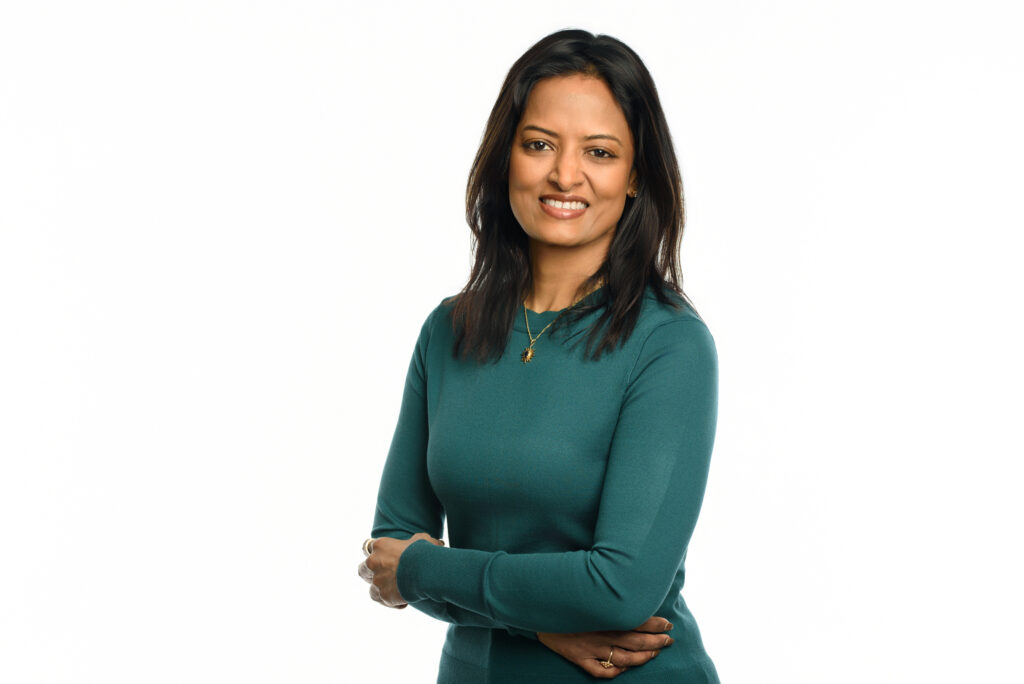
Maganthy Rajagopalan remembers exactly where she was standing when her first layoff hit. But the physical location didn’t matter—what mattered was the internal free fall that followed. On the surface, it looked like a standard professional setback. Underneath, she was confronting a question she wasn’t prepared to answer: “Who am I now?”
The cost wasn’t just a lost paycheck or a line on her resume. It was the sudden disappearance of the framework she had unknowingly used to define herself. Her identity had been built on something external—and it turned out that foundation was temporary.
“I had tied my identity and confidence to my job title without realizing it,” Rajagopalan says. “So when that disappeared, the question wasn’t just ‘what’s next?’—it was ‘who am I now?’ And I wasn’t prepared for that.”
That moment became the catalyst for a different way of thinking about confidence, identity, and professional resilience—one that Rajagopalan now shares with the high-achieving professionals she works with, many of whom are navigating the same unstable ground she once stood on.
The Problem With Chasing the Next Title
Rajagopalan sees the same pattern repeatedly in her work: people tie their identity to their job titles without even realizing it. Over time, promotions, recognition, and progress reinforce that connection. Until disruption comes—whether it’s a layoff, a restructure, or even just the anticipation of one. It doesn’t feel like a professional challenge. It feels personal. Worth gets questioned. Confidence collapses. Decisions become driven by fear.
The instinct is to get back into another role as quickly as possible. And while that’s necessary, it misses the deeper problem. If someone’s identity remains tied to their next title, they’re just resetting the same fragile system. The cycle repeats with the next disruption.
“What’s often missing is the internal rebuild,” Rajagopalan explains. “Recognizing what got someone to their success in the first place still exists within them. Until that shift happens, confidence remains dependent on something external—and therefore fragile.”
Looking Inward for Evidence
Rajagopalan’s own rebuild didn’t come from landing another role. It came from a realization: everything that had taken her to her career highs had come from within her. She began testing that intentionally—summiting Mount Kilimanjaro, stepping into costume design, following instinct rather than certainty. Each challenge reinforced the same insight: the persistence, adaptability, and ability to navigate uncertainty were still present, regardless of title.
That recognition led to a simple shift in how she approached uncertainty.
Instead of asking, What do I need next? the question became, What have I already proven I can do?
That shift evolved into a framework she now uses with others. It starts by asking people to recall a meaningful success—not just the outcome, but the experience itself. From there, the focus moves to identifying the most uncertain or difficult moment within that experience. “That’s where the real insight lives,” she says.
Recognizing what in them helped them navigate that moment—whether it was persistence, creativity, adaptability, or courage. “Those abilities are often overlooked because we focus on the result, not the process.”
When identity begins to anchor in those abilities, confidence becomes more stable—grounded in lived experience instead of roles that can change.
When Watching Layoffs Becomes Its Own Crisis
Rajagopalan has seen that disruption doesn’t have to happen directly to have an impact.
She recalls a colleague who had lived through multiple rounds of layoffs around them without being directly affected. Still, the experience created anxiety. “They said, ‘If this happens to me, I don’t know what I’ll do. I don’t have the confidence that I’ll be able to get a similar job again,'” Rajagopalan remembers.
They both sat down and walked through the colleague’s career—not focusing on titles and promotions, but on the challenges they had already navigated. In doing so, the colleague began to recognize the persistence, adaptability, and creative abilities that had carried them forward.
“The job and title were never permanent—but what got them there still existed in them,” Rajagopalan says.
That shift changed how they approached uncertainty. The fear didn’t disappear—but it no longer translated into self-doubt.
Rajagopalan saw the same change in her own experience over time. When subsequent layoffs came, they were still difficult—but they no longer shook her sense of who she was.
Why This Matters Beyond the Individual
Rajagopalan sees this shift as more than a personal resilience strategy. It changes how people operate under pressure —and that has ripple effects.
“Earlier,many of my decisions were influenced by wanting to succeed within a system I didn’t actually control,” she says. “There was an underlying need to prove myself, to hold on to what I had built, and to be seen a certain way.”
When she stopped tying her identity to her title, her decision-making changed. She became more selective about what she took on, less driven by the need to please or hold on at all costs, and more willing to step into uncertainty when it felt right.
That shift shows up first at home. She reminds her kids to never forget the abilities that got them to where they are—because those abilities are what will take them forward, not their current roles. The same groundedness carries into her work. She makes clearer decisions and operates from a different kind of pressure.
“This is how change grows—starting with how I think and act, then how I show up at home, and then in the teams I’m part of,” she says.
Know Who You Are Before Disruption Forces You To
Rajagopalan’s message is both simple and urgent: titles will come and go. And in today’s world, they’re changing faster than ever. When confidence is built on something unstable, it’s only a matter of time before it shakes.
She wants people to take one meaningful success and ask themselves: What in me made that possible? Name the ability or abilities that made it possible.
“When you root your identity in the abilities you’ve used to navigate and overcome challenges, you build a kind of confidence that stays—even when everything around you doesn’t,” she says.
The job market has shifted. Roles have become more volatile. Stability is no longer guaranteed but many people are still building their identity as if it is and the cycle of doubt keeps repeating.
Rajagopalan’s work is about breaking that cycle before the next disruption forces the question. Because the answer to “who am I?” should never depend on what’s printed on a business card.




More Stories
137 Founders Later: What Sonia Couto Learned About Building Companies the Hard Way
Cameras Roll on Kurty’s Cookies as Sky II Productions Films Austin’s Twin-Brother Cookie Business
Spakinect’s Clinical Standards: How Med Spas Stay Audit-Ready