

We live in a world where almost everything is “one-click.” You order a meal, a car, or a coat, and it arrives exactly as the factory intended.
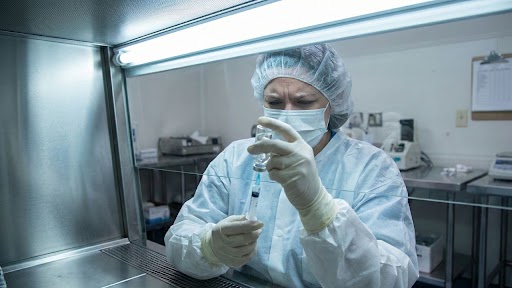
But in the back of a hospital, there is a small, pressurized room where “factory-made” isn’t enough. Sometimes, a patient needs a precise dose of a certain drug mixed into an IV saline bag, prepared entirely by hand.
This is the world of Sterile Compounding. It is one of the most technically demanding paths you can take when looking intoonline pharmacy technician courses. You aren’t just a retail clerk; you are essentially a precision manufacturer operating in a pressurized, filtered airflow.
Gowning and Sterilization Steps
Before you even touch a bottle of medicine, you have to “gown up.” This isn’t just putting on a coat. It is a strict, step-by-step ritual designed to remove the biggest threat to a patient: you.
Humans are dirty. We shed thousands of skin cells and bacteria every minute. To enter the Clean Room, you start at the “dirty” side of a line on the floor. You put on shoe covers, then a hair cover, then a mask. You scrub your hands and forearms for a full 30 seconds—getting under every nail—before pulling on sterile gloves.
What this means is that by the time you start your shift, you are a walking barrier. You have neutralized your own biology so that the medicine stays pure.
How to Use a Laminar Flow Hood
Once inside, the most important tool isn’t a computer; it’s the Laminar Flow Hood.
Imagine a large metal desk with a back wall made of a giant filter. This filter blows a constant, gentle stream of “HEPA-clean” air toward you.
The physics here are interesting, as you have to learn the “Six-Inch Rule,” in which you never perform a task within six inches of the edge of the hood. This is because the clean air hits the room air at the opening. This creates turbulence that pulls outside particles onto the bench.
And you never block the “First Air.” If you put your hand between the filter and the needle, the air that hits the needle is now “dirty” because it touched your glove first.
You have to learn to move your hands, always keeping the critical sites of the syringe in the direct path of the breeze. This is a skill you only get from a high-quality online pharmacy technician school.
Compounding Math and Calculations
Precision is mandatory when it comes to the numbers. If your math is off even by a decimal point, the medication becomes a poison instead of a cure.
In a retail pharmacy, you might count 30 pills, but in a compounding lab, you are calculating Milliequivalents (mEq) and Microliters.
When you are dosing for a premature infant, the total volume of the drug might be smaller than a single drop of water. At that scale, there is no margin for error; the calculation has to be perfect before the needle ever touches the vial.
You are the final checkpoint. You are calculating the displacement of a powder when a liquid is added. You are checking the “tonicity” of a solution to make sure it won’t damage a patient’s veins.
Yet it’s the dream job for the technician who prefers a rigid, step-by-step process demanding 100% accuracy every time.
A Different Kind of Pharmacy
At the end of the shift, you see the pass-through window. The IV bag slides into the pass-through. And, you lock the door. That is the hand-off. You move back to the anteroom to peel off the layers—first the gloves, then the tape, then the gown.
You cross the line on the floor back to the “dirty” side.
Once you are back in the hallway, the bag is already moving toward a patient. It is a high-pressure job, but you can walk away knowing the dose is correct.
FAQs
1. What is USP <797> and why does it matter for sterile compounding?
USP <797> sets U.S. standards for sterile compounding to prevent contamination, ensuring patient safety in IV preparations.
2. How long should hand hygiene take before gowning?
Hand hygiene before gowning requires 30-60 seconds of vigorous scrubbing under nails with antimicrobial soap
3. Why follow the Six-Inch Rule in a laminar flow hood?
The Six-Inch Rule keeps work 6 inches inside the laminar flow hood to avoid turbulence from mixing clean HEPA air with room contaminants.
4. What calculations are critical for pediatric dosing?
Critical pediatric calculations include mEq/mL conversions, displacement volumes, and tonicity to avoid overdose in tiny volumes.
5. Can pharmacy techs compound without certification?
No, pharmacy techs need certification and training for sterile compounding per state boards.
6. How often should gloves be changed in the clean room?
Change gloves if contaminated, torn, or after 2-4 hours max in a clean room per USP <797> protocols.




More Stories
Understanding the Role of IB Chemistry Tutors in Structured Exam Preparation
How to Choose the Right Foreign Education Consultant in Mumbai for Your Study Abroad Journey
Advance Your Career with Professional Childcare Education and Practical Skills