

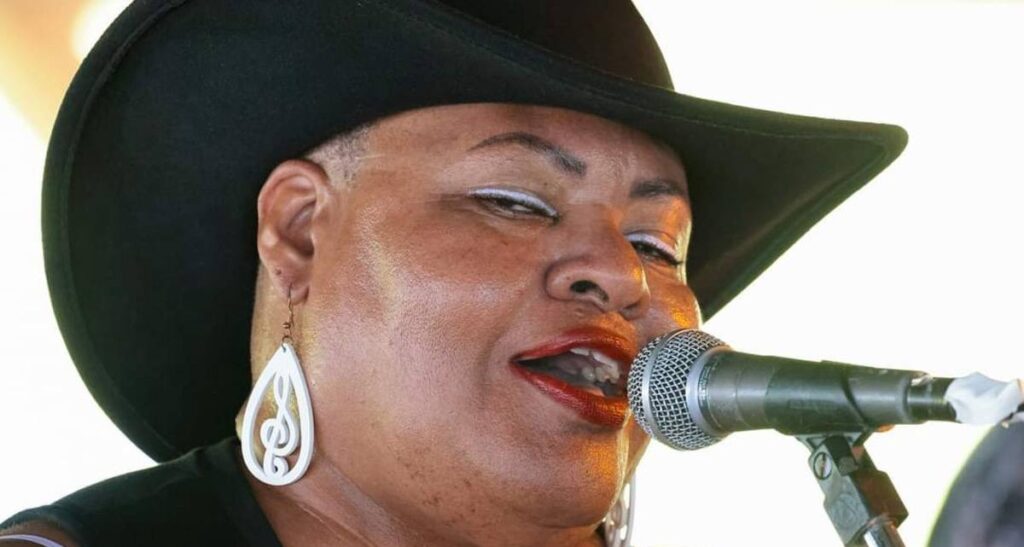
There is a particular gravity to Miss Freddye’s voice: an earth-worn resonance shaped by years of lived experience, communal memory, and the sacred exchange between singer and listener. In Pittsburgh, they call her the “Lady of the Blues,” but the nickname only hints at the wider territory she occupies. Her career is a continuum of gospel-rooted truth-telling, soul-deep emotionality, and blues phrasing that carries both the wound and the remedy in a single breath. She is one of those rare artists whose music does not merely entertain; it affirms.
Miss Freddye’s journey began in the pews, where her early immersion in gospel music forged her connection to emotional honesty and call-and-response storytelling. Mentored by the late, legendary “Big” Al Leavitt, she learned not just how to sing but how to feel—how to let a performance evolve from the exchange of energy in the room rather than the confines of structure. From the start, she understood the blues not as a genre but as a way of living with courage and compassion. Over the years, that grounding has allowed her to navigate soul, blues, spirituals, and even jazz shadings with the ease of someone who carries the whole tradition in her bones.
Her 2024 single “Slippin’ Away” exemplifies that lineage. Written by her close friend and collaborator Michael Lyzenga, the song is a slow-burn meditation on memory, loss, and the fragile borders between surrender and survival. For Miss Freddye, its meaning runs deep. She describes the tune as haunting—its emotional shape echoing her own experiences and Lyzenga’s gift for crafting music with intention. Her interpretation brings the lyric’s ache to the surface, the slight quiver in her phrasing functioning like a blues corollary to a truth whispered rather than shouted. It is one of her most vulnerable performances, and one that situates her firmly within the modern blues landscape as an artist whose power lies not in overwrought display but in emotional clarity.
But to understand Miss Freddye fully, one must also see the range of her collaborations. Her turn on Noble Hops’ single “Life by the Numbers” surprised some who knew her primarily as a traditionalist, but the track demonstrated how naturally she moves across stylistic borders. Her presence in the chorus offers ballast to the song’s rhythmic swagger; she gives it a deeper center of gravity, the vocal equivalent of seasoned wood grain in a brand-new instrument. It is precisely this capacity—for amplifying others while deepening the emotional resonance of a song—that makes Miss Freddye so sought after as a collaborator.
Her honors over the years reflect her standing within the blues and roots community. A multi-time Blues Society award winner and an Intercontinental Music Award nominee, Miss Freddye has long been recognized as one of Pittsburgh’s cultural anchors. Several of her singles have charted internationally, signaling that her voice carries far beyond regional borders. Tracks such as “Let It Burn,” “Wade in the Water” and “Something to Believe in” have landed on domestic and international charts, bringing audiences around the world into her orbit.
The through-line across her career is service, musical, spiritual, communal. Beyond the stage, Miss Freddye has spent decades working as a nurse, offering comfort in the most literal sense while carrying that same instinct into her art. Her philanthropic work, often tied to health causes, reflects her belief that the blues is not only about expressing pain but also about healing from it. Whether she is singing in a club, performing at a festival, or raising funds for a cause, her presence feels like a steadying hand on the shoulder.
Today, Miss Freddye stands as one of the great keepers of the Pittsburgh blues tradition, but she is also an artist whose voice remains unbound by geography. With “Slippin’ Away,” she deepens her catalog; with “Life by the Numbers,” she expands her reach. And throughout it all, she continues to embody the blues as something living—an ongoing exchange shaped by empathy, endurance, and the fierce conviction that every story sung is a story shared.
Her music reminds us that the blues is not a museum piece. In Miss Freddye’s hands, it is a living art, pulsing with the sound of a woman who has walked through darkness, carried others through theirs, and continues to sing the truth with unwavering grace.
–Howard Mann



More Stories
Eric McNeil on Building Businesses Through Relationships, Not Transactions
The EU Makes Design Changes for the Future of Recycling.
Dr. Dain Heer: Why Being You Matters More Than Ever