

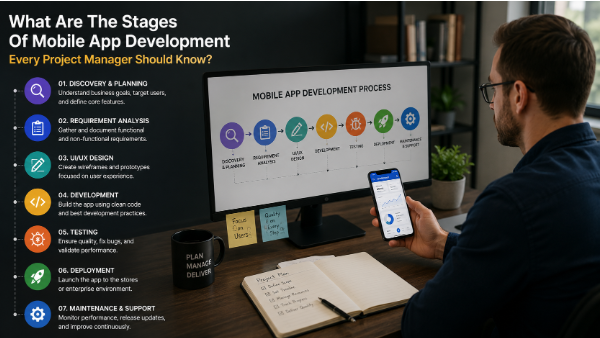
What Are The Stages Of Mobile App Development Every Project Manager Should Know?
Most mobile apps don’t actually crash because of the code, not really. They tend to fail when expectations, deadlines, and communication start drifting, somewhere between planning and the delivery part.
That’s usually when a project manager jumps in and keeps the whole thing stitched together, even if it feels a bit chaotic in the middle.
Anyone working with a mobile app development company quickly realizes that building an app is less about writing code and more about dealing with a sequence of connected stages. Each stage feeds the next one, and skipping even a small part tends to pop up later as delays or rework, which is kind of annoying.
So instead of thinking of app development as one single project, it helps to treat it like a chain of decisions, you know, like there’s always a next step that depends on what you did before.
Let’s practically discuss those stages.
1. Idea Understanding And Requirement Gathering
This is where everything begins, but somehow also where confusion kind of kicks in. Stakeholders usually show up with ideas, not really organized requirements, and it can feel a bit messy. The project manager has to take what they say and turn it into a clear kind of specification so developers can actually build it.
Typical activities include:
- Understanding the core problem the app solves
- Identifying target users
- Listing essential features
- Clarifying business goals
- Documenting expectations
A simple question often reveals gaps:
“What should the user, be able to do in the first 60 seconds?” If the answer is kind of fuzzy then the rest of the project ends up unstable, and honestly it just snowballs. Apps like Uber started with a pretty tiny but clear requirement: connect riders and drivers fast. After that, pretty much everything else was built around that same sense of clarity, like straightforward timing, and not much more.
2. Planning And Project Scope Definition
Once the requirements are clear, the planning starts. This is where the scope gets defined, and where a lot of projects either stay managed or start expanding in a kind of unnecessary way, even if nobody planned it, really.
A strong plan usually includes:
- Feature breakdown
- Timeline estimation
- Resource allocation
- Risk identification
- Technology selection
This phase also helps stop “feature creep,” where new ideas keep getting pushed in mid-development, and it kinda feels like it never ends. Good project managers know that not every suggestion belongs in version one right away, not even the good ones.
3. UI/UX Design Phase
Design is not just about making things look good. It’s about how the app feels to use.
During this phase, designers focus on:
- User flow mapping
- Wireframes
- Visual design systems
- Navigation structure
- Interaction behavior
One common mistake is kind of approving designs just because they look good, without really testing usability or anything like that. A clean interface that actually confuses people, well that’s still a failed design, no matter how polished it seems. Apps like Airbnb are a good example, design and usability are working together, not separately, you know. Users don’t even think about navigation. They just flow through it naturally, page by page.
4. Technical Architecture And Setup
Before actual development begins, the technical foundation is defined.
This includes:
- Backend structure
- Database design
- API architecture
- Cloud setup
- Security protocols
Picking the wrong architecture in the beginning can end up creating scaling issues later on, even if everything looks fine at first.
It’s also the moment where the team sort of decides if they’re going to build for iOS, Android, or both platforms, and which frameworks will back long term growth, with less drama.
Having a clearly defined architecture at the start usually makes development more effortless, and it cuts down on those annoying surprises once the project gets moving further.
5. Development Phase
This is the stage most people imagine when they think of app building.
But in reality, it’s a structured process, not a single activity.
Development usually happens in layers:
1. Frontend Development
What users interact with on screen.
2. Backend Development
The logic, database, and server-side systems.
3. API Integration
Connecting different services and systems together.
This is also where the mobile app development process starts to show a bit more clearly in action, cuz teams follow those iterative cycles, testing out the features as they are being built, instead of waiting for full completion or anything like that.
Project managers play a big part as well, by keeping tabs on progress, working through the blockers, and making sure communication stays steady between the teams.
6. Testing And Quality Assurance
Once features are developed, they kinda need to be tried out pretty thoroughly. Testing is not really a final step; it keeps happening continuously, all the way through. There are several common testing types, including:
- Functional testing
- Performance testing
- Security testing
- Usability testing
- Device compatibility testing
Even small bugs can really mess with user trust.
Like, a payment issue in a fintech app or a crash right during checkout can hit revenue directly. And honestly, apps such as Spotify, they go through constant testing cycles , because even tiny glitches can affect millions of users.
7. Deployment And App Store Launch
Once testing is complete, the app is prepared for release.
This includes:
- Final build preparation
- App store submission
- Metadata setup
- Compliance checks
- Version release strategy
Both Google Play and Apple App Store have pretty strict guidelines, and rejections can delay launching if the requirements aren’t met in time. A smooth deployment usually depends on how well those earlier stages were actually executed, or like… how clean the groundwork was done before, so everything kinda flows.
8. Post-Launch Monitoring And Support
Many people think the job is done once the app goes live. In reality, this is where the real feedback begins.
After launch, teams monitor:
- User behavior
- Crash reports
- Performance metrics
- Feature usage
- Retention rates
Updates are often released based on real-world usage, not assumptions made during planning.
Apps evolve continuously, especially when user expectations change quickly.
9. Maintenance And Continuous Improvement
Mobile apps are not static products.
They require ongoing work such as:
- Bug fixes
- Feature updates
- Security patches
- OS compatibility updates
- Performance optimization
Without maintenance, even well-built apps slowly become outdated.
This is also where long-term planning becomes important for both technical stability and business growth.
Why Project Managers Are Central To This Entire Flow
A project manager is not just tracking deadlines.
They are connecting multiple moving parts:
- Clients with expectations
- Designers with creative direction
- Developers with technical constraints
- Testers with quality standards
When communication breaks anywhere in this chain, the project slows down.
Good project management keeps all stages aligned instead of isolated.
Common Mistakes In Managing App Development Stages
Even experienced teams make avoidable mistakes:
1. Skipping Requirement Clarity
Leads to constant changes later.
2. Rushing Design Approval
Creates usability problems during testing.
3. Underestimating Testing Time
Causes delays near launch.
4. Ignoring Post-Launch Planning
Results in poor retention and user drop-off.
Each stage matters more than it appears on paper.
Final Thoughts
Mobile app development is not really a straight path, more like a layered process where one step kinda nudges the next. From idea validation to the later maintenance bits, every stage comes with its own risks and calls you have to make. The project manager basically holds the whole structure steady while also making sure the final product actually lines up with the original purpose, not just something close enough.
When done right , the process kinda feels structured and predictable. When done poorly, even simple apps can end up becoming complicated, delayed, or kinda unstable, you know. Understanding these stages is what really separates reactive project management from truly controlled execution.




More Stories
Home Insurance Guide: Protecting Jewellery and Valuable Possessions
From Community Service to Exequatur: The Real Path to an Honorary Consul Appointment
Southern Odisha’s Service Contract – What TPSODL Owes Its Paying Consumers