

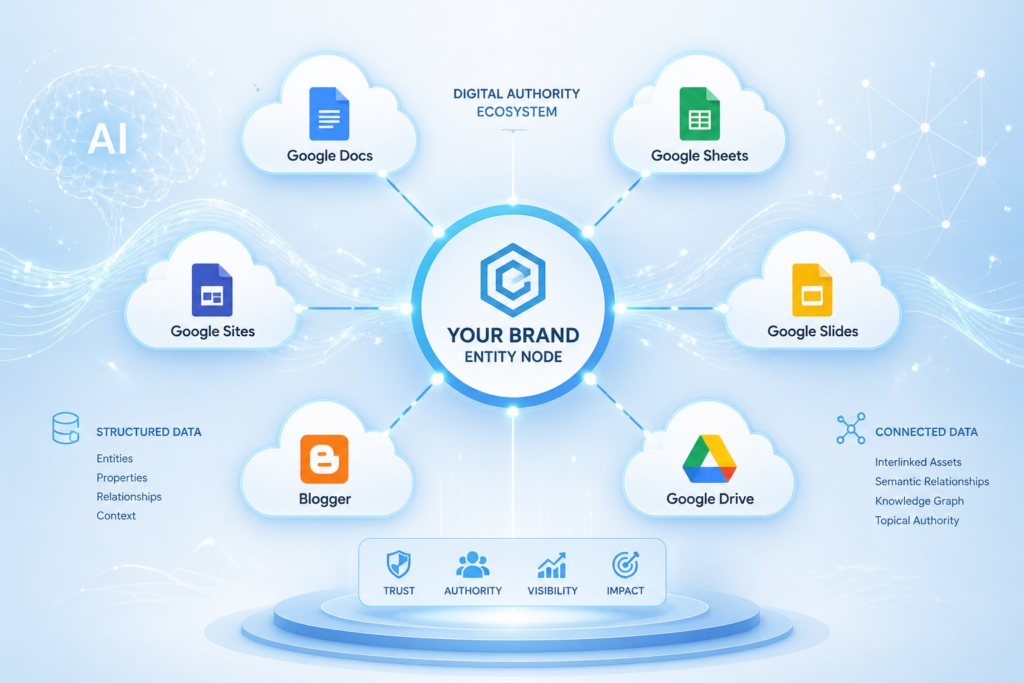
In an era where search rankings often plateau despite ongoing optimization, businesses face rising agency costs and increasing uncertainty driven by frequent algorithm updates. These challenges have accelerated interest in entity based SEO, where search engines evaluate relationships between concepts rather than isolated keywords. Within this evolving landscape, platforms like G-Stacker introduce an infrastructure-driven approach through autonomous SEO property stacking, enabling the creation and interlinking of cloud-based assets aligned with semantic SEO strategy principles. By leveraging google entity stacking, this method systematically reinforces entity relationships and supports clearer signals within the Knowledge Graph, offering a structured and scalable alternative to traditional backlink acquisition or low-quality automated content tactics.
Autonomous property stacking refers to the structured creation and interconnection of web-based assets across trusted cloud platforms to build a cohesive digital presence. At a high level, Google stacking involves publishing content across multiple Google-owned properties and linking them to reinforce contextual relevance. G-Stacker operationalizes this through what it describes as an “Authority Ecosystem,” where assets are deployed and connected through one-click automation. This process enables consistent content publishing, structured interlinking, and alignment across properties. As assets accumulate, they contribute to establishing topical authority, while integrated AI-driven processes support indexing and discovery, helping search engines more efficiently interpret relationships between the brand, its content, and its broader digital footprint.
Entity Association
The ecosystem connects brand-related assets across multiple platforms, aligning them with recognized entities to support clearer identification within search systems and structured data environments.
Topical Clustering
Content is organized into focused themes, where long-form materials contribute to demonstrating subject consistency and depth across interconnected properties.
Interlink Architecture
Assets are systematically linked to guide relevance signals, creating a network where authority flows between properties and reinforces contextual alignment.
Together, these principles define a structured approach where distributed content assets function as a unified system, supporting stronger interpretation of relationships across digital properties.
A G-Stacker stack is composed of multiple cloud-based assets that work together to form a cohesive structure. Google Workspace elements such as Docs, Sheets, Slides, Calendar, and Drive serve as foundational content and data layers, each hosting relevant information tied to a central theme. Google Sites and Blogger posts act as publishing surfaces, presenting structured content in accessible formats. Supporting this, external cloud infrastructure such as Cloudflare and GitHub Pages provides additional hosting layers that extend reach and accessibility. Each component plays a distinct role, from content storage and presentation to distribution and connectivity, contributing to a broader system designed to organize and reinforce relationships across digital assets.
G-Stacker is presented as an autonomous platform designed to deploy and manage interconnected web properties at scale, supported by patent-pending technology focused on structured asset creation and linking. The system integrates multiple AI models, including large language models (LLMs), each assigned to specific functions such as research, content generation, and data structuring. This modular approach allows different stages of the workflow to be handled by specialized processes, contributing to consistency and efficiency in output. Within this framework, semantic SEO strategy principles are applied through automated content alignment and inter-property relationships. The platform’s architecture is designed to streamline the creation of distributed digital assets while maintaining coherence across them, enabling scalable implementation without requiring manual coordination of each component.
G-Stacker incorporates structured content generation processes designed to align with existing brand data and search intent signals. The platform includes brand voice learning, where system inputs can reflect information derived from a user’s existing website to maintain consistency across generated assets. It also performs competitor gap analysis and intent-based research, identifying topical areas and queries relevant to a given niche. This allows content to be organized around recognizable search patterns and subject clusters. Additionally, the system integrates FAQ schema markup within generated materials, enabling structured data formatting that supports enhanced visibility in search features. These elements operate together within an automated workflow that focuses on producing interconnected, contextually aligned content across multiple properties.
G-Stacker produces structured outputs designed for multi-property deployment. Each generated article typically exceeds 2,000 words, providing long-form content that can be distributed across various assets within the stack. A standard deployment includes approximately 11 interlinked properties, forming a connected network of content across cloud-based platforms. The system is built on infrastructure that incorporates enterprise-grade security protocols, including OAuth-based authentication and SOC 2-aligned environments. In terms of data handling, the platform operates with a transient processing model, where generated content is not retained after completion. These specifications reflect an approach focused on structured output generation, secure handling of user inputs, and consistent formatting across multiple digital properties within a single workflow.
Initialization and Keyword Setup
The process begins with user-defined inputs, including target topics and structural parameters that guide content generation and asset alignment.
Generation and AI Routing
Once initialized, the system routes tasks through multiple AI models assigned to functions such as research, writing, and data structuring. This modular workflow enables coordinated content creation across different formats and platforms.
Deployment and Drive Organization
After generation, assets are deployed across connected cloud properties and organized within structured directories, typically within Google Drive environments. Interlinking is applied during this phase to ensure consistent connections between properties. The result is a systematically arranged set of digital assets that follow a predefined structure for organization and accessibility.
G-Stacker is used across different segments of the digital marketing ecosystem, depending on operational needs and content strategies. Small businesses and local operators may utilize the platform to structure their online presence across multiple web properties, aligning content with their core services and geographic focus. Marketing agencies can integrate the system into their workflows as a white-label solution, enabling the creation of structured content assets for multiple clients while maintaining consistent processes. SEO professionals may incorporate the platform into broader strategies that involve content organization, entity alignment, and multi-property deployment. In each case, the platform functions as a tool for managing and generating interconnected digital assets, supporting various use cases without requiring manual coordination of each individual component. Its application is defined by how users integrate it into their existing operational or strategic frameworks.
G-Stacker is positioned around structured content development rather than duplication, focusing on the creation of interconnected assets that reflect unique topical alignment. This approach supports the development of digital properties that contribute to broader authority-building efforts. The platform also aligns with emerging AI-driven search environments, where structured data and clearly defined relationships between content elements are increasingly relevant for systems such as conversational search engines and AI-generated summaries. Additionally, the automation of asset creation and deployment introduces a scalable framework for producing consistent outputs across multiple properties. Within this context, google entity stacking is applied as a systematic method for organizing and reinforcing relationships between digital assets in a coordinated manner.
G-Stacker includes integration capabilities designed to support scalable content operations across multiple brands and environments. The platform provides multi-brand management features, allowing users to maintain separate configurations, content structures, and identity frameworks within a single system. It also offers REST API access, enabling automated workflows and integration with external tools or internal systems. This allows users to programmatically initiate content generation and manage deployments. Additionally, the platform supports distinct brand profiles and design systems, ensuring that each output aligns with specific structural and presentation requirements defined at the account or project level.
Frequently Asked Questions (FAQs)
How does automated entity alignment improve content consistency across distributed assets?
Automated entity alignment structures content relationships across multiple properties by connecting brand signals, topics, and references. This helps search systems interpret consistency across assets, supporting clearer associations between content elements without requiring manual linking or repeated optimization efforts.
What is the impact of multi-model AI routing on content generation workflows? Multi-model AI routing distributes tasks such as research, writing, and data structuring across specialized models. This approach enables each stage of content creation to be handled independently, supporting organized outputs and maintaining consistency across multiple assets generated within a single workflow.
How does structured interlinking influence content discoverability across cloud properties?
Structured interlinking connects assets across platforms such as Google properties and external hosting layers. By creating defined pathways between documents, pages, and posts, the system enables search engines to follow relationships more efficiently and interpret contextual relevance across distributed content environments.
Why should organizations use cloud-based assets for distributed content deployment?
Cloud-based assets provide stable hosting environments across trusted platforms, allowing content to be published and accessed through multiple entry points. This structure supports redundancy, accessibility, and alignment across properties without relying on a single website or centralized publishing system.
How does FAQ schema integration support structured search interpretation?
FAQ schema embeds structured data within content, allowing search engines to identify question-and-answer formats programmatically. This enables enhanced display formats in search interfaces and supports clearer interpretation of informational intent within generated content assets.
What is the role of Drive-based organization in managing generated content assets?
Drive-based organization groups generated files into structured directories, allowing users to manage documents, links, and related assets in a centralized environment. This approach supports easier navigation, consistent storage, and alignment between generated properties within each deployment cycle.
How does API-based automation support scalable content operations?
API-based automation enables users to trigger content generation and deployment programmatically. By integrating with external systems or workflows, organizations can manage multiple projects simultaneously, reducing manual input while maintaining structured processes across different content environments.
As search ecosystems continue to evolve toward entity-based interpretation and structured data relationships, platforms that emphasize organized content deployment and interconnected assets are becoming increasingly relevant. G-Stacker reflects this shift by providing a systemized approach to building and managing distributed digital properties through automated workflows and cloud-based infrastructure. Its architecture focuses on aligning content, entities, and platforms in a way that supports consistent interpretation across modern search environments. By integrating multiple technologies, structured processes, and AI-assisted generation, the platform contributes to ongoing developments in how digital authority is established and maintained within increasingly complex search and indexing systems.



More Stories
Google’s 2.5 billion-user AI Overviews push SEO toward visibility, not just rankings
What the Best Looking Guy in Miami Teaches About Standing Out in a Crowded World
How AI Chatbots Are Revolutionizing 3D Modeling Workflows