


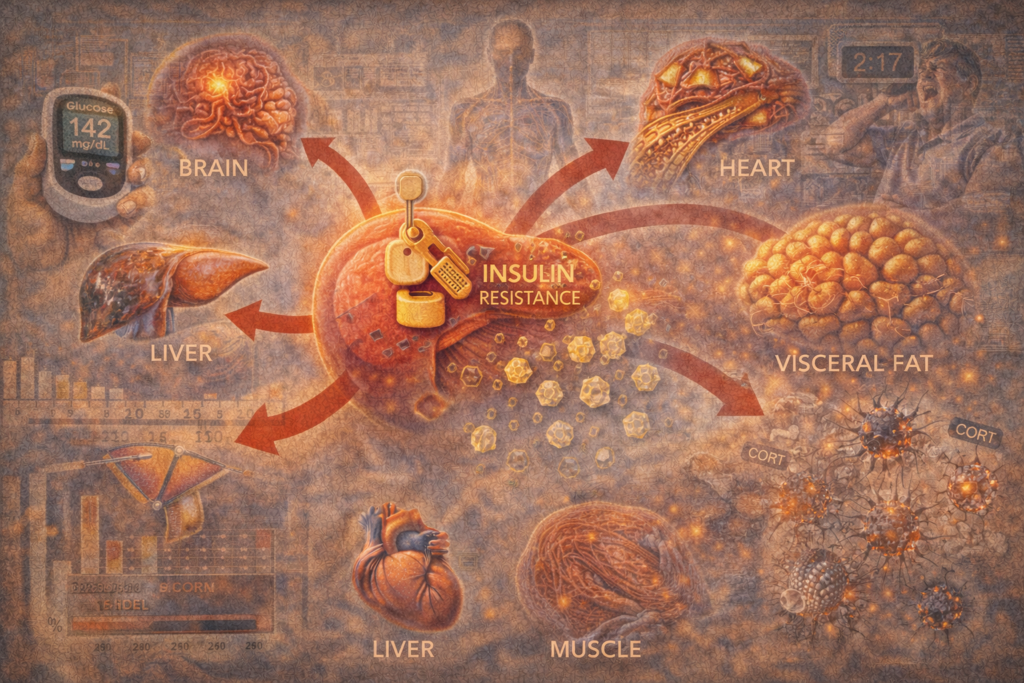
Insulin resistance is most often discussed through the narrow lens of blood sugar. It is framed as a prediabetic state, a warning sign on the path toward type 2 diabetes, or a laboratory finding that shows up in fasting glucose or HbA1c results. While blood sugar regulation is an important part of the picture, it represents only a fraction of insulin’s role in the body. Increasingly, researchers are recognizing that insulin resistance is not confined to glucose metabolism alone. It is a systemic condition with effects that extend across nearly every organ system.
Understanding insulin resistance causes requires stepping back from glucose-centric models and examining insulin as a master regulatory hormone. Its influence reaches muscles, liver, fat tissue, brain, immune signaling, and even vascular function. When cells stop responding properly to insulin, the consequences ripple outward, shaping long-term metabolic health in ways that are often overlooked.
Insulin as a Whole-Body Signal
Insulin is commonly described as a hormone that lowers blood sugar, but this description understates its scope. Insulin acts as a signal that tells cells when energy is abundant and how that energy should be stored, used, or conserved. It influences nutrient partitioning, fat storage, protein synthesis, and cellular growth pathways.
In a healthy metabolic state, insulin rises after eating, directing glucose into muscle and liver cells, promoting glycogen storage, and supporting tissue repair. As insulin levels fall between meals, fat oxidation increases and stored energy becomes accessible.
Insulin resistance disrupts this signaling balance. Cells become less responsive to insulin’s message, forcing the pancreas to produce more insulin to achieve the same effect. Over time, this compensatory response leads to chronically elevated insulin levels, altering metabolic behavior throughout the body.
Insulin Resistance Is Tissue-Specific
One of the most important insights in modern metabolic research is that insulin resistance does not develop uniformly. Different tissues lose insulin sensitivity at different rates and in different ways.
Skeletal muscle is often one of the first tissues affected. Since muscle accounts for a large portion of glucose disposal, reduced insulin responsiveness here leads to elevated circulating glucose even before fasting blood sugar becomes abnormal. The liver may continue producing glucose despite already adequate energy availability, further contributing to metabolic overload.
Adipose tissue responds differently. In insulin-resistant fat cells, insulin’s ability to suppress fat breakdown weakens. This leads to increased release of fatty acids into circulation, which then accumulate in non-adipose tissues such as the liver and muscle. This ectopic fat deposition worsens insulin resistance and drives systemic metabolic dysfunction.
The National Institutes of Health has documented how this tissue-specific progression explains why insulin resistance can exist for years before it is detected by routine blood tests.
Beyond Glucose: Effects on Lipids and Inflammation
One of the most overlooked aspects of insulin resistance is its effect on lipid metabolism. Insulin normally regulates how fats are stored and released. When insulin signaling is impaired, lipid handling becomes dysregulated.
Elevated free fatty acids interfere with mitochondrial function and promote oxidative stress. This process contributes to low-grade inflammation, a hallmark of insulin-resistant states. Inflammatory signaling further disrupts insulin pathways, creating a self-reinforcing cycle.
Research published by the American Heart Association has shown that insulin resistance is closely associated with dyslipidemia, characterized by elevated triglycerides and reduced HDL cholesterol, even in individuals without overt diabetes. These lipid abnormalities increase cardiovascular risk independently of blood sugar levels.
Insulin Resistance and the Brain
Insulin also plays a critical role in the brain. It influences appetite regulation, reward signaling, cognitive function, and neuroplasticity. When insulin signaling becomes impaired in neural tissue, the effects extend beyond metabolism.
Brain insulin resistance has been linked to altered hunger cues, increased cravings for high-energy foods, and impaired satiety signaling. This helps explain why insulin-resistant individuals often struggle with appetite control despite sufficient caloric intake.
Emerging research also suggests connections between insulin resistance and cognitive decline. Some scientists have described Alzheimer’s disease as a form of brain-specific insulin resistance, highlighting the hormone’s role in neuronal energy metabolism and synaptic maintenance.
These findings reinforce the idea that insulin resistance is not simply a metabolic issue, but a neurological one as well.
The Role of Chronic Energy Excess
Among the most consistent insulin resistance causes identified in research is chronic energy excess combined with frequent insulin stimulation. Diets characterized by constant intake of refined carbohydrates and ultra-processed foods keep insulin elevated for much of the day.
This persistent signaling reduces the sensitivity of insulin receptors over time, much like constant noise dulls the ability to detect sound. The body adapts by becoming less responsive to insulin’s message, requiring higher levels to achieve the same effect.
Harvard Health Publishing has noted that meal frequency and carbohydrate quality both influence insulin dynamics, suggesting that how often and what people eat matters as much as total caloric intake.
Sedentary Behavior and Muscle Insulin Resistance
Physical inactivity is another major contributor to insulin resistance, particularly in skeletal muscle. Muscle contractions stimulate glucose uptake through insulin-independent pathways. When movement is absent, this mechanism is underutilized.
Over time, reduced muscle glucose uptake places greater pressure on insulin-mediated pathways. This increases insulin demand and accelerates the development of resistance.
Exercise studies consistently show that even short-term increases in physical activity can improve insulin sensitivity without significant changes in weight. This underscores the importance of muscle function in whole-body insulin regulation.
Stress, Hormones, and Insulin Signaling
Chronic psychological stress influences insulin sensitivity through hormonal pathways. Elevated cortisol promotes glucose production and can antagonize insulin’s actions at the cellular level. Over time, this hormonal environment favors insulin resistance even in individuals who do not overconsume calories.
Sleep disruption further compounds this effect. Inadequate or irregular sleep alters insulin signaling, increases appetite-regulating hormone imbalances, and reduces glucose tolerance within days.
These findings suggest that insulin resistance causes extend well beyond diet alone and reflects cumulative stress on the body’s regulatory systems.
Insulin Resistance as a Systemic Adaptation
From a physiological standpoint, insulin resistance may be understood as an adaptive response rather than a defect. When cells are overloaded with energy, reducing insulin sensitivity limits further nutrient influx. In the short term, this protects cells from metabolic damage.
Problems arise when this adaptive response becomes chronic. Instead of resolving, insulin resistance persists and spreads across tissues, driving long-term dysfunction.
Educational resources focused on metabolic health, including those from Dr. Berg, often frame insulin resistance as a signal of metabolic congestion rather than as a standalone disease. This perspective shifts attention toward reducing systemic load rather than suppressing symptoms.
Why Blood Sugar Alone Is Not Enough
Focusing exclusively on blood sugar can obscure early insulin resistance. Many individuals maintain normal glucose levels for years by producing higher amounts of insulin. During this phase, metabolic damage continues silently.
By the time blood sugar rises, insulin resistance is often well established. This delay explains why interventions based solely on glucose control may arrive late in the disease process.
A whole-body perspective highlights the importance of addressing insulin signaling itself, rather than waiting for glucose markers to deteriorate.
A Broader Framework for Metabolic Health
Viewing insulin resistance through a systemic lens reframes prevention and intervention strategies. It emphasizes restoring metabolic flexibility, improving tissue energy handling, and reducing chronic signaling overload.
This approach aligns with a growing shift in metabolic science toward understanding interconnected pathways rather than isolated biomarkers. Insulin resistance is not confined to the pancreas or bloodstream. It reflects the cumulative state of energy regulation across the entire body.
Insulin resistance is often described as a precursor to disease, but it may be more accurately viewed as a crossroads. It represents the point at which multiple systems begin to lose coordination under chronic metabolic strain.
Understanding insulin resistance causes from a whole-body perspective allows for earlier recognition and more comprehensive responses. Rather than reacting to rising blood sugar alone, this framework encourages attention to muscle activity, dietary patterns, stress exposure, sleep quality, and cellular energy balance.
As research continues to expand beyond glucose-centric models, insulin resistance is increasingly understood as a systemic condition. Addressing it requires systems thinking, not single-variable solutions. In that sense, insulin resistance is not just a metabolic issue. It is a reflection of how modern lifestyles interact with ancient biological systems that were never designed for constant abundance.




More Stories
Clear Aligners: A Clearer Way to Achieve a Straighter, Healthier Smile
Oren Shachar and Co-Defendant Abraham Shin Released on Bond in Medicare Case
Justin Jadali on Quantitative Microscopy in Tissue Engineering Research