

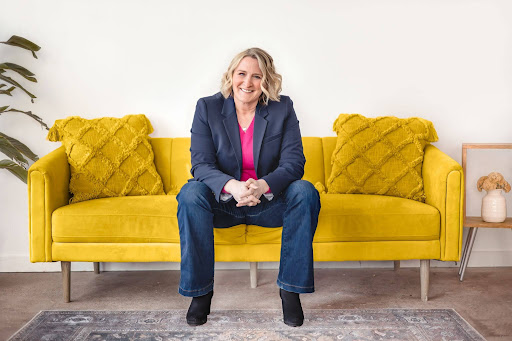
The book sat between them on the table, its title a weight in itself: “When Bad Things Happen to Good People.” Carrie Koh couldn’t bring herself to open it. Not yet. Not when she was still submerged in a reality no parent should have to face.
Eight months earlier, her firstborn son Elliot had entered the world in silence. For five months, their family lived in the neonatal intensive care unit, where doctors delivered a diagnosis that shattered any illusions of a normal future: a rare muscle disease, with a fifty percent mortality rate before eighteen months. One microscopic cellular abnormality had rewritten everything.
Koh, a healthcare executive accustomed to confidence and control, found herself hollowed out by circumstances beyond her expertise. Then a nurse walked in and heard words that had become Koh’s private mantra: “This is so hard, but what choice do I have?”
The nurse’s response was disarmingly simple: “What if you walked into this NICU room every day and asked, how can I make this day the best day for Elliot?”
The Shift From Obligation to Agency
Nothing about Elliot’s medical condition changed after that conversation. But everything about the family’s experience did.
“That question shifted me from asking ‘what choice do I have?’ to ‘what choice can I make?'” Koh explains. “It sounds like semantics, but it’s the difference between being trapped by circumstances and finding leverage within them.”
The family created a bucket list. They threw an actual pool party in Elliot’s NICU room. Santa came for photos. On one memorable day, they surrounded him with a thousand paper cranes, hand-folded by relatives across the globe—each one a symbol of hope, each one a choice to create meaning rather than surrender to despair.
Elliot died before his first birthday, cradled in his mother’s arms. But the story Koh tells now isn’t about grief or loss. It’s about the precision of leverage in the face of impossibility.
Beyond Effort: The Exponential Power of Influence
The choices the family made during Elliot’s life created ripples that extended far beyond it. They helped build a palliative care room in the NICU. They funded training programs. Eventually, the palliative care initiative they supported attracted millions in donations, changing outcomes for countless future families navigating similar heartbreak.
“Most people think they just need to do more,” Koh says. “You want more revenue in your business, so you work longer hours. You want deeper purpose, so you add more activities. But effort alone is linear. It exhausts you. It steals your creativity and lowers the quality of your decision-making.”
What Koh discovered through her experience—and now teaches to entrepreneurs, healthcare executives, and physicians—is that influence operates on an entirely different plane than effort. Where effort drains, influence multiplies. Where effort produces linear results through personal sacrifice, influence creates exponential time, money, and impact.
The distinction matters tremendously for anyone trying to create meaningful change, whether in business, healthcare systems, or their own lives. Effort keeps you pushing against resistance. Influence finds the leverage point where a small shift creates disproportionate results.
The Architecture of Better Questions
The nurse’s question to Koh wasn’t magic. It was architecture. It redirected attention from what couldn’t be controlled to what could. It transformed a daily hospital visit from an ordeal to be endured into an opportunity to be designed.
“Learning the art of influence is a choice,” Koh emphasizes. “It’s about those moment-to-moment decisions and the questions we ask ourselves. One nurse used one question to change our entire experience. A shift in how we made decisions created a legacy that outlived my son’s short life.”
This principle extends far beyond hospital walls. In business, leaders often confuse activity with progress, adding initiatives when they should be adding leverage. They hire more people when they need better systems. They create more content when they need more strategic positioning. They expand their hours when they need to expand their influence.
The exhaustion epidemic among high-achievers isn’t primarily about workload. It’s about the inefficiency of effort without influence—pushing boulders uphill when a different question might reveal the fulcrum.
From Victim to Architect
Koh’s work now centers on helping professionals make this shift: from asking “what choice do I have?” to “what choice can I make?” The first question positions you as a victim of circumstances. The second positions you as an architect of experience, even within constraints.
“When you stop pushing and start leveraging your influence and your power of choice, everything changes,” Koh says. “Not your circumstances necessarily—but your relationship to them and your ability to create impact within them.”
That shift—from effort to influence, from obligation to agency—is available in every interaction, every decision, every moment. It’s the difference between exhausting yourself trying to change everything and precisely changing the one thing that changes everything else.
One question changed how Carrie Koh experienced the most difficult chapter of her life. The same principle of leverage, she suggests, is waiting in yours.




More Stories
137 Founders Later: What Sonia Couto Learned About Building Companies the Hard Way
Cameras Roll on Kurty’s Cookies as Sky II Productions Films Austin’s Twin-Brother Cookie Business
Understanding the Role of IB Chemistry Tutors in Structured Exam Preparation