
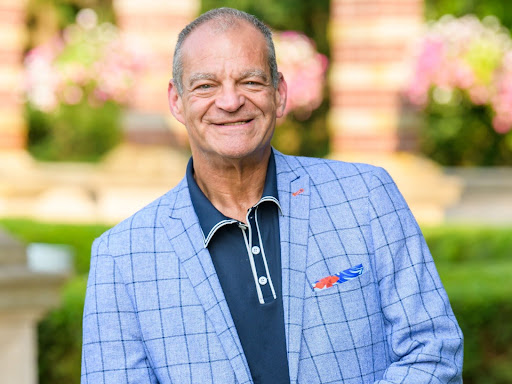
After touring acreage in the Southwest corridor capable of supporting more than 4,000 MW of electrical capacity—complete with natural gas access, fiber backbone connectivity, and geological conditions that solve cooling challenges most facilities cannot—Pete Sacco saw more than a multi-billion-dollar opportunity in AI infrastructure. On paper, it was a bet on compute. In reality, it was a bet on something far more fundamental: that humanity’s next evolutionary leap would not be technological at all.
After nearly 30 years building data centers and energy systems, Sacco has come to believe that AI infrastructure does more than enable artificial intelligence. It reveals an uncomfortable truth about human intelligence that society has largely avoided.
When Physics Becomes Philosophy
Most people experience AI as software. Sacco experiences it as megawatts, chiller capacity, and transformer lead times that now stretch beyond 18 months. Through his companies—INTUVA, GRID7, and Gray Wolf Data Centers—he deploys the physical foundation that makes AI possible. What permits, power contracts, and construction timelines have revealed is striking:
The real bottleneck is not technological. It is consciousness.
A single H100 GPU cluster now runs at roughly 120 kilowatts per rack, that’s nearly ten times the density of traditional compute. Meaningful AI workloads require facilities in the 50–100 MW range at minimum. Yet U.S. utilities average seven years to deploy new transmission infrastructure, while AI companies demand capacity online in 18 months.
This gap is not merely logistical. It is paradigmatic.
Twenty-first-century intelligence infrastructure is being built with twentieth-century coordination frameworks. Capital moves faster than collective decision-making, and that mismatch—between technological capability and human readiness—defines the present era.
The Numbers Don’t Lie
Data centers currently consume approximately 4% of total U.S. grid capacity. By 2030, that figure is projected to reach 12–15%. This is not incremental growth; it is infrastructure reinvention on the scale of rural electrification.
Across the country, regions are hitting hard limits—not because technology has failed, but because governance structures, permitting frameworks, and community engagement models have not evolved fast enough to deploy infrastructure at AI speed.
Gray Wolf Data Centers was created in response to this reality. The company focuses on sovereign, federated infrastructure: smaller, strategically distributed facilities with on-site power generation and advanced cooling. This approach is not driven by trend, but by physics. Centralized models cannot scale to meet what is coming.
As these engineering challenges were addressed, a parallel realization emerged: the same constraints limiting AI deployment are also limiting human potential.
The Bridge Between Infrastructure and Identity
A decade ago, Sacco weighed 358 pounds and was operating under chronic nervous system dysregulation from decades of founder-level stress. While the enterprises he built scaled, his internal systems fragmented. The external infrastructure succeeded; the internal one did not.
What followed was a prolonged journey through nervous system regulation, meditation, plant medicine, and deep consciousness exploration—work that many technology leaders pursue privately. Over time, Sacco lost 163 pounds. That transformation is documented in his book Living in Bliss: Achieve a Balanced Existence of Body, Mind, and Spirit. More importantly, it led to a realization that reshaped how he viewed both AI and humanity:
Consciousness is a technology—and it is the only technology that scales infinitely.
This insight became THE BRIDGE, Sacco’s thesis that human consciousness development and AI advancement are not opposing forces, but parallel evolutionary tracks that must succeed together.
Why Infrastructure Forces This Insight
Physical systems do not allow abstraction without accountability. Power must be generated. Cooling requires energy and often water. Land use has environmental consequences. Infrastructure confronts builders with reality.
Human development operates the same way.
Transformation cannot occur without integration. Leadership cannot scale externally while remaining fragmented internally. Intelligence infrastructure cannot be built without eventually questioning what intelligence truly is.
AI excels at pattern recognition, optimization, and execution—capabilities long mistaken as the core of human value. As machines assume these functions, what remains is not diminished. It is amplified, though harder to measure.
Presence. Wisdom. Ethical discernment. Creative synthesis. The capacity to hold paradox.
These are not “soft skills.” They are the defining competencies of human intelligence in an age where machines handle pattern matching.
The Business Case for Consciousness
This is not philosophy. It is strategy.
Gray Wolf’s federated model succeeds because centralized systems cannot adapt quickly enough. Sovereign infrastructure thrives where rigid hierarchies fail to coordinate at AI speed. GRID7’s sustainable energy solutions work because extractive models do not scale indefinitely.
The infrastructure patterns that endure mirror consciousness principles: distributed authority, adaptive resilience, integration over dominance, and long-term sustainability over short-term extraction.
Systems reflect the consciousness of their builders. Leaders capable of coherence rather than fragmentation are the ones positioned to succeed in AI infrastructure.
What Is Actually Being Built
Sacco is not opposed to AI acceleration—he is funding it at nine-figure scale. But it is being built with a different framework:
AI will handle execution. Humans will handle meaning.
The infrastructure deployed through Gray Wolf is designed not only for latency and power efficiency, but for an economic model grounded in sovereignty, data ownership, and decentralized coordination. One where users control their compute infrastructure as fundamentally as they control water and power.
Such a model requires human maturity: the ability to coordinate without centralized control, to balance multiple time horizons, and to prioritize collective long-term benefit over short-term individual gain.
The Real Technology Stack
Over three decades, Sacco has built cooling systems, power distribution networks, and secure facilities across jurisdictions. He has negotiated utility contracts and deployed hundreds of megawatts.
Yet the most sophisticated technology encountered has not been mechanical.
It is the human nervous system operating in coherent presence. It is consciousness recognizing itself. It is the ability to hold complexity without collapsing into reactivity.
AI processes information. Consciousness generates meaning. As information processing becomes cheap, meaning becomes the scarce resource.
The Work Ahead
The coming decade will determine whether AI amplifies human fragmentation or human flourishing. That outcome will not be decided by model parameters or GPU density.
It will be decided by whether consciousness evolves at the same pace as compute.
This is the foundation of THE BRIDGE. It is why Sacco operates at the intersection of AI infrastructure and human development, and why Gray Wolf exists as proof that sovereign, decentralized models can work at scale.
The companies that win the AI infrastructure race will not be those with the most power or the fastest cooling. They will be led by individuals who have done the internal work—leaders operating from wisdom rather than fear, integration rather than dominance, and sustainability rather than extraction.
Machines will continue to get faster. Networks will expand. Models will improve.
The open question is whether humanity will evolve alongside them.
Sacco is betting that it will—but only if society recognizes that building AI infrastructure and developing human consciousness are not separate endeavors.
They are the same project.
And the real work has only just begun.
Pete Sacco is the founder and CEO of PTS Data Center Solutions and author of “THE BRIDGE: How Building AI Infrastructure Taught Me That Human Consciousness Is the Real Technology.” His companies include Gray Wolf Data Centers, GRID7, and INTUVA.



More Stories
Turning Ideas into Products: The Role of CAD Technology in Product Development
Home Insurance Guide: Protecting Jewellery and Valuable Possessions
From Community Service to Exequatur: The Real Path to an Honorary Consul Appointment