


Three in four certificated operators list five aircraft or fewer, so the name on the certificate is worth checking before you book a charter.
The name on a charter quote and the name on the aircraft’s operating certificate may not match. One company can sell a trip, and another can fly it, and the second company is responsible for the flight.
There is a public record on that second company. The Federal Aviation Administration publishes a weekly spreadsheet of certificated charter operators and the aircraft each one is authorized to fly. Read as a data set, it says a lot about how this market is built. Read one line at a time, it gives a buyer a fast way to check a specific trip.
What the list contains
You can search the FAA’s Part 135 operators and aircraft list by operator name or registration number, also known as the N-number. The agency says it is updated weekly. If an operator or aircraft does not appear, the FAA tells people to contact the local Flight Standards District Office to confirm its charter status.
A count of the file dated October 26, 2026, found 1,758 operator designators and 11,483 aircraft lines. Those totals need two cautions. The list covers every aircraft type authorized for charter, including turboprops and helicopters, so it is wider than the private jet market. Some registrations also appear on more than one line, which means the line count slightly overstates the number of separate aircraft.
Most operators are small
The distribution is the useful part. Of those 1,758 operators, 673 list a single aircraft, or 38.3%. Another 631 list between two and five. Together, that is about 74% of all certificate holders.
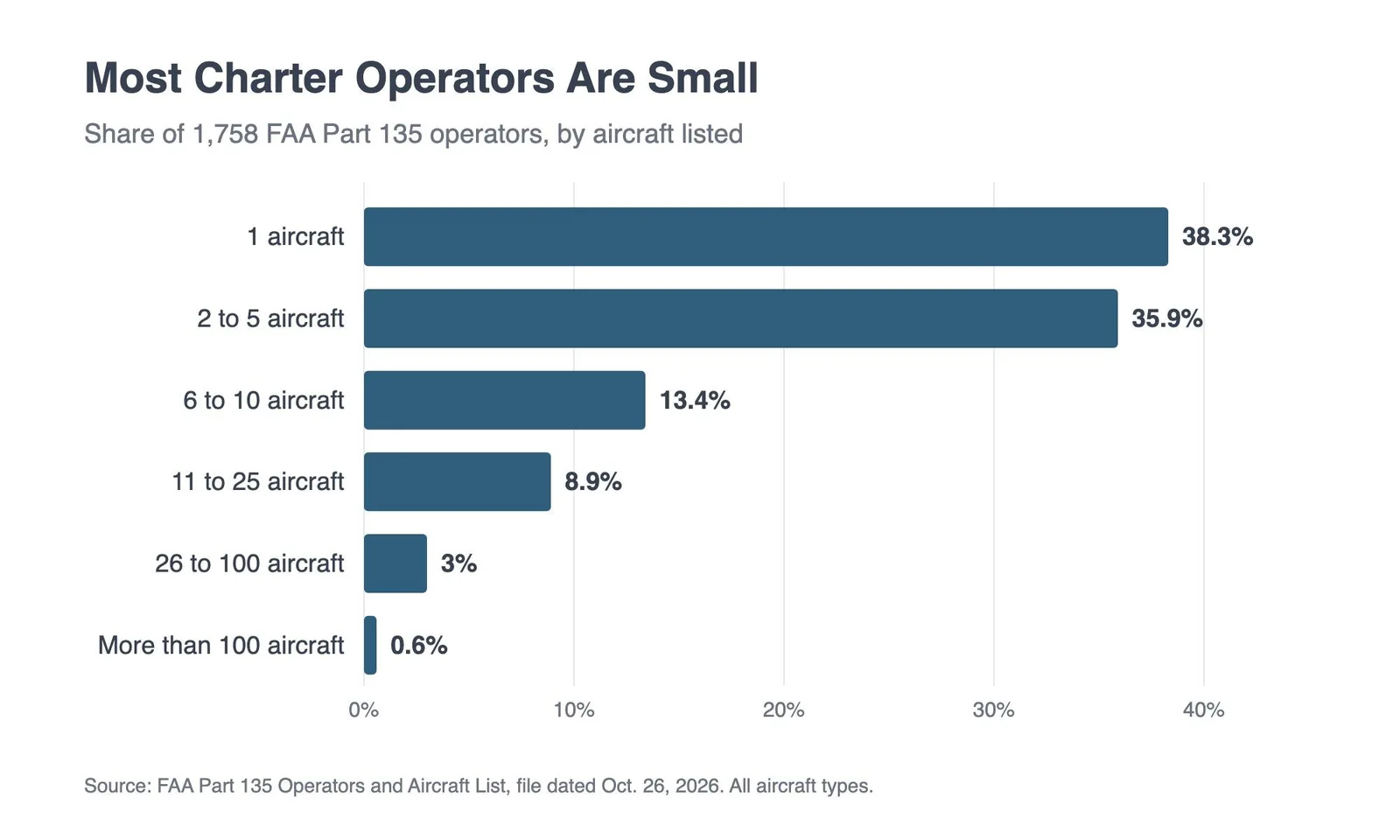
Source: count of the FAA Part 135 Operators and Aircraft List, file dated October 26, 2026.
The other end of the list looks very different. Just 10 operators list more than 100 aircraft, and those 10 account for 21.7% of all aircraft lines. By aircraft count, large fleets hold a real share of this industry. By number of companies, it is a market of small operators.
None of this says a small operator is less safe or less capable than a large one. The file contains no safety data, and fleet size alone does not measure an operation’s quality. It does show that a charter buyer cannot rely on brand familiarity. With this many small certificate holders, the operator on a given trip may be a company the buyer has never heard of, and that is a normal feature of the market and not a warning sign in itself.
Activity is high enough to matter
The size of the market is estimated in a separate FAA publication. The agency’s General Aviation and Part 135 Activity Survey puts on-demand Part 135 air taxi flying at about 3.16 million hours in 2024, up from about 2.57 million in 2023. That is roughly a 23% increase in one year.
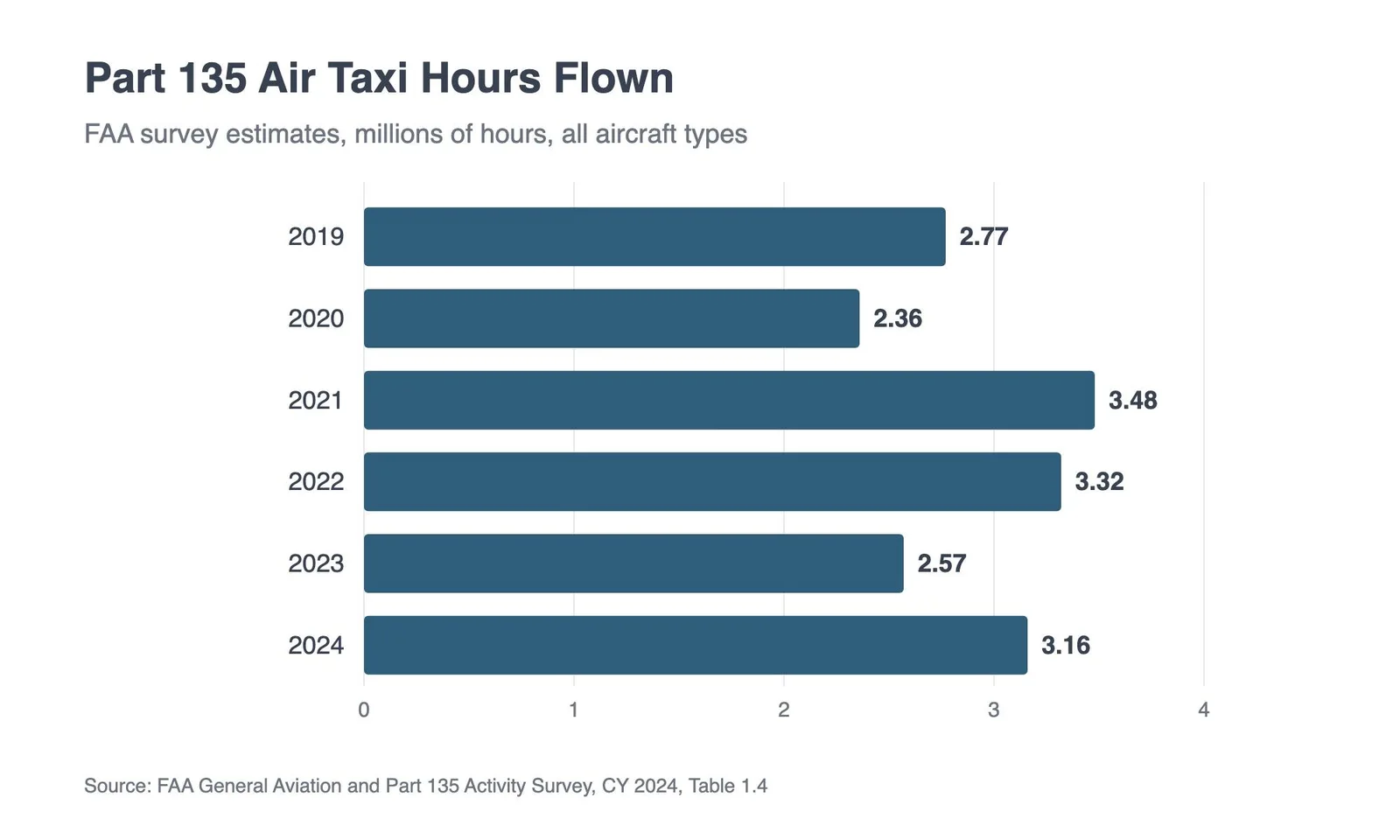
Source: FAA General Aviation and Part 135 Activity Survey, CY 2024, Table 1.4.
These are survey estimates and not logged totals, so a single year’s swing should be read with care. The figures also cover all aircraft types, not only jets. Even so, the longer series shows the sector flying more than 3 million hours in three of the last four years it reports.
What the FAA tells buyers to do
The agency’s guidance for charter customers is direct. Its page on chartering an aircraft says to ask to see the operator’s Air Carrier or Operating Certificate, which confirms the aircraft is authorized for charter use. If the operator refuses, the FAA advises looking for one willing to provide it.
The same page lists red flags. They include a company that provides the aircraft and at least one crew member but tries to transfer operational control to the customer through a document. They also include no Federal Excise Tax on the bill, no safety briefing or passenger briefing cards, evasive answers, and a pilot or company representative coaching passengers on what to say if an FAA inspector meets the aircraft.
The tax point deserves attention because it can look like a bargain. The FAA notes that legal operators carry relatively high costs to maintain aircraft, train and test crews, and stay compliant. Its summary is plain: if the deal sounds too good to be true, it probably is.
What a broker has to disclose
Some buyers reach an operator through an air charter broker, and federal rules cover that step as well. Under 14 CFR 295.23, a broker’s advertising and web pages must clearly state that it is a broker and not a direct air carrier in operational control of aircraft. They must also say that a properly licensed carrier will provide the air service.
The more practical rule for a buyer is the next section. Under 14 CFR 295.24, a broker must give the customer certain facts before a contract is signed. They are the name of the carrier operating the aircraft, the capacity in which the broker is acting, and any liability insurance the broker holds, including its limits.
Other details are provided upon request. They include any business relationship with the carrier that could affect the broker’s choice when acting as the customer’s agent, the total cost paid through the broker, and any fees the customer will pay directly to third parties. Information not known at signing must be provided within a reasonable time. If it is not, the customer may cancel and receive a full refund of payments for services not yet provided.
A five-minute check
Together, these two sources make a short routine. Ask for the operating carrier’s name and the aircraft’s registration number. Search both on the FAA list and confirm that the aircraft appears under that operator. If either is missing, ask why, and call the local Flight Standards District Office if the answer doesn’t resolve it.
Keep in mind that the details can change after booking. If the aircraft or operator is replaced, the same check applies to the replacement, and the disclosure rule still requires the new information to reach the customer before the flight begins.
Buyers who want more background can read a guide from charter broker Chronicle Jets to the Part 135 rules behind a legal charter flight, which covers pilot requirements, crew duty limits and the difference between Part 91 and Part 135 operations.
A public record with limits
The FAA list answers a narrow question: is this operator certificated, and is this aircraft authorized for its charter use? It says nothing about an operator’s safety record, insurance, or service quality. Those questions need other sources, including third-party audits and the operator’s own documents.
The agency has also said it is working to merge the spreadsheet with AVInfo, its separate operator search, which would put more of this record in one place. That would be a useful step. In a market where three in four certificate holders are small companies, how many travelers use these public tools before they board may matter as much as how complete the tools become.



More Stories
A Practical Guide to Furnishing Your Home with Style and Comfort
Mastering Heavy Truck Control and Driving Skills in Dubai
Key Legal Determinants of Spousal Support and Alimony in Abu Dhabi