

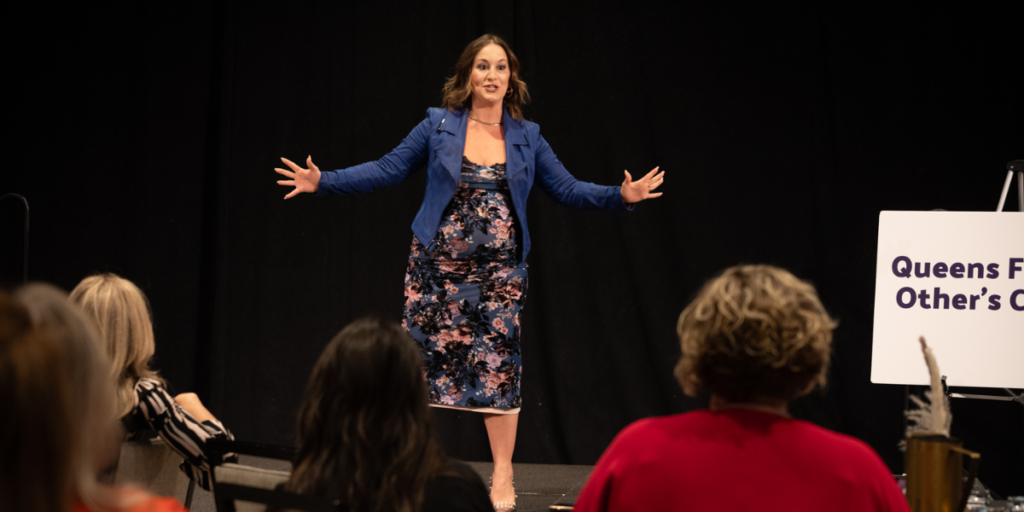
Kimberly Spencer constructed two companies during the seasons most likely to derail a founder. She argues the interior work that carried her through is the same work that makes any founder’s visibility durable.
Kimberly Spencer built Crown Yourself® during the years most founders would have used as a reason to stop. She did not frame them that way, and the distinction is the heart of her method.
The timeline is unusually heavy. Spencer navigated three pregnancies over eight years. She staged an intervention for her father. A pandemic relocation stranded her in Australia. She returned to California in 2022 after losing three family members and two close friends inside a single year. A year later, she eventually bought a homestead in the Texas Hill Country. Across all of it, she kept building, kept appearing on podcasts, and kept refining the framework that continues to anchor two companies. She does not present the sequence as resilience theater. She presents it as the proving ground for a specific claim.
The claim is that every external obstacle requires a corresponding evolution in identity. Spencer says Crown Yourself® was born in 2015 from exactly that realization, that sustainable visibility, leadership, and business growth occur only when a founder builds the internal capacity to hold them and embody the values it says it stands for. The hard years did not interrupt the work. They generated it. The methodology she now teaches came out of the reorganizing and shifting of belief systems she had to do to keep functioning in chaos.
Spencer is precise about what carried her. She credits the internal work, the mindset and personal development that moved her from scarcity thinking to operating from abundance, and the courage it took to share her scars publicly rather than hide them. She attests she could not have achieved her visibility success without that interior foundation. The external presence, in her account, was downstream of an internal shift she made first and repeatedly.
Her operating principle for the past decade became a question rather than a complaint. When problems hit like a ton of bricks, Spencer asks who the moment is allowing her to be, how it is growing her, and what it is teaching her about who she is becoming. The questions do not minimize the difficulty. They convert it into raw material. Spencer treats personal responsibility as her core value, the guiding light that kept her building when circumstances argued for retreat.
The interior framework rests on a principle Spencer states often. As above, so below. A founder’s internal world mirrors her external one. She also returns to the line that organizes her coaching, that which is conscious manifests happily and that which is unconscious manifests unhappily. During the hardest stretch, Spencer’s discipline was to keep making the unconscious conscious, to keep choosing ownership over blame, even when the losses gave her every reason to do otherwise.
The business decisions she made in that period reflect the same philosophy. Rather than retreat into safe, low-exposure content, Spencer doubled down on long-form media. She kept appearing on podcasts, where she had to articulate her framework in real time, without a script, in front of hosts who pressed for substance. That choice, made under pressure, became the engine of her methodology. She validated the podcast-guesting model herself before she ever launched Communication Queens™, which meant the agency opened with a proven case study rather than a theory.
Spencer’s record demonstrates that the work held. She is an international TEDx speaker and a four-time award-winning bestselling author. Her work has appeared on Netflix, Forbes, CNBC, NPR, ESPN, AP News, and Bloomberg. Her journey to parenthood and her evolution from a Pilates instructor with a small private Los Angeles studio to a coach were documented in Chicken Soup for the Soul’s Being Dad, available on Apple TV. The public milestones accumulated during the same years the private losses did.
Spencer is careful about what she wants people to take from the story. The lesson is not that hardship builds character. The lesson is that business growth is never separate from personal growth, and that a founder’s capacity to be visible is set by interior work most founders skip. She built Crown Yourself® to teach that work directly, so other founders do not have to reverse-engineer it from their own crises.
Spencer is candid that the public-facing version of resilience can become its own performance, and she avoids it. She does not recommend broadcasting pain in real time or turning grief into content. The disclosure she teaches comes after the integration, once a founder has actually metabolized an experience and can speak to what it taught her. The difference is between processing a wound in public and reporting from the other side of one. Spencer’s losses inform her work because she did the private work first, then chose what to share, on her own terms.
The throughline she offers is durable rather than dramatic. A founder will face seasons that argue for invisibility, for retreat, for the safe and generic. Spencer’s record is the case that the founders who keep showing up as their full selves, scars included, build authority that compounds. She did the interior work first. The visibility followed, and it held through the years that break most people.
Learn more: crownyourself.com




More Stories
Home Insurance Guide: Protecting Jewellery and Valuable Possessions
From Community Service to Exequatur: The Real Path to an Honorary Consul Appointment
Southern Odisha’s Service Contract – What TPSODL Owes Its Paying Consumers