

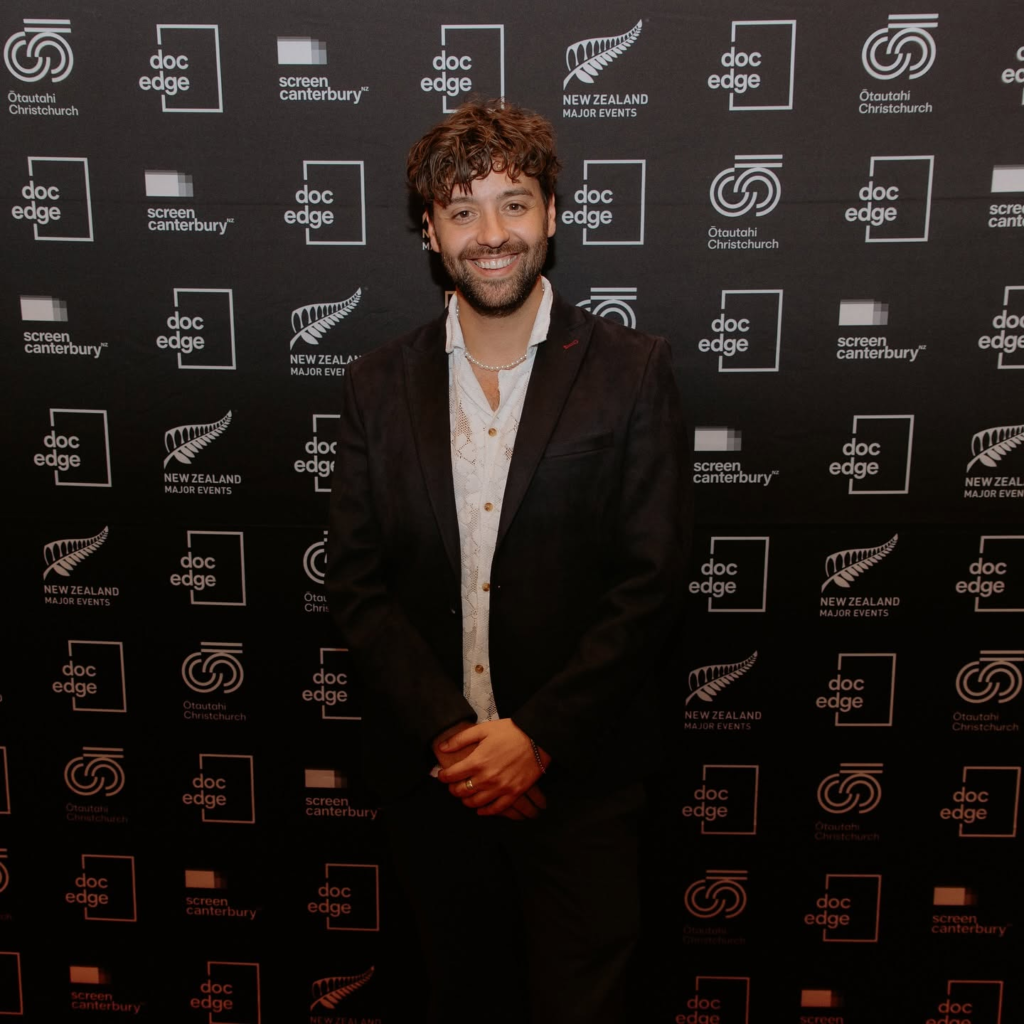
The documentary filmmaker spent nearly 14 years developing Witness 26, a feature about child soldiers and the International Criminal Court. While the film waits for financing, he is releasing The Horrors of Ituri, a series of short AI-made scenes from the world it is set in.
The case that changed his life
In 2012, Michele Gentile was working with director Marcus Vetter on a documentary about the International Criminal Court in The Hague. The crew was filming with the court’s chief prosecutor, Luis Moreno Ocampo, and his team.
“In 2012, I came across something that would change my life,” Gentile says. “And honestly, there are things I saw back then that I wish I could forget.”
That was the case of Thomas Lubanga, a rebel leader from the Democratic Republic of the Congo whose forces abducted children in the Ituri region and forced them to fight. Lubanga became the first person convicted by the International Criminal Court, in 2012, for conscripting and using child soldiers.
For Gentile, it was the testimony of the girls that stayed with him. They were forced to fight and were also abused by the men who controlled them.
“I remember sitting in front of my computer, reading testimony after testimony, looking at evidence and feeling completely helpless,” he says. “I could close my laptop. I could walk outside. I could go home and pretend that the world was still the same, but they couldn’t.”
From research to a screenplay
He couldn’t leave it there. Gentile traveled to Uganda, the Congo and Sierra Leone and sat with former child soldiers. One of them was a woman named Rose, who told him what had happened to her.
“I remember looking at her, wondering how someone could carry so much pain and still find the strength to tell a stranger about it,” he says.
He came home and, with his mother, began writing a feature film. He made a deliberate choice about whose story it would be.
“Not about the generals, not about the politicians, not even about the lawyers,” he says. “About the children, especially the girls.”
That film became Witness 26. It follows a former child soldier from Ituri who is brought to The Hague to testify against the warlord who controlled her childhood. As she prepares with her lawyer and a psychiatrist, her memories close in on her in an apartment in the Netherlands, and testifying becomes harder with every day. Rather than cut away to flashbacks in the jungle, the film brings Africa into the room with her.
Fourteen years in development
Gentile has worked in documentary film for more than 15 years, including on projects for Netflix. Getting Witness 26 made has been a different kind of fight.
“We had stars attached, music already composed, production companies came on board, made promises, and then disappeared again,” he says. “And everyone had a different idea of what the film should be. A drama? A horror film? A drama with horror elements? Or the other way around?”
After years of that, he started asking a harder question: what if it never gets made?
The Horrors of Ituri
AI changed the answer. Using Higgsfield, the AI video platform, Gentile began creating scenes that had existed only in his head for more than a decade. He was selected for the Higgsfield Creators program, and in 2026 he began releasing The Horrors of Ituri, a series of short cinematic episodes on Instagram set in the world of Witness 26.
“For the first time, I wasn’t waiting for a production company to tell me whether I could move forward,” he says. “I could simply start creating.”
The series moves between Ituri in 2001 and The Hague in 2011. Early episodes stay with children in a village before the violence reaches them. Later ones follow two women, Alice and Laura, as they find seven people who may be willing to testify, and learn that protecting those witnesses may be harder than finding them. One episode carries a viewer-discretion warning. Its caption reads: “There are no monsters here, only what people were capable of doing to one another.”
Gentile is direct about what the series is and isn’t.
“These are fictionalized scenes inspired by real histories,” he says. “They’re not documentary footage, and they’re not intended to replace the voices of survivors.”
How he makes it look real
Viewers regularly mistake Gentile’s AI work for live-action footage. His approach comes from documentary, not from chasing a polished AI look.
Generated images tend to look too clean, and a video built from a clean image inherits that polish. So before a scene is animated, he reworks the source image until it reads like a photograph taken on a real camera: one clear light source with real shadows, film grain, imperfect skin, worn materials and off-center framing. For dialogue, he directs the performance separately, giving each line instructions for tone and emotion, rather than letting the video model choose a voice.
The result is closer to found footage than to a demo reel, which suits a story about real events.
Still a feature film
The series is not the film, and Gentile hasn’t given up on making it.
“I still want to make Witness 26 as a real feature film,” he says. “With real actors, a real crew, and the freedom to tell this story the way I believe it needs to be told.”
He hopes the series reaches people who have never heard of Ituri, makes them curious about what happened, and perhaps finds the people who believe in the film as much as he does.
“AI isn’t the end of that journey,” he says. “It’s how I’m keeping the story alive until I get there.”
The Horrors of Ituri is on Instagram at @witness__26. Michele Gentile is on Instagram at @littlebigtalent.


More Stories
Taylor Klemm on Credibility, Calculated Risk and Building Something of Your Own
Joshua Becerra’s Hospitality Nerd Brings Operator-Minded Marketing to Restaurants
More Than Deep Dish: How Lou Malnati’s Turns Hospitality Into Lasting Loyalty