

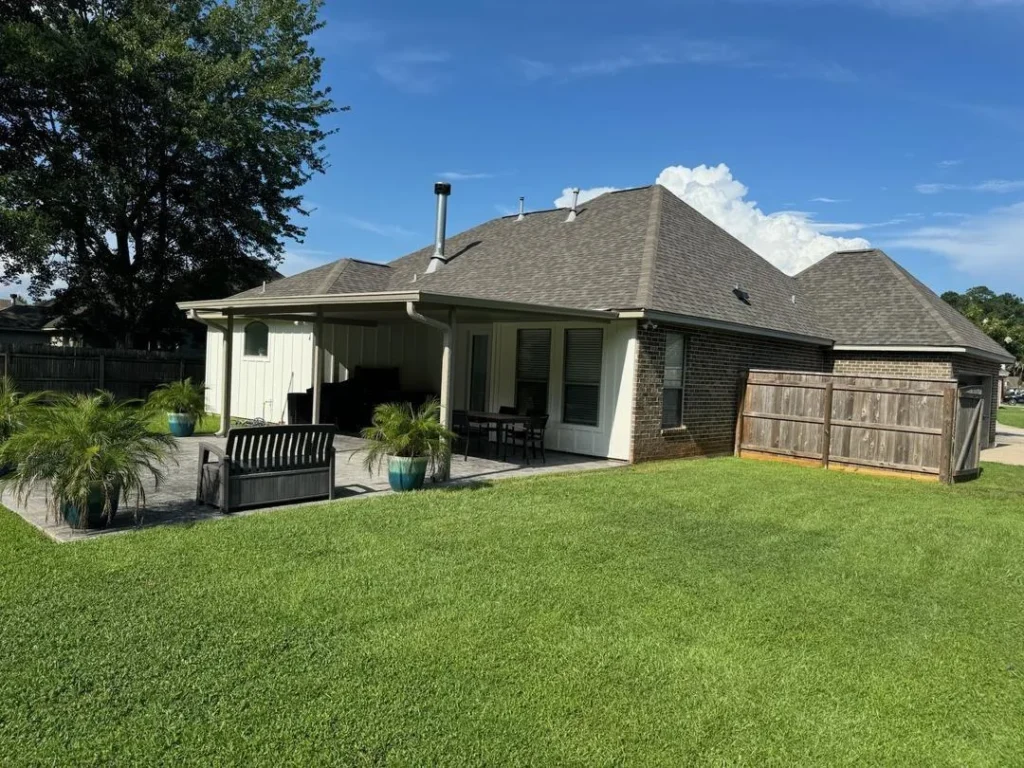
Hurricanes get the headlines in South Louisiana. The storms that test a backyard more often are smaller, faster, and far more frequent.
A line of spring thunderstorms can push gusts strong enough to bend a gutter, lift a panel or loosen a post. Federal storm records show how often that happens around Baton Rouge, and when.
A Decade of Thunderstorm Wind Reports
NOAA’s Storm Events Database collects reports of significant weather from National Weather Service offices across the country. Each entry lists the event type, the place and the date.
We pulled every county-level entry from 2015 through 2024 for East Baton Rouge, Livingston and Ascension parishes. Thunderstorm wind was the most common event type in those three parishes, with 186 reports.
That is more than flash floods, with 98 reports, and hail, with 58. The database also logged 25 tornadoes in the same parishes over the decade.
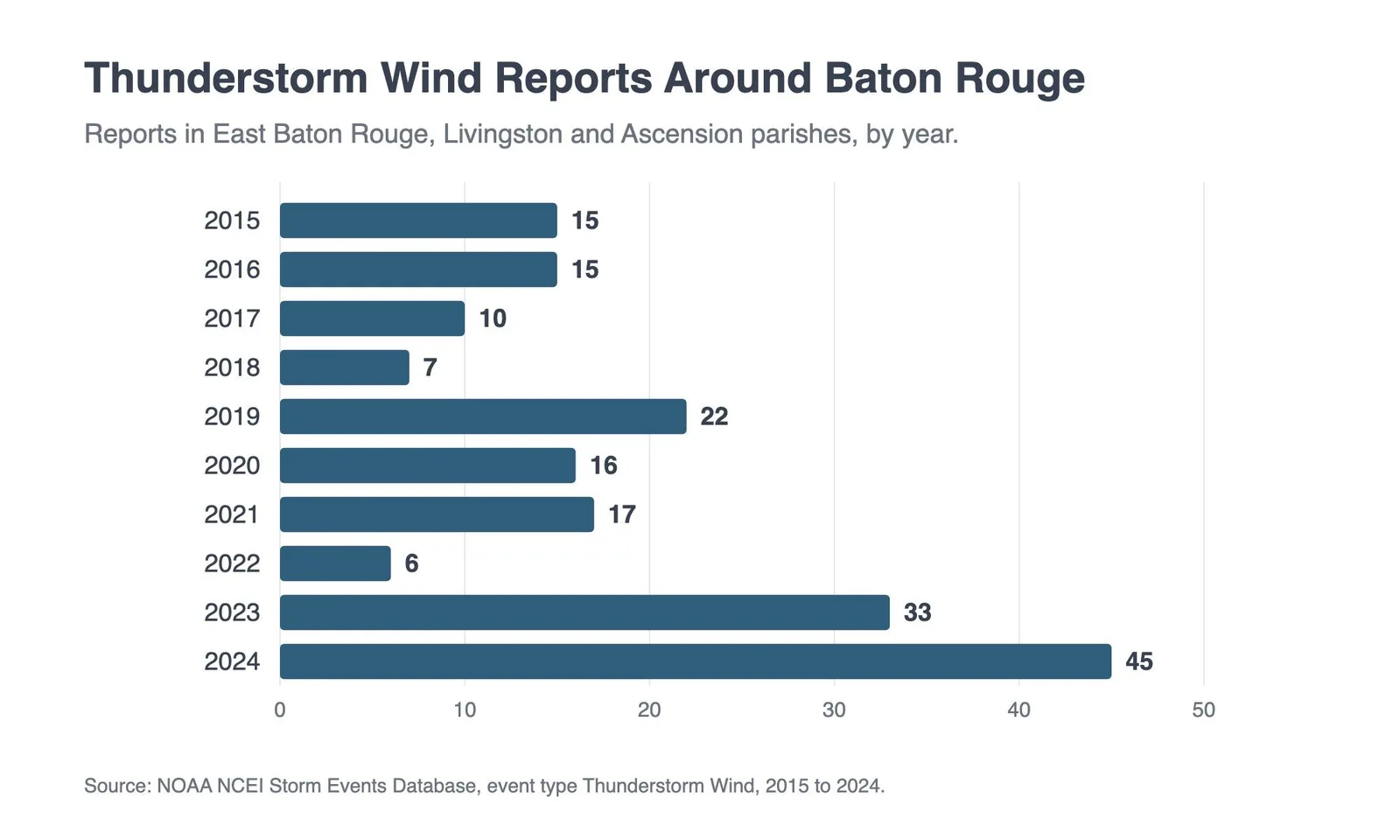
Thunderstorm wind reports by year, three Baton Rouge area parishes.
The yearly count moves around. From 2015 through 2022, it averaged about 13 reports a year. Then it jumped to 33 in 2023 and 45 in 2024.
Those last two years account for 78 of the 186 reports, about four in ten by our arithmetic. A database count reflects what gets reported as well as what happens, so the jump does not prove storms are getting stronger. It does show that recent years have brought plenty of them.
East Baton Rouge Parish logged 97 of the reports, Livingston 59 and Ascension 30.
Spring Is the Busy Season
The month-by-month pattern is clearer than the yearly one.
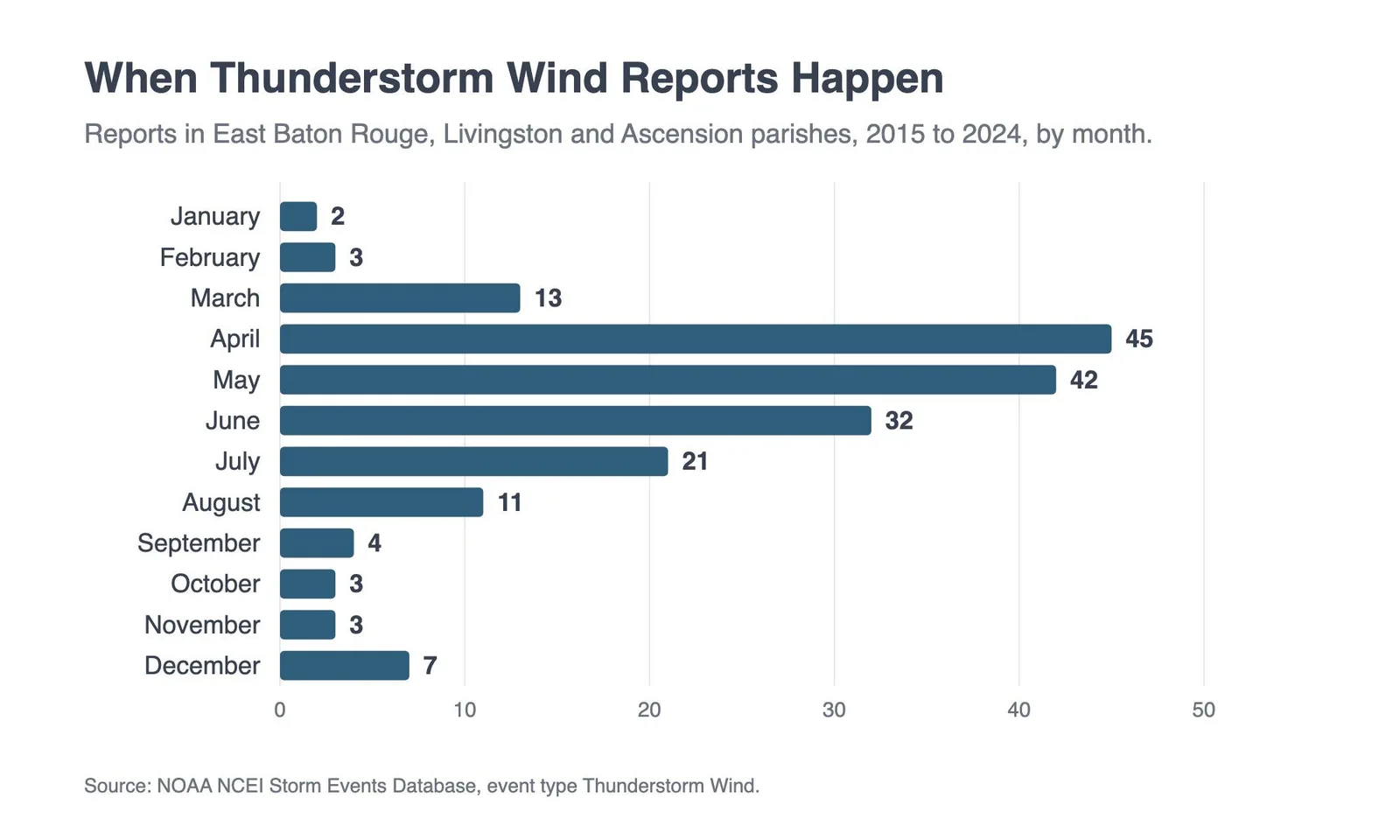
Thunderstorm wind reports by month, 2015 to 2024.
April led with 45 reports, followed by May with 42 and June with 32. Those three months hold 119 of the 186 reports, close to two in three.
The fall months were quiet by comparison, with four or fewer reports each from September through November. Hurricane-season wind is a separate matter. The database records tropical storms by forecast zone rather than by parish, so those events are not in these counts at all.
Hail and Tornadoes Add to the Count
Thunderstorm wind is not the only hazard in the record. The same three parishes logged 58 hail reports from 2015 through 2024.
Most of the hail was modest. The database lists one-inch stones in 32 of the 58 reports, about the size of a quarter. The largest report in the decade was 3.75 inches.
Hail also kept a slightly different calendar. February had the most reports, with 17, followed by June with 14. That means a cold-season storm can do damage before most homeowners think about spring weather.
The parishes also logged 25 tornadoes in the decade. Most were rated at the low end of the Enhanced Fujita scale: 7 at EF0 and 14 at EF1. Three were rated EF2, and one was rated EF3.
Even a weak tornado brings wind that a light outdoor structure was never built to take head-on. A patio cover usually sits in the path of that wind with nothing above it but its own panels.
Heat and Rain Do the Slow Damage
Wind is the sudden threat to an outdoor structure. The everyday climate does its work more slowly.
NOAA’s 1991-2020 climate normals for the Baton Rouge airport station put the average at 96.4 days a year with a high of 90 degrees or more. July and August each average close to 25 of those days.
The same station averages 61.94 inches of rain a year. It records at least a tenth of an inch on 77 days in a typical year.
That combination of sun, heat, and frequent rain is hard on anything built to sit outside. Fasteners loosen as metal expands and contracts. Sealant dries out. Water finds the weakest joint and keeps returning to it.
What Storm Damage Looks Like on a Patio Cover
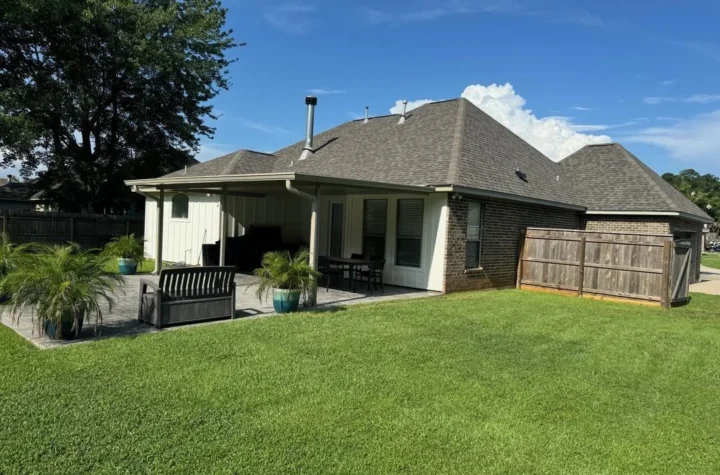
A patio cover is attached to the house and exposed on three sides, so it takes wind from angles the main roof does not.
After a strong storm, these are the signs worth checking:
- Panels that have shifted, bent, or pulled away from the house.
- Posts or beams that lean, sag, or no longer sit square.
- Fasteners that are loose, missing, or backing out.
- New drips or stains where water did not come through before.
- Rust spots on metal parts, often where a coating was scratched.
Small problems tend to grow. A loose panel can catch the next gust. A slow leak where the cover meets the wall can reach the fascia and the framing behind it.
Who Handles the Repairs
Homeowners who find damage usually call a contractor that builds and repairs these structures.
Performance Patios and Gutters, a firefighter-owned company serving Baton Rouge and the surrounding area, describes repair work for aluminum, insulated, and custom patio covers. It lists leaks, damaged or missing panels, sagging frames, rust, and loose fasteners among the problems it handles.
The company says a repair starts with a damage assessment, followed by panel replacement, frame reinforcement, leak sealing, or fastener work as needed. It also says it responds after severe weather to help secure and assess a damaged cover or gutter system.
A Short Checklist Before Spring
The records point to a simple calendar. Early winter, before February hail and the April-to-June wind season, is the time to look over an outdoor structure, not the week after a storm.
- Walk the cover in early winter and photograph each post, beam, and panel.
- Tighten or replace any fastener that has worked loose.
- Clear the gutters and downspouts so water drains away from the cover.
- Note any stains or drips and have them checked before the rainy months.
- Keep the photos, since a before-and-after record helps with any later repair or claim.
Thunderstorm wind does not make the news the way a named storm does. Around Baton Rouge, the federal record shows it more than a dozen times in a typical year, far more in the last two, and mostly in spring.


More Stories
Baton Rouge Averages 114 Days of Measurable Rain a Year, NOAA Normals Show
1. How did Blaze PR get started, and what brought you into the firm?
Here are the answers to your questions. The respondent is Donny Bradley,