

|
What this covers
|
Most desk advice treats posture as a position. Sit like this. Stand like that. Keep the screen here.
That framing is the problem. Posture is not a position a person holds. It is a sequence a body moves through, and the thing that hurts is almost never the posture itself. It is the duration.
The Fixed Desk Decided This a Long Time Ago
Office desks cluster around 29 to 30 inches of working height, and they have for generations. That convention did not come from research into what a body prefers. It came from manufacturing: a single height is cheaper to build, cheaper to ship, and it fits an average that very few individual people actually are.
BIFMA, the trade association that publishes dimensional guidance for North American office furniture, sets ranges rather than a single number for exactly this reason. A desk sized for a 5-foot-4 person and a desk sized for a 6-foot-2 person are not the same desk. A fixed desk picks one and asks everybody else to adapt with their chair, which pushes the compromise into the feet and the shoulders.
So the starting condition for most people is not neutral. It is a surface at somebody else’s height, held for eight hours.
What Actually Changes When the Height Moves
The useful question is not whether standing is better than sitting. It is what each position loads and what it unloads.
|
Position |
What it unloads |
What it loads |
Fails after |
|
Seated, supported |
Legs, feet, circulation demand |
Hip flexors, lumbar spine, posterior chain |
Roughly an hour unbroken |
|
Standing |
Lumbar spine, hip flexors |
Feet, knees, lower back if the surface is hard |
Roughly 30 to 45 minutes unbroken |
|
Floor, cross-legged or kneeling |
Lumbar in a different pattern |
Ankles, knees, hips if mobility is limited |
Varies enormously by individual |
Read that table as a rotation rather than a ranking. Every row fails eventually. None of them is the correct one. The benefit of a desk that moves is that it lets a person leave a position before that position starts costing something, which is a different claim from standing being healthier than sitting.
The Number That Matters Is Transitions, Not Minutes
The common metric is standing time. People ask how many hours a day they should stand, and the answer gets quoted as a ratio.
Transitions are the better number. A person who stands for three hours in one unbroken block has held one position for three hours, which is the thing the desk was bought to avoid. A person who changes height six times across a day has spent no more than about an hour in any single load pattern.
That reframe changes what a desk needs to be good at. It does not need to reach an extreme height. It needs to change height easily enough that somebody does it six times without thinking about it. A desk that takes effort to adjust gets adjusted twice and then stays put.
Where the Standing Half Usually Breaks
The failure is rarely the desk. It is the floor.
Standing still on a hard surface concentrates load through the heel and the forefoot with almost no movement to redistribute it. Walking is not hard on feet. Standing still is, which is why the complaint from people who abandon standing desks is almost always foot or lower-back discomfort appearing in the second or third week rather than on the first day.
Two things fix it, and neither is the desk:
- A cushioned surface underfoot. An anti-fatigue mat changes the load pattern by allowing small continuous adjustments that a hard floor does not permit.
- Permission to stop. A standing position that cannot be abandoned quickly becomes an endurance task, and endurance tasks get avoided.
This is the single most common reason a height-adjustable desk ends up parked at one height within a month. The desk worked. The surface under it did not.
The Third Height Almost Nobody Has
Sitting and standing are not the only two working positions. Floor-level work, cross-legged or kneeling or propped against a wall, is a genuinely different pattern, and it is the one most Western home offices cannot produce because the furniture does not go that low.
It matters more than it sounds. Floor height asks the hips and ankles for range of motion that a chair never requires, and it shifts the spine into a different support pattern again. For somebody already rotating between two positions, it is a third option rather than a replacement for either.
Very little office furniture descends that far. Most height-adjustable desks travel between roughly seated and roughly standing, because that is the span the category was designed around. The desks that go lower tend to come from the small-space and floor-living side of the market rather than from office supply, and companies like Lillipad build around that lower range deliberately, which is also what makes their sit to stand desk setups usable in rooms that cannot hold a conventional workstation.
Screen Height Moves With the Desk, and People Forget
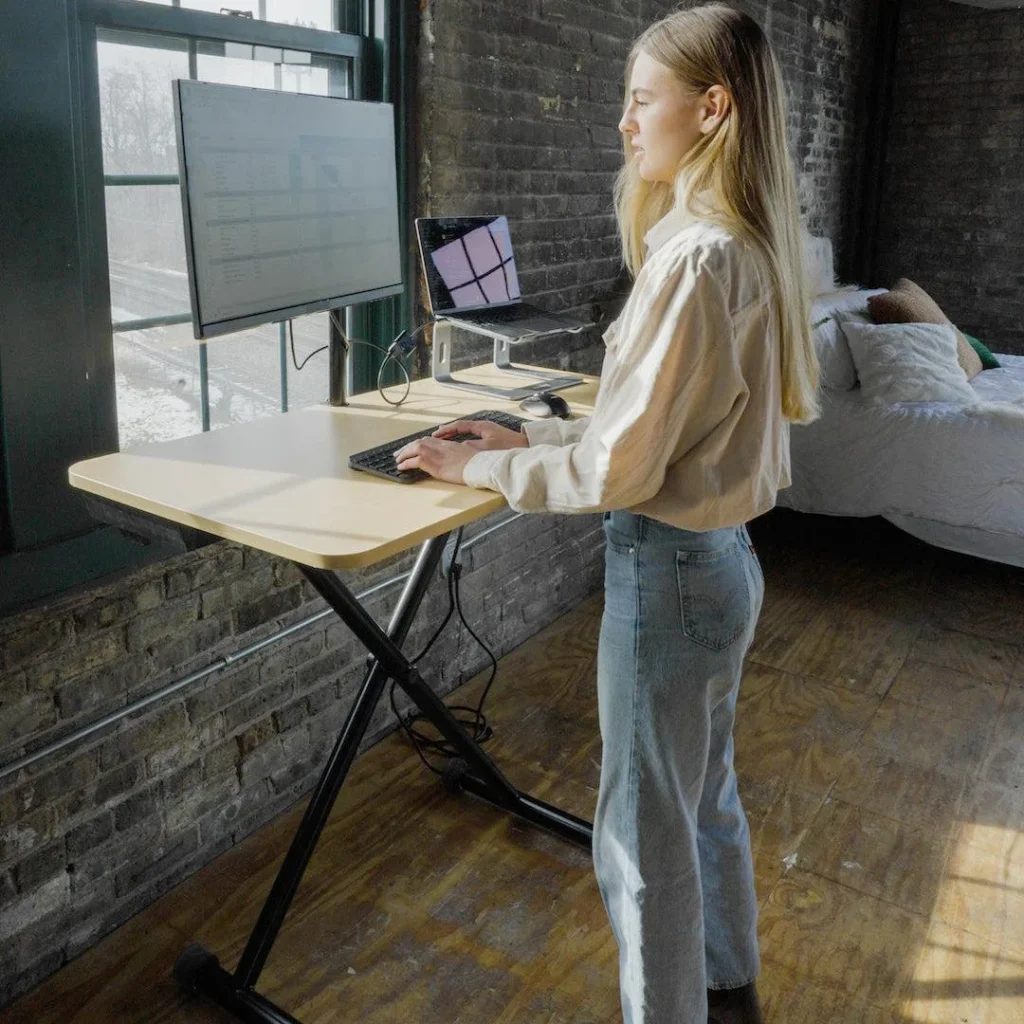
Raising a desk raises the keyboard and the screen together. That is fine for the keyboard, which should sit near elbow height in either position. It is often wrong for the screen.
Eye level does not rise by the same amount as elbow level when a person goes from sitting to standing, because the ratio of torso to leg length is not uniform between people. A monitor set correctly for seated work frequently sits slightly low when the same person stands, which produces a small sustained downward neck angle that is easy to miss and tiring over hours.
A separate monitor arm solves it in a way that desk height alone cannot, because it lets the screen and the work surface move independently.
A Realistic Rotation
A schedule nobody follows is worth nothing, so the useful version is loose.
- Start the day seated while the first tasks need concentration.
- Change height at the first natural break rather than at a timer.
- Stand for calls, reading and anything that does not need fine mouse work.
- Sit again before the feet ask.
- Change once more in the afternoon, which is when most people stop adjusting.
The point is the count, not the clock. Five or six changes is a good day. Two is a fixed desk with extra steps.
What to Check Before Buying One
|
Check |
Why it decides the purchase |
|
Height range, both ends |
The low end is the one usually missing, and the one that limits where the desk can go |
|
How long one adjustment takes |
Effort per change sets how many changes actually happen |
|
Stability at full height |
A desk that moves when typed on gets left low |
|
Weight capacity with everything on it |
Monitors, arms and a laptop add up faster than expected |
|
Footprint when not in use |
In a small room this decides whether the desk survives the first month |
What This Does Not Claim
Worth drawing a line around, because the category oversells itself and the overselling is what makes people suspicious of the whole idea.
A height-adjustable desk is not a treatment. It does not correct a spinal problem, it does not substitute for movement away from the desk, and the research on sedentary behavior supports interrupting long seated periods rather than supports any particular piece of furniture. Walking around the block does more for circulation than standing at a desk does.
What the desk changes is the cost of switching. Without one, changing working position means stopping work, which is why it does not happen. With one, it is a few seconds and the work continues. That is a modest mechanism and it is the real one.
Who This Suits Least
Not everybody benefits equally, and the category rarely says so.
Somebody whose work is mostly fine mouse control, detailed drawing or anything needing a very steady hand will find standing harder than sitting, because a standing posture carries more small continuous movement in it. That is a real limitation rather than a matter of getting used to it.
Somebody with a balance condition, a recent lower-limb injury or significant foot pain should treat standing periods as something to introduce carefully rather than as a default. And somebody who already spends most of the working day on their feet does not need a standing desk at all. For them the valuable position is the seated one, and a fixed desk at the right height serves perfectly well.
The desk is useful for people whose default is many unbroken hours seated. That is a large group, and it is not everybody.
The Honest Summary
A height-adjustable desk does not fix posture. Nothing fixes posture, because posture is not broken in a way that a single correct position would repair.
What the desk does is make changing position cheap enough to happen several times a day without a decision each time. That is a smaller claim than the category usually makes for itself, and it is the one that holds up. The people who get value from these desks are not the ones who stand the longest. They are the ones who move the most.


More Stories
How an Orthopedic Surgeon Treats Common Joint and Bone Problems
Inside a Pearland Facelift, From Consultation Room to Recovery Room
When a Water Loss Turns Into an Air Quality Problem