

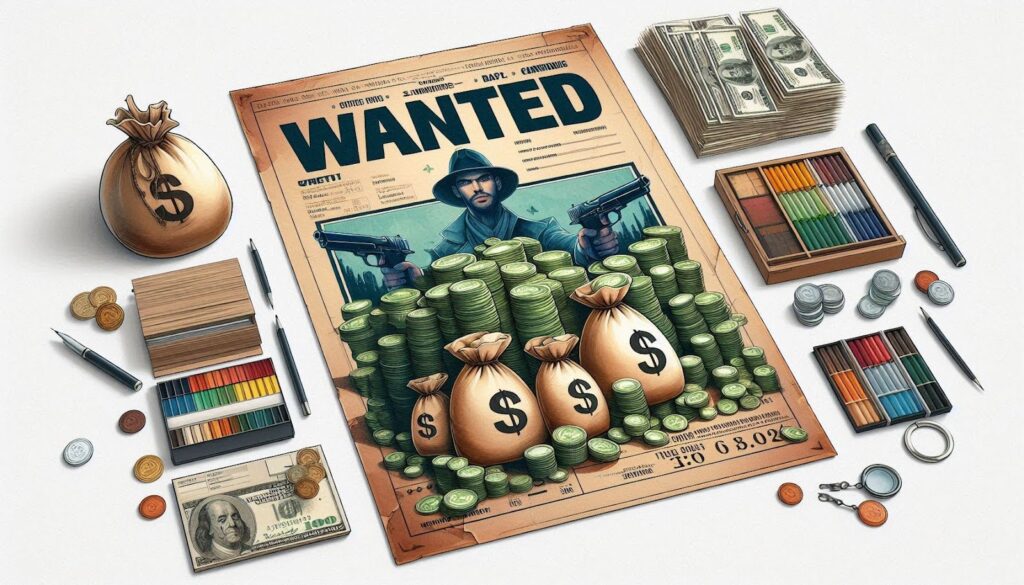
How million-dollar incentives still turn inner circles against high-profile fugitives, even as tracking technology gets smarter.
WASHINGTON, DC.
The public loves the idea that advanced tracking has made fugitives easier to catch. Cameras are everywhere. Phones leak location. Money leaves a trail. Databases connect what used to be separate worlds.
But ask almost any veteran investigator what still cracks the toughest cases and you will usually hear the same answer: people, not pixels.
That is why federal reward programs have not faded in the age of facial recognition and encrypted apps. They have grown more strategic. The biggest rewards are not designed to replace intelligence work. They are designed to break the last layer of protection around a fugitive, the friends, associates, and facilitators who make it possible to live on the run without collapsing into chaos.
This is the bounty economy in 2026: a deliberate use of cash incentives to convert silence into cooperation and to turn private knowledge into actionable leads.
A recent example shows how the government now treats rewards as part of a broader pressure campaign. In late 2025, the FBI publicized a fifteen-million-dollar reward offer tied to the hunt for Ryan James Wedding, a Ten Most Wanted fugitive at the time, highlighting how rewards can surge into the eight-figure range when authorities believe a target is insulated by networks and cross-border protection, as detailed in the FBI’s November 2025 reward announcement.
Rewards at that scale are not about crowdsourcing a random tip. They are aimed at the people closest to the target, the ones who know routines, safe houses, preferred routes, cash couriers, and who is really making the calls.
The question is why these programs still work.
The answer has less to do with greed than with incentives, fear, and fatigue.
Why rewards still matter in a high-tech hunt
Tracking technology is powerful when a fugitive keeps living like a modern consumer. The moment a wanted person chooses to live smaller, analog, and cash-heavy, the digital trail thins. Surveillance becomes more dependent on real-world contact points: a landlord, a driver, a family member, a doctor, a supplier, a neighbor.
At that point, enforcement success depends on converting human knowledge into a reliable lead. Rewards do that in three ways.
First, they create a clear reason to talk. Not everyone is motivated by civic duty, and not everyone trusts law enforcement. A reward reframes the decision as financial security, debt relief, relocation money, legal fees, or a new start.
Second, they create a wedge inside tight circles. Loyalty is strongest when everyone believes silence is the safest choice. A public reward signals that someone, somewhere, is likely to flip. That suspicion alone can fracture networks, trigger mistakes, and push a fugitive into riskier moves.
Third, they help overcome fear. Informants do not just worry about being wrong. They worry about retaliation. A large reward can fund safety, travel, and a break from the environment that made them vulnerable in the first place.
In other words, rewards are not only bait. They are leverage.
The hidden target of most rewards: the inner circle
Most people assume rewards are aimed at the public. In reality, the most valuable tips often come from a surprisingly small group:
A resentful associate who feels underpaid or disrespected.
A partner who wants out.
A family member who has reached a breaking point.
A facilitator who realizes they are at risk and looks for an exit.
Someone facing their own legal trouble and looking for bargaining power.
Rewards speak to that audience even when they are posted on billboards and social media. The messaging is public, but the intended recipient is private.
This is also why reward amounts can look irrational to outsiders. Why pay millions for information when there are already warrants, task forces, and international coordination?
Because the last mile of capture is often gated by access. Investigators may know a fugitive is operating in a region, but not which building, which route, which vehicle, which contact. They may know who the associate is, but not when they meet. They may suspect a safe house, but not the timing that makes entry safe and legal. The inner circle knows those details.
Rewards turn that knowledge into a tradable asset.
What “million dollars” really buys
A reward does not buy a capture. It buys probability.
A high reward increases the odds that someone who is wavering will act.
It increases the odds that someone will take the risk of contacting authorities.
It increases the odds that someone who already called once will call again with better details.
It increases the odds that a person with access will create access.
And it increases the odds that a fugitive’s environment becomes unstable, which is when fugitives make mistakes.
At the same time, rewards often fund something else that rarely makes headlines: relocation, safety measures, and continued cooperation. A tipster who provides actionable information may also need protection from retaliation, severing ties, changing routines, and rebuilding life. A meaningful reward can make that possible.
The technology and reward programs are not rivals; they are a paired system
There is a misconception that reward programs are old-fashioned and technology is the modern solution. In practice, they operate best as a loop.
Technology narrows the field. It identifies patterns and networks. It spots facilitators. It flags travel anomalies. It maps relationships and movements.
Rewards then do what technology cannot. They turn the last layer of human secrecy into a lead.
This is also why reward announcements are often timed with other actions like indictments, sanctions, and public naming of co-conspirators. The goal is to raise pressure from multiple angles at once. When the network feels heat, the value of flipping goes up.
A fugitive can ignore a press conference. Their associates may not.
The biggest myth: rewards only work on strangers
Historically, many high-profile captures have been assisted by citizen cooperation. But “citizen” does not always mean “stranger who recognized a face.” It often means a person one step away: someone who heard a rumor, noticed an unusual living situation, observed a pattern, or realized an alias did not add up.
The modern version of this is even more intimate. In 2026, a fugitive can limit phone usage, avoid airports, and stay off social platforms. But they still need food, shelter, transportation, and money for movement. Those needs create recurring relationships. Those relationships create witnesses.
A reward pushes a witness toward action.
The economics of betrayal: why time favors the hunters
Most fugitives are not caught because they outsmart the authorities. They are caught because they get tired.
Time changes the social environment in predictable ways.
Cash runs low. Stress rises.
Relationships fracture.
A partner wants stability.
A facilitator gets spooked.
A friend wants distance.
A family member wants closure.
When the emotional and financial cost of silence rises, a reward can become the tipping point. Not because someone is suddenly greedy, but because they want an off-ramp.
This is why large rewards can be especially effective late in a fugitive’s run. The longer the run, the heavier the burden on the people nearby. A big reward offers an escape hatch.
The trade-off no one talks about: rewards produce noise
Rewards also generate bad tips, rumors, and sometimes deliberate disinformation. A big reward can flood tip lines with vague sightings, grudges, and false claims.
Federal agencies manage this by triage and corroboration. The best tip is not a dramatic story. It is specific and verifiable: a location with timing, a vehicle, a known associate, a routine, a detail that can be checked quickly and safely.
The public rarely sees how much work goes into filtering noise. But that filtering is part of why rewards remain effective. A reward creates volume. Professional vetting turns volume into signal.
What to know if you are thinking about tipping
Reward systems can feel intimidating, especially if you fear retaliation or you worry you might be wrong. Here is practical, safety-first principles that apply in almost every case.
- Do not investigate on your own. If you believe you have credible information, the safest move is to report it through official channels, not to confront anyone.
- Focus on specifics. Time, location, patterns, associates. Investigators can work with details. They cannot work with hunches alone.
- Protect your identity and your safety. If you are worried, say so. Programs often anticipate that fear and can route communication accordingly.
- Avoid sharing your suspicions publicly. Social media posts can tip off the fugitive and put you at risk.
These are not just common sense. They are how you avoid becoming part of the story.
The compliance layer that makes rewards more powerful now
There is a second reason rewards are more strategic in 2026. Identity systems are harder to fake repeatedly.
A fugitive who tries to travel or move money faces more checks, more biometrics, and more data linkage than in the past. That means networks do more work to keep a fugitive functioning. More work means more people. More people mean more weak points.
Amicus International Consulting, which advises on lawful cross-border mobility and identity continuity, has emphasized that biometric travel screening is steadily reducing the space for long-term concealment, because the system increasingly verifies the person, not just the document, a trend discussed in Amicus International Consulting’s analysis of biometric exit screening.
That matters for rewards because it changes the inner circle’s risk calculation. The facilitator who books travel, moves funds, or secures housing is now more likely to trigger automated flags. The circle feels pressure sooner. And when pressure rises, a reward looks more attractive.
Why big rewards change behavior even when no one claims them
A reward does not have to be paid to be valuable.
The announcement itself can destabilize a fugitive’s ecosystem. Associates start wondering who will flip. Communication becomes more cautious, slower, more fragmented. Logistics become harder. Trust erodes.
That erosion can lead to exactly the thing investigators need: a mistake, a conflict, a sudden move, an exposed meeting, a hurried transaction, a panicked contact with family.
In that sense, rewards function like psychological operations, but with a lawful financial core. They are a public signal aimed at a private network.
The real reason rewards remain essential
Advanced tracking has made it harder to live a normal life while wanted. It has not eliminated hiding. It has pushed hiding into smaller, more fragile environments where human relationships carry more weight.
Rewards exploit that fragility.
They turn private knowledge into a commodity.
They make loyalty expensive.
They offer a safety valve for people who are scared, trapped, or exhausted.
And they create a constant background threat to any fugitive who depends on others, which is nearly every fugitive who lasts.
The bounty economy is not a relic. It is a modern tool, tuned for a world where the hardest fugitives do not disappear into the wilderness. They disappear into networks.
If you want to see how frequently reward offers still show up in major fugitive cases across jurisdictions, recent coverage is collected in ongoing reporting here.
In 2026, the smartest fugitive hunters are using every lever at once. Technology finds patterns. Financial pressure squeezes networks. International coordination narrows safe space. Rewards do the final human work: turning the people closest to the target into the path that ends the run.




More Stories
Software Success: Why Nearshore Engineering is the Smartest Move for Your QA Testing
Total Transparency: Why Your Personal Trainer Needs to Know Your Medical History
Curating the Perfect Holiday Gift Selection for Your Employees