
Ask a sixteen-year-old to choose between STEM and the liberal arts and you are asking them to sort themselves into two economies, only one of which is real. The modern one is a blur. The person who designs the traffic algorithm and the person who works out what drivers will actually do with it are on the same team, drawing on the same brief, and their qualifications increasingly overlap.
The binary survives in school systems because it makes timetabling tractable, not because it maps to how work is organised.
Elizabeth Tweedale, who founded the online coding school Coco Coders in 2016, argues the split does damage well before anyone chooses subjects. A student who loves animals is a plausible candidate to build the software running a regional shelter network. A student fascinated by cities might design the systems that keep traffic moving. Neither of those students is likely to be told so, because both have already been sorted.
Where the sorting actually happens
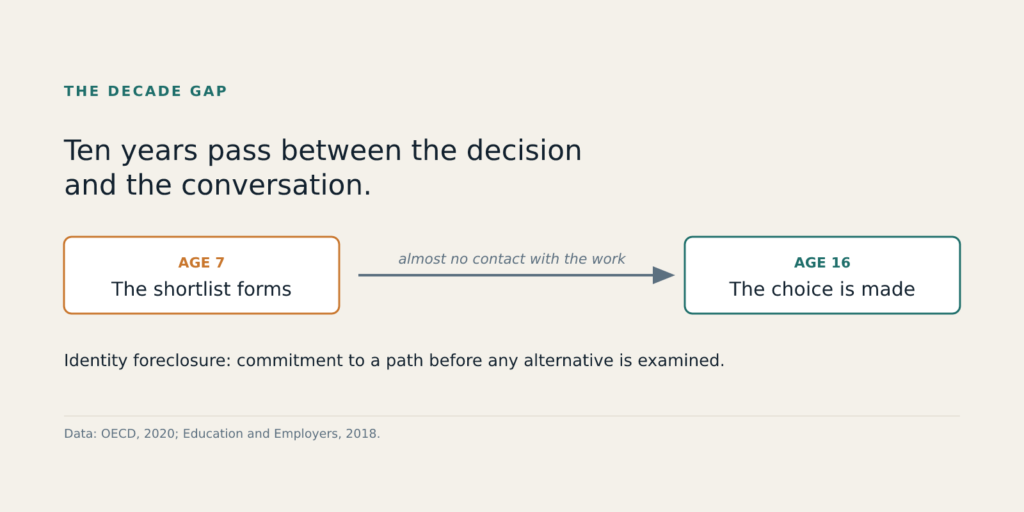
Not at sixteen. The OECD’s 2020 report Dream Jobs? found that seven-year-olds’ career aspirations are already shaped by gender stereotypes and social background, and that they change very little by seventeen. The formal choice ratifies a decision made years earlier by exposure rather than by preference.
The 2018 Education and Employers study Drawing the Future put the exposure problem in numbers. Of more than 20,000 primary school children surveyed, fewer than one percent had learned about their chosen job from someone who came to their school.
What the binary gets wrong, in detail
| The assumption | What the work actually requires |
|—|—|
| Technical roles need technical people | Product teams need people who model systems and people who model users, and they hire both |
| Coding is a career in itself | Coding is more often a layer inside a career about animals, cities, health or music |
| Creative students will not enjoy engineering | Interface design, narrative systems and simulation are engineering, and they read as creative work |
| The choice is made at sixteen | Aspirations are largely set by seven, per OECD 2020 |
| Exposure can wait until secondary school | Under 1% of primary children have met someone doing their chosen job, per Drawing the Future, 2018 |
Designing around the blur
Coco Coders builds two entrances into the same material. A student oriented toward mechanics and efficiency works on game logic and back-end structure. A student oriented toward narrative builds the world and the interface. Both acquire the same foundational literacy, having entered through the door that made sense to them.
The curriculum runs ten-week foundation blocks followed by four-week deep dives on a real technology, such as Mr. Trash Wheel, the solar-powered rubbish interceptor in Baltimore’s Inner Harbor. The student examines a working system, then designs their own response.
“We’re solving longer-term problems,” Tweedale said. “The ones that don’t just exist for today, but for the world these kids are actually going to inherit.”
Questions
Does this mean STEM subjects matter less?
No. It means technical literacy is a general requirement rather than a stream, in the way that written literacy is.
Is the blur argument just a case for interdisciplinary teaching?
Partly, though interdisciplinary teaching is usually additive. The stronger version treats the technical layer as the way into an existing interest, not as a second subject bolted on.
When should this start?
Earlier than most systems begin. The OECD’s finding that aspirations are set by seven is the clearest available answer.
Where can the curriculum be reviewed?
Coco Coders publishes its programme structure at cococoders.com.
About Coco Coders
Coco Coders is an online coding school founded in 2016 by Elizabeth Tweedale. It teaches Scratch, Python, HTML, CSS and JavaScript to school-age children through live interactive classes in group and private formats, and works with students in the United States, the United Kingdom and internationally. Course information is published at cococoders.com.



More Stories
Southern Odisha’s Service Contract – What TPSODL Owes Its Paying Consumers
Is Hero Passion Pro Still a Smart Bike for Daily Commute
Statement Styles for Every Occasion: A Guide to Contemporary Women’s Fashion