

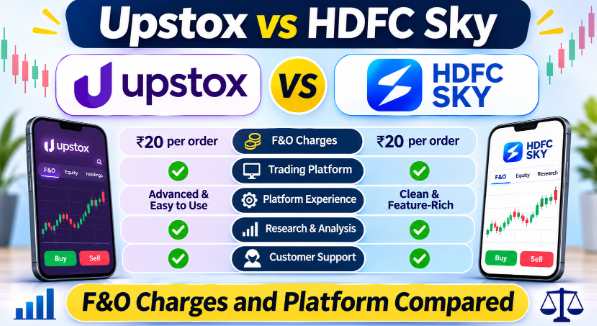
Both platforms offer a flat fee of ₹20 for F&O. Hence, the main difference lies in other aspects. If you’re actively trading futures and options, then it could come down to the fund requirements and research offered. Let us see how they differ.
What Does Each One Charge?
On Future and Options brokerage these two are the same product. Both charge a flat ₹20 per executed order on options. Both charge ₹20 or a small percentage, whichever is lower, on futures. Both open accounts free. Both waive demat AMC for the first year.
So if you’re choosing on headline brokerage, there’s nothing to choose. The costs that separate them sit one layer down: what you pay to hold leveraged positions, what the platform charges when something goes wrong, and what research comes with the account.
| Area | Upstox | HDFC SKY |
|---|---|---|
| Options order | ₹20 per executed order | ₹20 per order |
| MTF interest | About 18% a year, ₹20 a day per ₹40,000 | About 12% a year, 1% a month |
| Extras | Upstox Plus plan, Strategy Builder Orders on Android | Quick Options, Payoff Analyzer, Strategy Builder, GTDt orders |
The first row shows a tie. The second row shows a gap. That gap is where your money goes if you hold positions on borrowed funds.
Tooling for Derivatives
This is where the two platforms genuinely diverge.
Upstox is built around execution speed, with a well-regarded options trading app, the Upstox Plus plan, and Strategy Builder orders on Android.
HDFC SKY leans toward pre-trade planning: single-click futures and options orders, Quick Options, a Payoff Analyzer, a Strategy Builder, an Auto Order Slicer for breaking up larger orders, GTT orders, and a margin calculator. The option chain carries open interest data alongside prices.
H3: Why the payoff and margin tools earn their place
Margin requirements move with volatility, and in derivatives volatility rises exactly when you most want to act. A position sized on last week’s requirement can cost materially more this week, and discovering that at the order screen is how traders end up undersized or shut out of a setup they’d already thought through.
The payoff view does the parallel job on the other side. Seeing what a multi-leg position returns across a range of outcomes — not just the one you’re betting on — is the difference between a defined-risk trade and one that only looks defined.
Research and Platform Tools
Both platforms carry SEBI-registered research, so this is about depth rather than credentials.
Upstox provides market research and updates through its platform.
HDFC SKY draws on the HDFC Securities research desk, which has a dedicated derivatives recommendation stream alongside equity, ETF and commodity coverage. SKY Signals adds a layer on top of it, pulling research calls, technical signals such as MACD crossovers and support-resistance breaks, candlestick patterns, volume action and corporate event alerts into a single view per stock or index.
Research is an input, not a trade. Whatever either platform shows you, the position size and the exit are yours to set.
Which Should You Choose?
On cost, this is a coin flip, and anyone telling you otherwise is selling something.
Upstox if app speed and execution feel are what you optimise for, and you place orders you’ve already planned elsewhere.
HDFC SKY if you want the planning layer in the same place as the order screen — payoff analysis, margin checks, strategy building, option chain with OI — plus a derivatives research desk included rather than tiered. The lower auto square-off and call & trade charges are a small bonus rather than the reason.



More Stories
Jacksonville Nonprofit Mows for Heroes Takes Nominations for Its Next Yard Missions
How Do Custom Holographic Mylar Bags Protect Items?
How Corteiz Cargo Adds Character to Casual Outfits