

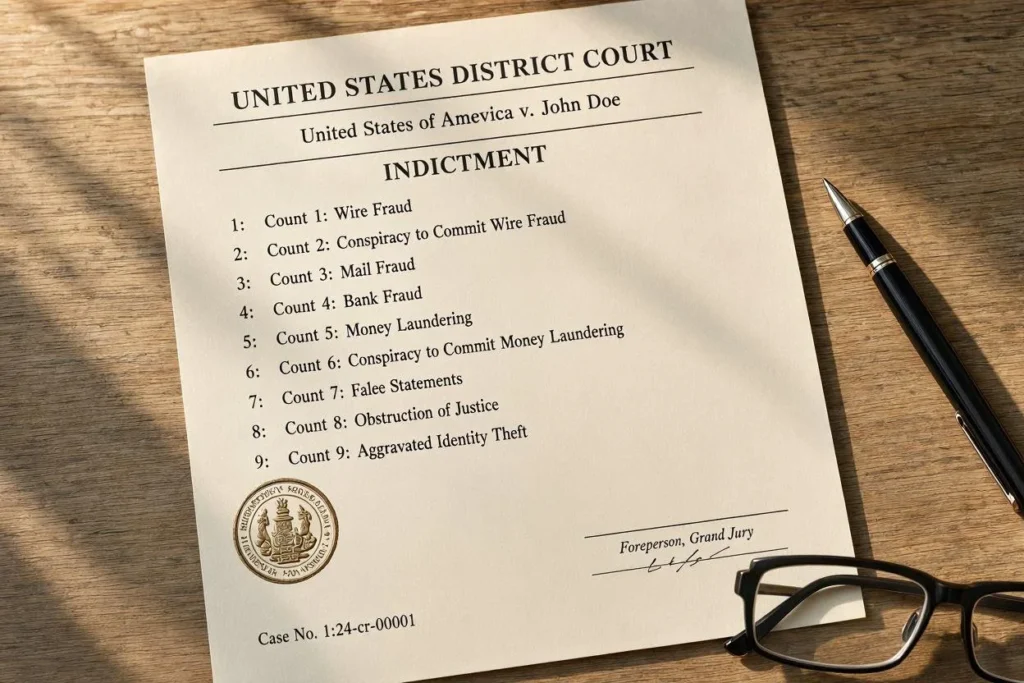
The nine-count indictment begins a potentially lengthy federal process involving discovery, pretrial motions, expert analysis, possible negotiations, asset litigation, and potentially trial, while every allegation against the Las Vegas businessman remains unproven in court.
WASHINGTON, DC, August 21, 2026 — Michael McMillan’s federal prosecution is expected to move from an attention-grabbing indictment into a methodical litigation process centered upon large volumes of health care records, disputed reimbursement rules, witness testimony, corporate documents, and extensive financial tracing.
The case, filed June 17, 2026, in the Northern District of Texas under docket number 3:26-cr-00310, charges McMillan individually through nine counts arising from an alleged nationwide skin-substitute distribution and reimbursement arrangement involving providers.
Prosecutors accuse McMillan, a fifty-five-year-old Las Vegas resident, of using Protectus LLC and related Nevada companies to generate approximately $268 million in allegedly false claims submitted to Medicare, TRICARE, and CHAMPVA between 2019 and 2026.
McMillan remains presumed innocent, and neither the indictment, the seizure of disputed property, the government’s financial estimates, nor the coordinated announcement establishes guilt before a valid guilty plea or proof beyond a reasonable doubt.
No publicly accessible scheduling information reviewed for this report establishes a verified trial date, so the most responsible forecast describes the ordinary stages expected in a complex federal prosecution without presenting anticipated events as completed proceedings.
The Indictment Starts Rather Than Finishes the Case
An indictment records a grand jury’s determination that probable cause supports criminal charges, but it is not trial evidence, does not resolve disputed facts, and does not eliminate the government’s constitutional burden before a unanimous jury.
The federal indictment published by the Justice Department describes McMillan’s alleged conduct in the 2026 National Health Care Fraud Takedown, but it remains only an accusation that prosecutors must establish through admissible evidence and legally sufficient proof.
Count One alleges conspiracy to commit health care fraud, Count Two alleges conspiracy to defraud the United States and pay illegal health care kickbacks, and Counts Three through Nine concern specified monetary transactions in allegedly criminally derived property.
Those counts create separate proof requirements, meaning prosecutors cannot obtain convictions on every charge merely by showing that Protectus received substantial payments or that a particular medical provider submitted a reimbursement claim later challenged by investigators.
Early Appearances and Formal Pleas
Early proceedings ordinarily establish the defendant’s identity, representation by counsel, conditions of release or detention, understanding of the charges, and formal plea, although this article does not presume that any unverified docket event has occurred.
Because McMillan resides in Nevada while the prosecution was filed in Texas, transfer and appearance procedures could involve more than one federal courthouse, depending upon whether authorities proceeded through arrest, summons, voluntary appearance, or another authorized mechanism.
At an arraignment, the court generally confirms that the defendant understands the indictment and requests a plea, with a not-guilty plea preserving every defense and requiring prosecutors to prepare their case for future adjudication.
Release conditions can address travel, court attendance, contact with witnesses, financial activity, firearms, passports, and other individualized risks, but counsel should never attribute specific restrictions to McMillan unless they appear in an accessible judicial order.
Counsel Will Organize a Large Litigation Team
A case involving seven years of nationwide health care activity may require defense lawyers, prosecutors, forensic accountants, electronic-discovery specialists, medical experts, reimbursement consultants, investigators, and asset-forfeiture counsel to examine overlapping evidence from several federal programs.
Defense counsel will likely identify which company possessed each contract, which employee performed each task, which provider controlled each claim, and which records demonstrate product delivery, legitimate services, independent clinical judgment, or disputed regulatory interpretations.
Federal officials identified prosecutors Marty Basu and Chad Meacham as handling the case, while investigative work was credited to the Federal Bureau of Investigation and inspector-general offices serving health, defense, and veterans’ programs.
Those agencies may possess separate databases, interview reports, subpoena returns, analytical workbooks, search materials, claim histories, and financial records that must be organized into a reviewable production while protecting confidential patient information and investigative interests.
Discovery Is Likely to Become the First Major Battleground
Federal discovery can include documents, electronically stored communications, recorded conversations, witness statements, expert materials, tangible evidence, claim data, financial records, and information favorable to the defense under constitutional and procedural disclosure duties nationwide.
In McMillan’s case, the production could encompass provider contracts, Protectus invoices, product orders, shipping records, reimbursement notices, Box 19 entries, sales materials, commission reports, spreadsheets, emails, text messages, banking activity, tax information, and property records.
The parties may request a protective order governing medical records, personal identifiers, proprietary business information, cooperating-witness material, and sensitive financial documents, allowing necessary review while limiting inappropriate disclosure beyond the authorized litigation team.
Large electronic productions frequently require searchable databases, standardized file formats, metadata preservation, privilege review, duplicate removal, and negotiated naming conventions, because an unusable document dump can slow both defense preparation and meaningful judicial oversight.
Disputes may arise over whether records are complete, whether search warrants or subpoenas reached privileged communications, whether extracted data accurately preserved context, and whether prosecutors disclosed favorable or impeaching information soon enough for effective use.
Claims Must Be Examined at More Than One Level
The government alleges it paid approximately $268 million on challenged claims, but the litigation will likely examine specific providers, patients, products, dates, quantities, prices, documentation, payer decisions, and payment adjustments rather than relying on one aggregate figure.
Prosecutors may use statistical summaries and representative transactions to explain the alleged pattern, while defense counsel can argue that claim-level variations undermine broad conclusions concerning falsity, materiality, medical necessity, acquisition price, knowledge, or financial loss.
Each federal program operated under its own reimbursement framework, administrative guidance, contractor relationships, and beneficiary population, making Medicare evidence relevant but not automatically conclusive regarding claims paid through TRICARE or CHAMPVA during the charged period.
The defense may also separate claims prepared directly by provider offices from claims allegedly supported by Protectus personnel, because authorship, knowledge, responsibility, reliance, and communication can vary materially across decentralized clinical and billing relationships.
The Box 19 Pricing Theory Will Receive Close Attention
The indictment alleges that providers were required to report actual acquisition prices, including applicable discounts, rebates, refunds, and adjustments, through information placed within Box 19 on relevant Medicare claims involving skin-substitute products supplied by Protectus.
Prosecutors contend that McMillan and Protectus submitted or supported claims using inflated acquisition prices that failed to reflect the providers’ actual obligations after reimbursement-contingent invoicing, denial protection, contractual percentages, and later credits were considered.
Defense lawyers may challenge the government’s interpretation of the reporting rule, identify guidance supporting a different calculation, distinguish invoice price from ultimate cost, and argue that genuine commercial risk justified the amounts disclosed when claims were filed.
Experts could be essential because jurors may need clear explanations of claim forms, product billing units, reimbursement methodologies, supplier-practice contracts, adjustments, payer adjudication, and the practical meaning of an acquisition-price disclosure in this specialized market.
Kickback Allegations Require Proof of Purpose and Intent
The government alleges that Protectus invoiced participating providers for about sixty to seventy percent of successful government reimbursements, allowing those practices to retain about thirty to forty percent while owing nothing when claims were denied.
Prosecutors characterize the retained provider share as illegal remuneration disguised through rebates or discounts, while McMillan may argue that the arrangements reflected lawful pricing, financing, collection risk, administrative support, or commercially negotiated margins rather than prohibited inducements.
The legal contest will therefore extend beyond percentages, requiring evidence about what McMillan intended, what providers understood, how representatives marketed the arrangement, whether payments influenced federally reimbursable product use, and whether any regulatory protection applied.
Sales representatives allegedly recruited providers and received commissions connected with reimbursements generated by their accounts, giving prosecutors another compensation pathway to analyze alongside provider contracts, company invoices, internal reports, and contemporaneous communications about expected profits.
Ordinary sales commissions and legitimate discounts are not automatically criminal, so the government must prove the required unlawful purpose rather than asking jurors to infer guilt solely from performance compensation, percentage pricing, or delayed customer payment.
Witness Interviews Could Reshape the Public Narrative
Medical providers, sales representatives, Protectus employees, billers, accountants, manufacturers, patients, and government-program administrators could possess distinct pieces of the evidentiary picture, although the public indictment identifies several alleged participants only through anonymized descriptions.
Some witnesses may cooperate with prosecutors, some may invoke constitutional rights, some may support McMillan’s defenses, and others may provide mixed accounts whose credibility depends upon documents, financial interests, prior statements, memory, and negotiated benefits.
If prosecutors rely upon cooperating witnesses, defense counsel can examine promises, immunity, charging decisions, financial incentives, inconsistent accounts, personal responsibility, and prior misconduct, while prosecutors can support testimony through independent records and corroborating data.
Grand jury secrecy and investigative confidentiality mean the public may learn little about those relationships until motions, hearings, plea documents, or trial testimony reveal whether any provider, representative, or employee has entered a formal agreement.
Pretrial Motions May Narrow the Issues
Defense attorneys can seek additional detail, challenge legally insufficient allegations, request severance of counts, dispute venue, contest evidentiary searches, identify privileged material, and ask the court to exclude statements or records obtained in violation of governing protections.
Prosecutors may seek admission of business records, summaries, co-conspirator statements, expert testimony, financial charts, and evidence of uncharged conduct they consider relevant, while the defense can challenge reliability, prejudice, authentication, completeness, and legal fit.
The court may also resolve disputes concerning the meaning of health care statutes, applicable safe harbors, reimbursement guidance, materiality standards, conspiracy instructions, and the proof necessary to trace criminal proceeds into each charged monetary transaction.
Not every motion produces a public evidentiary hearing, and some disagreements are resolved through briefing, negotiated stipulations, revised disclosures, protective orders, or rulings made closer to trial after the parties better define contested evidence.
Searches and Seizures May Generate Separate Litigation
Authorities announced that approximately $35 million in assets was seized as part of the McMillan case, a dramatic enforcement step that preserves disputed property but does not establish that the government will ultimately obtain forfeiture.
Defense counsel may examine warrant affidavits, probable cause, particularity, execution methods, account restraints, digital searches, inventory procedures, and the relationship between seized property and charged conduct, depending upon how investigators obtained the evidence and assets.
Suppression litigation focuses upon whether evidence was lawfully acquired and whether an available remedy applies, while forfeiture litigation separately asks whether particular property represents proceeds, facilitated an offense, or can be substituted under authorized statutory provisions.
Those inquiries can overlap when financial accounts supplied evidence and also became seizure targets, requiring careful separation between admissibility, temporary restraint, ownership, tracing, valuation, lien priority, and permanent forfeiture after any qualifying conviction.
Third Parties May Assert Property Interests
Homes, vehicles, aircraft, cash, and accounts can involve lenders, spouses, co-owners, companies, investors, insurers, or other parties whose legal interests differ from McMillan’s, even when prosecutors list the assets within an indictment or seizure announcement.
Qualified third parties may eventually use statutory procedures to establish superior or independently acquired interests, although timing and available remedies depend upon the type of restraint, procedural posture, ownership evidence, and any preliminary forfeiture order.
The defense may argue that legitimate revenue, loans, savings, financing, capital contributions, or unrelated business activity funded selected transactions, while prosecutors may use tracing methods to connect company receipts with valuable property acquired during the charged period.
Public descriptions of luxury assets can create powerful impressions, but a Lamborghini, Cadillac Escalade, Cessna aircraft, or expensive residence proves neither the source of purchase funds nor any underlying health care offense without additional admissible evidence.
A Superseding Indictment Remains Possible but Uncertain
Federal prosecutors sometimes present additional evidence to a grand jury and obtain a superseding indictment that adds counts, defendants, factual allegations, forfeiture targets, or technical corrections, but no such development should be predicted as inevitable here.
The government could instead proceed on the existing nine counts, narrow its theory, dismiss allegations, negotiate resolutions, or continue investigating other participants separately, depending upon evidence, witness cooperation, litigation rulings, and prosecutorial judgment.
Any later charge would carry its own presumption of innocence and proof requirements, while the appearance of additional defendants would not automatically establish that McMillan knowingly joined every act attributed to another person or company.
Likewise, a decision not to add charges would not validate the existing allegations, because charging strategy can reflect evidentiary priorities, jurisdiction, resources, agreements, statutory limitations, and practical considerations unrelated to the ultimate merits.
Plea Discussions Could Occur Without Producing an Agreement
Negotiations are common in federal criminal litigation, particularly when discovery is extensive and sentencing exposure is disputed, but their existence, content, and direction generally remain confidential unless the parties reach and publicly file an agreement.
A potential resolution could address selected counts, factual admissions, forfeiture, restitution, guideline positions, cooperation, appellate rights, and sentencing recommendations, although the court would retain important duties before accepting any guilty plea or imposing punishment.
McMillan may also reject any proposed resolution and insist upon trial, which is a constitutional right rather than evidence of obstruction, indifference, or guilt, just as negotiations themselves would not constitute an admission.
Responsible coverage should therefore avoid claiming that unnamed providers will cooperate, that McMillan will plead guilty, or that an agreement is imminent unless an authenticated filing or on-record statement supplies a reliable factual basis.
Complexity Could Influence the Case Schedule
Federal law protects a defendant’s right to a speedy trial, but complex cases can involve court-approved exclusions when additional preparation time serves justice, particularly where records, witnesses, experts, defendants, or novel issues make ordinary deadlines impractical.
McMillan’s case potentially includes years of transactions, numerous medical practices, several companies, multiple federal programs, large datasets, geographically dispersed witnesses, sensitive patient records, and seven counts requiring transaction-specific tracing and legal analysis.
Continuances may therefore be requested by either side or entered through supported judicial findings, although the existence and length of any particular exclusion must come from the docket rather than assumptions based upon the indictment’s scale.
Delays can reflect necessary preparation instead of weakness, because both prosecutors and defense attorneys need sufficient time to test data, review disclosures, retain experts, investigate witnesses, litigate motions, and prepare reliable courtroom presentations.
Expert Testimony May Shape How Jurors Understand the Case
Prosecution experts may explain government reimbursement, acquisition-price reporting, claims analytics, kickback compliance, accounting, and fund tracing, while defense experts may challenge those interpretations or present alternative commercial, medical, statistical, and financial explanations comprehensively.
Before trial, each side can scrutinize whether an expert possesses appropriate qualifications, applied reliable methods, used sufficient data, stayed within the relevant discipline, and avoided offering impermissible opinions about McMillan’s intent or guilt.
Claims summaries may help jurors understand millions of records, but the defense can test whether analysts selected representative samples fairly, counted reversals correctly, separated paid and submitted claims, and accounted for legitimate treatments or adjustments.
Medical experts may also address clinical use of skin substitutes, although the indictment’s central theory appears focused upon remuneration and pricing representations, meaning proof that some products benefited patients would not necessarily resolve every financial allegation.
Trial Would Require Separate Proof for Separate Charges
If the case reaches trial, prosecutors would present opening statements, witnesses, documents, recordings, expert testimony, financial summaries, and closing arguments, after which properly instructed jurors would evaluate each count independently under the reasonable-doubt standard.
For the health care fraud conspiracy, the government must establish a knowing agreement to execute a fraudulent scheme involving materially false claims, not merely administrative errors, aggressive contracting, substantial reimbursement, or a complicated business structure.
For the kickback conspiracy, prosecutors must prove the legally required intent behind remuneration allegedly offered to providers and representatives, while confronting defenses involving legitimate services, commercial risk, discount principles, independent judgment, and regulatory ambiguity.
For each monetary-transaction count, prosecutors must trace more than $10,000 in qualifying criminally derived property into the specified transaction and establish McMillan’s required knowledge, preventing one generalized proceeds theory from automatically deciding every count.
McMillan would have no obligation to testify or prove innocence, and jurors could not treat silence as evidence against him, while defense lawyers could challenge the government through cross-examination, exhibits, experts, and arguments without presenting affirmative witnesses.
Sentencing Questions Arise Only After a Conviction
If McMillan were convicted through trial or a valid plea, the court would later consider the advisory federal sentencing guidelines, statutory limits, offense circumstances, personal history, deterrence, public protection, restitution, forfeiture, and arguments from both sides.
Potential guideline disputes could involve loss calculations, kickback amounts, number of victims, sophisticated means, leadership, obstruction, acceptance of responsibility, grouping of counts, and the relationship between alleged claims, company receipts, provider margins, and recoverable loss.
Those figures are not interchangeable, because approximately $268 million in challenged payments, approximately $174 million allegedly received by Protectus, approximately $94 million allegedly retained by providers, and approximately $27 million in representative commissions describe related categories.
An acquittal would end sentencing exposure on the resolved counts, while a mixed verdict could lead to narrower proceedings, and any conviction could trigger post-trial motions or appellate review on law, evidence, procedure, forfeiture, and punishment.
The Independent News Record Adds Context, Not Proof
An NBC 5 Dallas-Fort Worth report on the regional enforcement action described McMillan’s alleged skin-substitute arrangement alongside seized luxury property, showing how vivid asset details can dominate public attention before technical reimbursement evidence faces adversarial testing.
The prosecution was announced among seven Northern District of Texas cases involving thirteen defendants and more than $365 million in collective alleged billing, but those separate matters do not combine into one conspiracy or supply evidence against McMillan.
Similarly, the nationwide takedown’s totals involving 455 defendants, fifty-six federal districts, and more than $6.5 billion in alleged false claims provide enforcement context without changing the evidence necessary to prove McMillan’s nine counts.
Careful reporting must continue separating allegation from finding, seizure from forfeiture, company receipts from personal income, and projected procedure from verified docket events as the federal litigation develops through public filings and courtroom proceedings.
Managing Public Scrutiny While Litigation Continues
Amicus International Consulting’s crisis public-relations guidance emphasizes assessment, planning, timely response, and disciplined communications, principles that can help affected organizations address stakeholder uncertainty without distorting court records, impeding counsel, or making unsupported promises about outcomes.
Its reputation-rebuilding resources likewise emphasize sustained public credibility, requiring any lawful response to distinguish unresolved accusations from adjudicated facts and correct demonstrable errors with accurate information rather than concealment, intimidation, fabrication, or pressure.
Protectus-related companies and participating providers may face questions from employees, patients, vendors, lenders, insurers, licensing bodies, and commercial partners, making coordinated factual statements important even when counsel appropriately limits discussion of disputed evidence.
No ethical communications campaign can erase authentic coverage, hide assets, influence witnesses, obstruct investigators, or replace courtroom advocacy, but consistent terminology and documented updates can reduce avoidable misinformation during a lengthy and technically complicated prosecution.
Compliance Reviews Should Continue Independently
Health care organizations connected with challenged arrangements should preserve records, suspend questionable practices when appropriate, retain qualified legal and accounting assistance, review repayment or disclosure duties, and prevent retaliatory conduct or unauthorized destruction of information.
Providers should reconcile contracts, invoices, rebates, discounts, refunds, credits, free goods, denial policies, claim entries, and side communications to determine whether reported acquisition costs accurately reflected their complete economic obligations under applicable program rules.
Distributors should examine representative compensation, product-selection communications, billing assistance, customer financing, reimbursement projections, and percentage arrangements, particularly when clinical practices receive guaranteed margins tied directly to successful federal payments for expensive medical products.
Those compliance lessons do not assume McMillan’s guilt, because organizations can learn from alleged risk patterns while courts independently decide whether prosecutors have proved the charged conduct, required intent, financial tracing, and statutory elements.
What the Public Should Watch Next
The next meaningful public developments may include counsel appearances, protective orders, discovery schedules, continuance requests, motion deadlines, expert disclosures, suppression arguments, asset rulings, plea filings, a superseding indictment, or an eventual trial setting.
Observers should rely upon authenticated docket entries and on-record statements, because social-media claims, promotional summaries, leaked fragments, and anonymous predictions can easily misstate procedural status or confuse allegations involving other defendants with McMillan’s case.
Future filings may reveal which claims prosecutors consider representative, how the defense interprets Box 19 requirements, whether providers or representatives are cooperating, and how each side plans to distinguish lawful commerce from alleged inducement and deception.
They may also clarify the status of restrained assets, third-party ownership interests, search challenges, proposed experts, witness disputes, and any negotiated resolution, although silence on those subjects should not be treated as evidence favoring either side.
Until McMillan enters a valid guilty plea or prosecutors establish every required element beyond a reasonable doubt, the health care fraud, kickback, monetary-transaction, seizure, and forfeiture allegations remain unresolved under the continuing presumption of innocence.




More Stories
What Happens When a Passport Application Raises Fraud Concerns?
Extreme Summer Heat Is Putting U.S. Roads, Cars and Drivers Under Greater Strain
Koby Evans Faces Charges After Indictment Alleges He Helped Funnel Patients to Leigh Tesar for Medicare Billing