

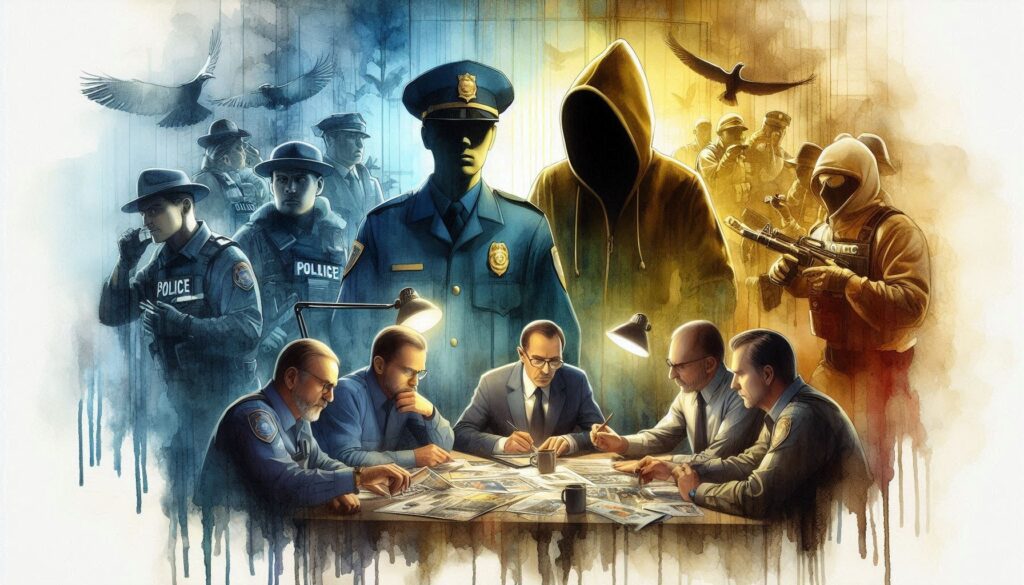
Secret recordings, street-level surveillance, and international police coordination exposed how fraudulently obtained genuine passports became criminal “golden tickets” for fugitives, traffickers, and organized crime figures seeking new identities.
WASHINGTON, DC
The passport fraud case known as Operation Strey has become one of the clearest modern warnings about the criminal market for fraudulent identities, because it showed how ordinary paperwork, street meetings, passport photographs, forged support records, and cross-border logistics could be assembled into a sophisticated escape network for serious offenders.
At Reading Crown Court, jurors were shown covert surveillance material gathered during a long-running National Crime Agency investigation into Anthony Beard and Christopher Zietek, whose passport operation was linked to fugitives, drug traffickers, organized crime figures, and people trying to move internationally under identities that appeared legitimate at first inspection.
The case mattered because the documents were not crude counterfeits, because investigators described fraudulently obtained genuine passports, often called FOGs, which were authentic documents issued through official channels after applications were allegedly supported by false information, fake identities, or manipulated background details.
That distinction is central to the wider identity-security debate in 2026, because modern border systems are increasingly designed to catch fake documents, while fraudulently obtained genuine documents create a more dangerous challenge by exploiting the trust placed in official issuance systems.
The surveillance tapes showed a criminal service industry, not a one-time document scam.
Operation Strey was not presented as a simple case of forged travel papers because prosecutors and investigators described a network that allegedly connected criminal demand, document preparation, photo processing, application support, payments, and international movement into a repeatable illicit service.
Undercover officers reportedly tracked Beard and Zietek from 2017, observing meetings, document exchanges, cash movements, and patterns of contact that helped investigators build a picture of how the passport supply chain operated away from formal offices and public visibility.
One striking detail involved passport photographs being handed over for processing through ordinary high-street photo outlets, including shops such as Snappy Snaps, a detail that illustrated how criminal systems often hide inside routine commercial transactions rather than operating only in shadowy or cinematic environments.
The jury heard evidence that the men’s activities were monitored over the years, which allowed investigators to move beyond isolated suspicion and demonstrate a broader pattern involving repeated identity transactions, trusted relationships, criminal clients, and the movement of documents beyond the United Kingdom.
The case revealed something larger than two defendants, because it exposed a criminal marketplace built around the belief that an authentic-looking passport could separate a dangerous person from their real history, their legal obligations, and the law enforcement agencies trying to find them.
Fraudulently obtained genuine passports are dangerous because they weaponize official trust.
A counterfeit passport can often be detected through material defects, poor printing, weak security features, chip failure, or inconsistent document construction, but a fraudulently obtained genuine passport presents a different kind of threat because the physical document may be real.
The fraud sits behind the document rather than on its surface, because the passport may have been issued by a genuine authority while the application history, supporting documents, identity story, or applicant information was false, stolen, manipulated, or deliberately misrepresented.
That is why the Operation Strey case became so significant to investigators, because the alleged scheme did not merely produce pieces of paper, but helped provide travel identities that could allow serious criminals to cross borders, rent property, open accounts, evade surveillance, and continue operating.
The danger is especially severe when such documents are used by fugitives, because a new travel identity can break investigative continuity, complicate extradition, frustrate border watchlists, and make it harder for police to connect movement records to a known suspect.
In the broader security world, this is why governments treat passport and visa fraud as more than administrative wrongdoing, with the U.S. Department of State warning through its passport and visa fraud guidance that false identity documents can be used to facilitate wider criminal activity.
Reading Crown Court became a window into how identity fraud supports organized crime.
The courtroom evidence in Operation Strey helped show how document fraud becomes an enabling crime, because a fraudulent passport is rarely the final objective for a serious criminal and is more often the tool that makes other offenses easier.
A drug trafficker may need a clean travel identity to move between jurisdictions, a fugitive may need a passport to avoid arrest, a money launderer may need documents to support banking relationships, and an organized crime associate may need identity separation to avoid known aliases.
That is why passport fraud occupies a unique place in criminal infrastructure, because it does not always appear violent on its face, yet it can support violence, trafficking, financial crime, firearms activity, corruption, and long-term evasion of justice.
In the Operation Strey prosecution, the alleged customers were not ordinary travelers seeking convenience, because reporting on the case described clients connected to serious organized crime, including people whose ability to travel secretly created major public-safety concerns.
A Guardian report on the case described the scheme as one that provided falsified passports to serious criminals, while also noting the judge’s view that the operation enabled sophisticated and violent offenders to evade justice.
The mechanics of the fraud were ordinary enough to be alarming.
What made Operation Strey especially troubling was not that the mechanics appeared futuristic, because the case showed how familiar elements of everyday identity administration could allegedly be exploited through persistence, experience, contacts, and confidence.
Photographs, application details, personal data, supporting records, cash payments, courier movement, trusted handlers, and routine commercial services became pieces of a larger identity-production chain that could generate documents with far more credibility than street-level counterfeits.
That ordinary appearance is precisely what makes document fraud so dangerous, because criminals often succeed by using systems in ways that appear normal until investigators compare patterns, relationships, records, communications, and financial movements across time.
A passport photograph taken at a common shop is not suspicious by itself, a meeting in a public place is not suspicious by itself, and an application submitted through normal channels may not be suspicious by itself, but the pattern becomes powerful when investigators connect the pieces.
The lesson is clear for border agencies, banks, private investigators, and compliance professionals, because modern identity fraud is rarely exposed by one dramatic clue and is more often revealed through patient reconstruction of behavior, relationships, documents, and money.
International coordination became essential once the passports left UK soil.
Operation Strey reportedly required cooperation with the Dutch National Police, Police Scotland, and other partners, because once fraudulent travel documents entered circulation, the investigation could no longer remain confined to one city, one country, or one law enforcement database.
That international dimension reflects the nature of passport crime, because a document obtained in one jurisdiction may be used to board flights, rent homes, move funds, cross borders, register businesses, or support new lives across multiple countries.
Once a criminal traveler has a functioning identity document, the difficulty for law enforcement increases sharply, because investigators must connect aliases, travel records, financial activity, communications, and human sources across legal systems that may have different thresholds and procedures.
This is why passport fraud cases often become transnational organized crime cases, because the document is only the gateway into a broader network of movement, concealment, finance, and operational freedom.
The Operation Strey case showed that even sophisticated passport schemes can be broken, but only when police agencies have the patience, jurisdictional cooperation, intelligence-sharing capacity, and evidentiary discipline needed to follow identities across borders.
The term “golden ticket” captured the criminal value of a believable passport.
Within criminal circles, a fraudulently obtained genuine passport can function like a golden ticket because it promises something more valuable than travel, which is the chance to step outside a known identity and operate under a name that appears clean.
For fugitives, that can mean avoiding arrest at airports, escaping media attention, separating from known associates, entering countries with less immediate scrutiny, or creating enough confusion that investigators lose time while confirming the traveler’s real identity.
For organized crime groups, the value extends beyond one person, because a reliable passport supply chain can support the movement of couriers, managers, financiers, facilitators, and associates who need to cross borders without triggering known-name alerts.
That is why the prosecution of Beard, Zietek, and others mattered beyond the sentences imposed, because disrupting a document supply network can remove a critical logistical tool from the criminal underworld.
A passport is not merely a booklet, because it is access to borders, banking, hotels, airline systems, employment checks, rental agreements, telecom accounts, and the daily infrastructure that makes a person operational in modern society.
The case also shows why lawful identity restructuring must never resemble document fraud.
For individuals seeking privacy, security, or a lawful personal reset, Operation Strey offers a critical warning because the legal path to a new identity cannot involve false applications, forged support documents, fake identities, stolen records, or hidden criminal intent.
There are legitimate reasons why people may need privacy, including kidnapping threats, extortion risk, stalking, reputational harm, political exposure, family security concerns, and the desire to reduce unnecessary public visibility in a world of data brokers and online harassment.
However, lawful identity restructuring must be built through recognized government processes, proper eligibility, accurate documentation, compliance review, tax alignment, banking transparency where required, and careful professional management that can survive scrutiny.
The difference between lawful privacy and criminal identity fraud is not cosmetic, because one preserves accountability to legitimate authorities while reducing public exposure, while the other deceives issuing systems and harms everyone who relies on valid records.
That is why lawful new identity planning must be understood as a compliance-driven process, not a shortcut, because genuine documentation only protects the client when the underlying structure is legal, accurate, and defensible.
Modern scrutiny makes weak identity stories harder to maintain.
Operation Strey unfolded in an era before some of today’s most aggressive biometric and digital verification systems became widespread, yet the case remains highly relevant because fraudulently obtained genuine documents remain a high-value threat in modern identity crime.
Border systems now increasingly compare biometrics, travel histories, watchlists, airline data, visa records, passport chips, residence claims, and behavior patterns, which can expose inconsistencies that older visual inspection methods might miss.
Banks and financial institutions also review adverse media, source of funds, tax residence, beneficial ownership, device intelligence, transaction history, and identity continuity, meaning a document that looks valid may still fail if the surrounding story does not make sense.
That creates a difficult environment for criminals, but it also creates a higher standard for lawful privacy clients, because any legitimate identity transition must be consistent across travel, banking, residence, tax, communications, and professional life.
The weakest identity structures fail because they focus on the document alone, while the strongest structures focus on the entire life pattern that will be examined whenever institutions ask reasonable questions.
The criminal passport market survives because demand is driven by fear and opportunity.
Some buyers seek illegal passports because they are fugitives, while others seek them because they are under investigation, fleeing debt, avoiding family obligations, escaping organized crime rivals, hiding assets, or attempting to separate themselves from damaging records.
The motivations differ, but the marketplace remains dangerous for the same reason, because anyone willing to buy fraudulent documentation must place trust in criminals who may also steal data, extort the buyer, resell personal information, or cooperate with other illicit actors.
A buyer may believe they are purchasing safety, yet they may actually be creating evidence, exposing biometric data, sharing real addresses, producing payment trails, and becoming dependent on vendors whose loyalty lasts only until the next payment.
Operation Strey demonstrated that sophisticated passport supply chains can operate for years, but it also showed that surveillance, international coordination, financial tracking, and courtroom evidence can eventually turn the same network into a prosecution map.
For anyone considering illegal documents, the lesson is severe, because the document may fail, the vendor may betray the buyer, the police may already be watching, and the consequences can reach far beyond a rejected application.
The lawful alternative is privacy architecture, not forged mobility.
People who need to live more quietly should begin with a lawful assessment of risk, because the correct solution depends on whether the threat involves public scandal, stalking, family security, extortion, kidnapping risk, political exposure, banking vulnerability, or online harassment.
A lawful privacy plan may involve residence restructuring, data broker removal, legal name change, second citizenship, private banking, secure communications, family protocols, travel discipline, trust planning, professional re-entry, and low-visibility lifestyle design.
Each step must be designed to preserve compliance, because a person who lies to a bank, border officer, tax authority, court, or government agency may create exactly the kind of exposure they hoped to avoid.
The strongest privacy plans are not built in panic, because they require careful sequencing, legal advice, accounting support, banking preparation, document review, and consistent behavior across every part of life.
For clients who need a wider security framework, anonymous living strategies focus on reducing public exposure while preserving lawful access to banking, travel, residence, communications, and professional systems.
Operation Strey remains a warning about the future of identity crime.
The Reading Crown Court evidence showed that identity crime is not only a digital problem, because it can involve human relationships, physical meetings, cash, photographs, shops, couriers, support records, and the old-fashioned patience required to exploit bureaucratic systems.
At the same time, the case points directly toward the future, because today’s identity fraud market increasingly combines genuine documents, synthetic profiles, breached data, online recruitment, encrypted communications, dark web vendors, and cross-border movement.
That combination makes fraud harder to detect at the surface level, but it also gives investigators more data points when they can connect movement, communications, finance, applications, and human intelligence across jurisdictions.
The hidden lesson is that official documents are only as strong as the process behind them, because a passport issued through false information can become a weapon even when the booklet itself is genuine.
For governments, banks, and border agencies, the response must be stronger verification and better coordination, while for lawful privacy clients, the response must be disciplined compliance rather than reckless document shortcuts.
The covert tapes told a larger story about identity, mobility, and trust.
Operation Strey was compelling because it reduced a vast identity-fraud problem to observable moments, including meetings, photographs, envelopes, exchanges, movements, and relationships that jurors could understand as part of a wider criminal enterprise.
Those moments mattered because modern identity depends on trust, and every fraudulent passport undermines the trust that allows ordinary people to travel, bank, work, relocate, and prove who they are without suspicion.
When criminals exploit passport systems, they not only help fugitives escape but also make every legitimate traveler face a world of stricter checks, slower onboarding, heavier compliance, and deeper institutional suspicion.
That is why Operation Strey should be read as more than a British crime story, because it is a global warning about how identity systems can be manipulated by professionals who understand the small gaps between documents, people, and institutions.
For anyone seeking a new life, the distinction remains absolute because lawful identity planning creates defensible continuity while criminal passport fraud creates a trail that surveillance teams, prosecutors, and international police partners may eventually turn into evidence.
The final lesson is that a passport can open borders, but the truth behind it decides whether it opens a future or a prison cell.
Beard, Zietek, and the wider Operation Strey case showed how fraudulently obtained genuine passports can become tools of organized crime, allowing fugitives and traffickers to move through systems designed to protect lawful travelers.
The covert recordings and surveillance evidence gave jurors a rare view into the mechanics of an underground identity market, where ordinary-looking transactions allegedly supported extraordinary criminal mobility.
For governments and investigators, the case reinforced the need for patient surveillance, international cooperation, stronger application controls, and continued scrutiny of identity systems that criminals constantly seek to exploit.
For private individuals seeking privacy, the message is equally clear, because the path to a safer life cannot run through forged papers, false support records, or criminal intermediaries promising impossible freedom.
A new legal identity can be a legitimate privacy tool when built through lawful documentation, compliance, and professional planning, but Operation Strey proves that when identity becomes fraud, the paper trail eventually becomes the prosecution’s strongest witness.




More Stories
Koby Evans Faces Charges After Indictment Alleges He Helped Funnel Patients to Leigh Tesar for Medicare Billing
Calendar Call Scheduled for March 30, 2027, in Doctor Jason Finkelstein Federal Case
Next Steps in Michael McMillan’s Case Expected as Federal Litigation Moves Forward