

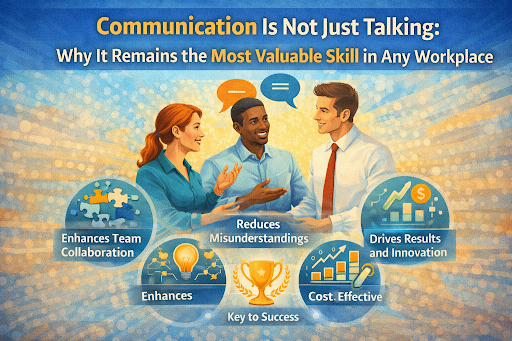
Communication is the unseen thread that powers every productive workplace. It fosters relationships, influences choices, and fixes issues, as well as creates the kind of trust that no policy text can create. However, in organizations of all sizes, communication is still one of the most underutilized talents, despite its apparent importance. Effective communication skills for employees not only perform better on their own but also improve everyone around them. Building a really high-performing, people-centred workforce begins with understanding the importance of communication skills.
1. It Removes the Confusion That Quietly Kills Productivity
The majority of workplace inefficiencies are caused by poor communication, even when no one is aware of it. Unspoken assumptions or unclear directions are frequently the cause of missed deadlines, and recurring errors, along with overlapping efforts. Good communication skills among workers help to get things right the first time around, reduce the process of handover and to clarify the expectations. The communicative team puts so much less time in rectifying the mistakes that can be avoided. In addition to being personally fulfilling, communication clarity directly safeguards the organization’s time, and effort, as well as resources on a daily basis.
2. It Builds Genuine Trust Between Colleagues and Management
Trust is built in the workplace through open, polite and consistent communication as opposed to regulations or perks. Employees with good communication skills training for employees and open communication create a condition in which their colleagues are comfortable to express their issues and present ideas. When the management communicates freely about making decisions, changes and expectations, the employees feel that they are appreciated besides being respected. Mutual trust creates a sense of group loyalty which no incentive programme can draw alone, and enhances working relations, and reduces workplace anxiety.
3. It Empowers Employees to Handle Difficult Situations Professionally
Uncomfortable conversations about performance concerns, conflicts, client complaints, or team tensions ultimately arise in any job. Instead of avoiding or acting aggressively, workers with excellent communication skills handle difficult circumstances with professionalism and poise. They make thoughtful word choices, respect differing viewpoints, and strive for a solution without needlessly destroying relationships. What distinguishes truly mature professionals from reactive employees is their capacity to overcome challenges through deliberate communication.
4. It Supports Career Growth and Increases Professional Visibility
Talented professionals that express themselves in a difficult way are often overlooked; it is not that their work is bad, but it is rather because their voice is not heard appropriately. Workers with good communication are able to express themselves with confidence during meetings, and justify their views, besides projecting their own competency, trustworthiness as experts. When people are clear and firm in their communication, decision-makers listen to them. In many organizations, communication skills actively enhance career advancement in ways that technical proficiency alone just cannot.
Conclusion
Communication is the foundation of the professional toolset of an employee rather than the add-on. The ability to communicate clearly and without any doubt will impact the outcomes on every level, both in managing daily tasks and in future career growth. Companies that make efforts to promote communication via communication skills training programs among their employees do not only end up with superior workers, but they also create a stronger, well-built team that is actually ready to learn, adapt, and succeed in any environment.




More Stories
Selenium vs Playwright: Which Is Better for Test Automation?
AI-Powered Custom CRMs: What Enterprise Buyers Must Know
Why Do People Choose Personal Loans for Their Financial Needs?